
The European Union has finalized the implementation framework for its landmark AI Act, establishing a definitive timeline for transparency requirements that will fundamentally alter how artificial intelligence is integrated into digital products and consumer interfaces. Starting August 2, 2026, any company providing or deploying AI systems that interact with or generate content for citizens within the European Union must adhere to strict labeling mandates. These regulations, specifically outlined in Article 50 of the EU AI Act, represent the world’s first comprehensive attempt to codify the "right to know" when a human is interacting with a machine or consuming synthetic media. While initial industry reactions were characterized by concerns over "sweeping measures" and "drastic fines," a closer examination of the guidelines reveals a targeted approach designed to mitigate deception while preserving the utility of AI-assisted productivity tools.
The Legislative Context and Implementation Timeline
The path to these transparency obligations began in April 2021, when the European Commission first proposed the AI Act. Following years of intense negotiation among the European Parliament, the Council of the EU, and the Commission, the Act was officially adopted in early 2024 and entered into force on August 1, 2024. However, the European Union utilizes a staggered implementation approach to allow industries time to adapt to the new technical standards.
While some prohibitions on high-risk AI (such as social scoring or certain biometric surveillance) take effect as early as late 2024, the specific transparency and labeling obligations for general-purpose AI and synthetic content are slated for full enforcement on August 2, 2026. This two-year grace period is intended to allow software engineers, UX designers, and legal departments to audit their existing AI features and implement the necessary disclosure mechanisms.
Critically, the reach of the EU AI Act follows the precedent set by the General Data Protection Regulation (GDPR) and the European Accessibility Act (EAA). The "Brussels Effect" ensures that these rules apply to any entity, regardless of its headquarters’ location, provided its AI output is consumed by individuals within the EU. Consequently, a Silicon Valley startup or a Tokyo-based enterprise must comply with Article 50 if their AI-generated summaries, images, or chatbots are accessible to the European market.
Defining the Scope: What Requires an AI Label?
The core objective of the new transparency rules is to ensure that users can recognize artificially generated or manipulated content in a clear and distinguishable manner. Article 50(4) of the Act identifies four primary categories that necessitate explicit disclosure:

- AI Systems Interacting with Humans: This includes chatbots, customer service avatars, and voice assistants. Users must be notified at the start of the interaction that they are communicating with an AI.
- Synthetic Audio, Image, Video, or Text Content: Any content generated by AI that resembles existing persons, objects, places, or events—and could be falsely perceived as authentic—must be labeled.
- Emotion Recognition and Biometric Categorization: Systems designed to detect human emotions or categorize individuals based on biometric data must disclose their operation to the subjects.
- Deepfakes and Manipulated Media: High-fidelity synthetic media that portrays individuals doing or saying things they did not do or say must be prominently marked as artificially generated.
The legal burden of compliance is shared between "providers"—the companies that build the AI models—and "deployers"—the businesses that integrate these models into their specific services. This means that a company cannot avoid liability simply by using a third-party API, such as those provided by OpenAI, Google, or Anthropic. If the end-user interaction occurs within a company’s app or website, that company is responsible for the presence and clarity of the AI label.
The Human-in-the-Loop Exception
One of the most significant clarifications in the EU’s recent guidance concerns the distinction between AI-generated content and AI-assisted content. The disclosure obligation does not apply to the vast majority of productivity-focused AI work where a human maintains editorial control.
According to the Commission’s "Code of Practice," text that has been substantively reviewed and edited by a human does not require an AI label, provided a named person or entity takes editorial responsibility for the final output. This exclusion is vital for journalists, copywriters, and marketers who use AI for brainstorming or drafting but perform the final refinement themselves.

However, the definition of "substantive review" is strict. The Commission has explicitly stated that a "human skim" before publishing is insufficient. To bypass the labeling requirement, the human intervention must be meaningful, involving intentional manual changes that alter or verify the core message of the content. Automated spellchecks, grammar corrections, basic formatting, and AI-driven language translations are generally categorized as assistive edits rather than "generation," and thus do not trigger the mandatory disclosure.
Conversely, AI-generated summaries of long documents, composite imagery where multiple AI elements are combined, and substantive rewrites where the AI provides the core narrative structure are all considered AI generation. In these instances, a disclosure is mandatory unless the environment is a closed B2B setting where all parties are aware of the AI’s role.
Design Standards: Beyond the "Sparkle" Icon
For several years, the "sparkle" icon (✨) has served as the de facto industry standard for signaling AI-powered features. However, the European Commission’s new guidelines suggest that this symbol may be legally insufficient for compliance. The primary critique is that the sparkle is too ambiguous; it is often used to denote "newness," "magic," or "premium features" rather than specifically informing the user that the content they are viewing is synthetic.

To address this, the Commission has released an official EU AI icon set. This set includes three distinct variants designed to communicate different levels of AI involvement:
- Basic AI Signal: A standardized "AI" mark to indicate an automated system is in use.
- Fully Generated: An icon for content entirely produced by an AI model.
- Partially Modified: An icon for human-authored content that has been significantly altered by AI.
The guidelines emphasize that the label must be "clear and distinguishable." This means the disclosure cannot be buried in a footer, hidden within a "Terms of Service" link, or displayed only momentarily. For images and videos, the label should ideally be embedded in the metadata (following standards like C2PA) and displayed on the asset itself to ensure the disclosure persists when the content is downloaded or reshared on social media.
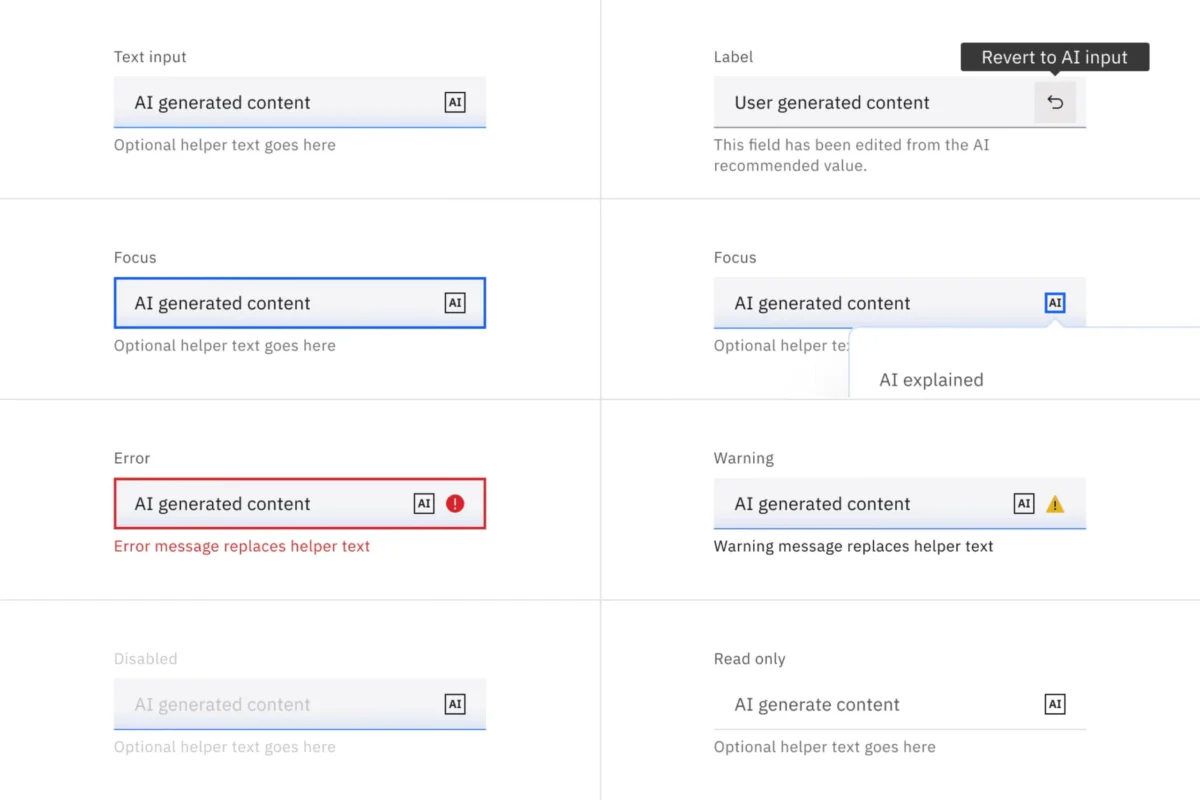
The Carbon Design System, maintained by IBM, has already begun implementing these standards, offering "AI Label" components that include inline icons, icon-only versions for tight interfaces, and "explainability panels" that provide users with context on how the AI reached its conclusion. The EU’s guidance mirrors this approach, suggesting that a safe compliance strategy involves pairing a recognizable icon with plain-language text, such as "AI-generated."

Global Regulatory Convergence
The EU is not acting in a vacuum. The 2026 deadline aligns with a global trend toward AI transparency. In the United States, several states have already passed laws regarding "synthetic performer transparency" and the use of AI in political advertising. The 2023 White House Executive Order on AI also directed the Department of Commerce to develop standards for watermarking and labeling AI-generated content.
In Asia, China’s Cyberspace Administration (CAC) has implemented some of the world’s strictest rules for "deep synthesis" services, requiring clear labels and prohibiting the removal of digital watermarks. Similarly, South Korea and India are currently drafting frameworks that prioritize the identification of AI-generated misinformation.
This global convergence suggests that AI labeling is becoming a universal requirement for digital product design. Companies that proactively adopt these transparency patterns now will likely find themselves better positioned to navigate the patchwork of international regulations emerging over the next five years.

Enforcement and Economic Implications
The penalties for non-compliance with the EU AI Act are modeled after the GDPR’s aggressive fine structure. Violations of the transparency obligations can result in administrative fines of up to €35 million or 7% of a company’s total worldwide annual turnover for the preceding financial year, whichever is higher.
Beyond the financial risk, there is a growing reputational component. Market research from groups like NN/g (Nielsen Norman Group) indicates that users are becoming increasingly wary of "AI slop"—low-quality, unverified synthetic content. Clear labeling acts as a trust signal, allowing users to differentiate between automated outputs and high-value, human-vetted information.
The "public interest" clause in Article 50 further complicates the landscape. If AI-generated content touches upon sensitive topics such as health, safety, the environment, finances, or politics, the disclosure requirement is even more stringent. Advertisers and PR teams are being advised by legal experts to label any realistic AI-generated illustrations as a precaution, particularly if those images could influence consumer behavior or public opinion.

Conclusion: Embracing the Transparent Interface
The shift toward mandatory AI labeling represents a maturation of the technology sector. The era of "invisible AI" is drawing to a close, replaced by a framework that prioritizes user agency and information integrity. While the transition will require significant technical and design adjustments, the ultimate goal is to create a digital ecosystem where the boundaries between human creativity and machine generation are honest and visible.
For designers and developers, the challenge of the next 24 months will be to integrate these disclosures without creating "notification fatigue" or cluttering the user experience. By adopting the EU’s standardized icons and focusing on substantive editorial review, organizations can meet their legal obligations while maintaining the seamless, efficient experiences that AI technology promises. As the August 2, 2026, deadline approaches, transparency will likely evolve from a legal hurdle into a competitive advantage in an increasingly synthetic world.

