
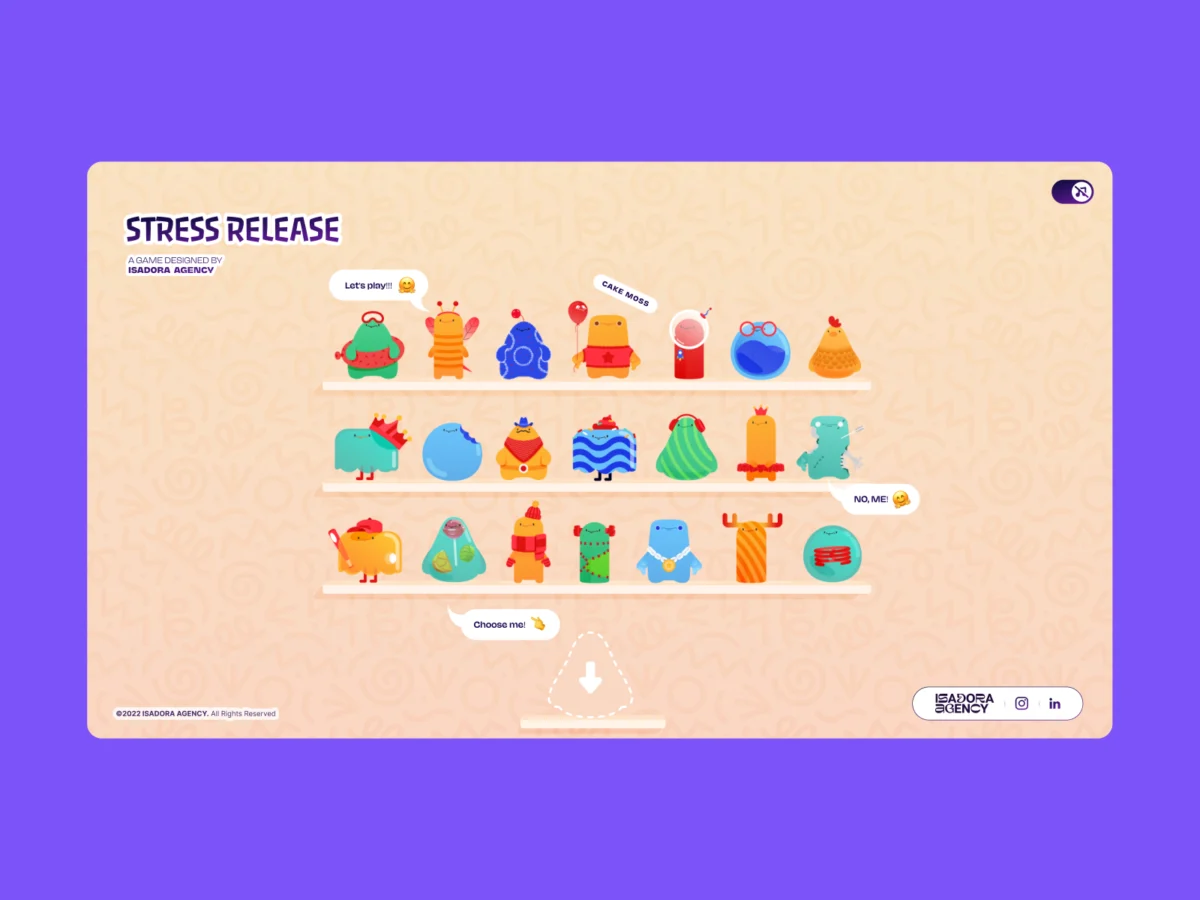
The landscape of modern front-end development is increasingly defined by the tension between automated simulation and artistic intent. As digital interfaces strive to become more immersive, developers have historically turned to complex physics engines—such as Matter.js, Cannon.js, or bespoke WebGL-based solutions—to simulate reality. However, a recent architectural shift spearheaded by Isadora Agency suggests that for certain highly designed experiences, the "plausible motion" generated by these engines may actually undermine the "intentional motion" envisioned by designers. In the development of their recent project, Stress Release, the agency’s engineering team, led by Alexey Kopytin, successfully demonstrated that a highly tactile, responsive web game could be built entirely without a physics engine, relying instead on programmatic Lottie state controls, DOM manipulation, and distance-based mathematics.
The Evolution of the Digital Squeeze Toy
The project, titled Stress Release, was conceived as a digital stress-relief tool specifically designed for creative professionals experiencing burnout. The core mechanic involves a series of animated characters that users can "smash, stretch, and distort" through clicking or tapping. From the outset, the design requirements demanded a level of tactile satisfaction that mirrored physical squeeze toys. This required every interaction to yield a specific, frame-perfect reaction that felt "squishy" and responsive.
Initially, the development team explored traditional routes. The industry standard for creating "bouncy" or "destructive" web interfaces usually involves a physics engine that calculates the movement of bodies based on mass, gravity, and friction. While these frameworks excel at creating realistic simulations, the team found that algorithmic approximations often conflicted with the bespoke, frame-by-frame animations crafted by their design team. The realization that "physics engines produce plausible motion, but animators produce intentional motion" became the foundational philosophy of the project’s architecture.
Chronology of Development: From Physics to Deterministic Control
The development timeline of Stress Release followed a non-linear path that reflects the iterative nature of creative engineering. The project began with a prototyping phase where Matter.js was utilized to handle character deformation. During this stage, the team observed that while the characters moved realistically, they lacked the "personality" and "exaggerated squash-and-stretch" characteristics that define high-quality character animation.
By the second month of development, the team made the strategic decision to scrap the physics engine entirely. They shifted their focus to Lottie, an open-source animation file format developed by Airbnb that renders After Effects animations in real-time as scalable vectors (SVGs). This allowed the animators to maintain absolute control over the visual narrative. The subsequent phase involved building a custom interaction layer that could translate user input—specifically the location and intensity of a click—into specific segments of the Lottie timeline.

In the final stages of development, the team focused on mobile optimization and performance. Since Lottie files can be resource-intensive, particularly when multiple animations are active, the engineering team implemented a tiered quality system. This ensured that the experience remained fluid across a wide range of hardware, from high-end desktop monitors to mid-range mobile devices.
Technical Architecture: Radial Input Mapping and Pythagorean Logic
The "tactile feel" of Stress Release is achieved through a technique known as radial input mapping. Instead of using a complex collision detection system provided by a physics engine, the developers utilized standard DOM events and basic geometry. When a user clicks on a character, the application captures the click position relative to the character’s local coordinate space.
The system calculates the center point of the character and determines the click’s distance from that center using the Pythagorean theorem: distance = Math.hypot(a, b). This distance is not merely a number; it serves as the primary driver for the game’s logic. The distance value is mapped to a concentric zone system, similar to a dartboard. A click near the center (a "bullseye") triggers the highest point reward and the most intense animation reaction, while clicks further toward the periphery yield diminishing returns.

Crucially, this mathematical approach allows for spatial accuracy without the overhead of a physics simulation. When a click is detected, a secondary "explosion" Lottie animation is programmatically repositioned to the exact coordinates of the click. This creates a powerful visual feedback loop: the user sees the impact exactly where they touched the character, reinforcing the sensation of physical interaction.
Programmatic State Control: Managing Intentional Frames
One of the most significant advantages of using Lottie over a physics engine is deterministic control. In a physics-based system, the state of an object is often the result of cumulative forces, making it difficult to jump to a specific "frame" of a reaction. In Stress Release, the developers treated the Lottie JSON file as a state machine.
Each character animation is divided into specific frame ranges:

- Idle State: A looping sequence (e.g., frames 0–40) that plays while the character is waiting for interaction.
- Reaction Segments: A series of progressively intense "squeeze" animations (e.g., squeeze1: 41–80, squeeze2: 81–120) triggered by successive clicks.
- Mega Squeeze: A high-intensity sequence with a specific build-up and release (e.g., 181–396).
By using Lottie’s playSegments method, the developers could force the animation to jump to a precise frame the moment a click occurred. This eliminated the "lag" often associated with physics simulations, where an object must transition through various states of momentum before reaching a resting point. The result is an interface that feels "snappy" and hyper-responsive.
Optimization Strategies for Mobile Performance
While the DOM-based approach simplified many aspects of the build, it introduced challenges regarding file size and CPU usage. The project featured 21 unique character animations, each with multiple states. Loading and playing all of these simultaneously, especially on the "character shelf" screen, would have overwhelmed most mobile browsers.
To mitigate this, Isadora Agency implemented two primary optimization strategies:

- Dynamic Quality Scaling: The team utilized the
lottie.setQuality()method. For the shelf view, where 21 characters are visible, the quality was reduced to 50%, which lowers the complexity of interpolation calculations. When a user selects a specific character for play, the system scales that single animation back to 100% quality while unloading the others. - Framerate Modulation: By using
shelf.setSpeed(0.6), the team reduced the number of frames calculated per second for background animations. This preserved battery life and reduced thermal throttling on mobile devices without noticeably degrading the visual experience.
Industry Context and Supporting Data
The shift toward Lottie-based interactivity reflects a broader trend in the web development industry. According to data from the HTTP Archive, the use of SVG-based animations has seen a steady increase of approximately 15% year-over-year as developers seek alternatives to heavy video files and complex WebGL shaders. Furthermore, Lottie has become the preferred format for 2D character animation due to its small file size relative to traditional GIF or PNG sequences, often being up to 600% smaller while maintaining vector-based resolution.
Industry experts suggest that the "Stress Release" model represents a "third way" in creative coding. While WebGL remains the gold standard for 3D environments and Matter.js for emergent simulations, the DOM/Lottie stack offers a more accessible and SEO-friendly path for 2D interactive experiences. By keeping elements within the DOM, developers can leverage standard CSS for responsiveness, avoiding the "black box" scaling issues often found in <canvas>-based games.
Official Responses and Broader Implications
In statements regarding the project’s success, the Isadora Agency team emphasized that the architecture was a direct response to the needs of the art department. The agency noted that this approach "empowered the animators to dictate the exact feel of the experience, leaving the code to do what it does best: listen, calculate, and trigger."

The implications of this architectural choice extend beyond digital toys. The principles of deterministic motion and radial mapping can be applied to a wide range of UX/UI elements, from "bouncy" navigation menus to interactive data visualizations. By prioritizing intentional design over algorithmic simulation, developers can create interfaces that feel more human and less mechanical.
As web standards continue to evolve, the Stress Release project serves as a case study for the "Less is More" philosophy in technical architecture. It demonstrates that with a solid understanding of basic mathematics and the native capabilities of modern animation libraries, developers can deliver high-fidelity, tactile experiences that honor the vision of the designer while maintaining peak performance across the modern web ecosystem. In an era where "physics-ready" frameworks are often the default, Isadora Agency’s work highlights the enduring value of precision, control, and intentionality in digital craft.

