
The rapid integration of artificial intelligence into enterprise software has reached a critical inflection point where the initial promise of efficiency often clashes with the reality of cognitive overhead. As product teams across the globe rush to implement generative features, a new phenomenon is emerging: the "checker’s burden." This occurs when an AI feature saves a user time on a primary task, such as drafting a document, only for that user to spend an equivalent or greater amount of time verifying the output for accuracy. To address this discrepancy, design experts have developed a practical audit framework to help product teams determine where AI earns its place and what safeguards users require to verify its results.
The necessity for such an audit is illustrated by a recent case study involving a major health insurance provider. The company’s product team sought to streamline the workflow for benefits appeals specialists by introducing an AI tool capable of writing full written determinations for appeals. While the technology functioned exactly as specified, the specialists quickly abandoned it. Those who continued to use the tool found that processing each case actually took longer than it did before the AI was introduced. An evaluation revealed that reading an AI-generated determination carefully enough to legally sign off on it required as much cognitive effort as writing one from scratch. Furthermore, the specialists were forced to scan for "hallucinations" or logical errors they never would have committed themselves, effectively adding a new layer of work to a task they had already mastered.
The Cognitive Economics of AI Adoption
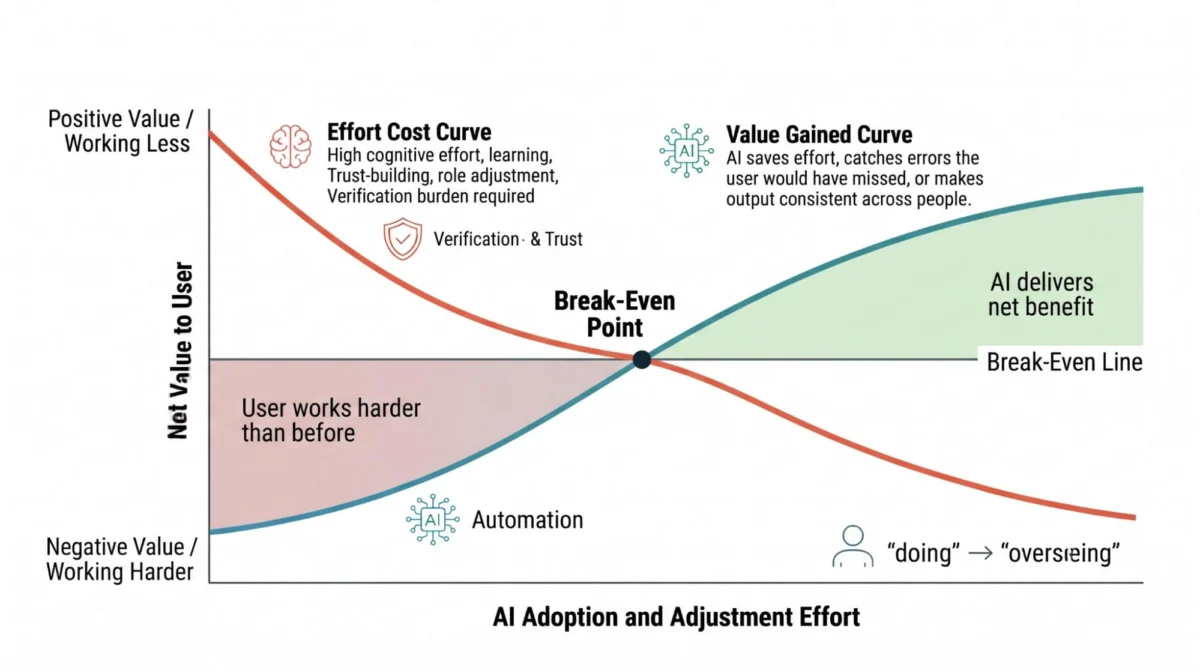
Every interface change imposes a "tax" on the user’s cognitive resources. According to research by Nelson Cowan (2001) on working memory, the human mind can generally hold only about four items in focus at any given time. When an AI feature is introduced, the user must rebuild their mental model of the tool, learn new navigation paths, and constantly evaluate the trustworthiness of the machine’s output. In an enterprise setting, these demands are amplified because AI fundamentally alters the nature of professional roles.
When a task is synthesized by AI, the human professional is transitioned from a "creator" to a "checker." For many high-skill roles, this shift can feel like a professional demotion. A 2025 study by Sophia Ackerhans and colleagues found that physicians asked to sign off on AI-assisted decisions reported a significant threat to their professional identity. Interestingly, the study noted that providing explanations for the AI’s reasoning increased both the physician’s trust and the perceived threat to their expertise simultaneously. This suggests that the value of an AI feature is not merely a matter of technical accuracy, but a balance between utility and the user’s standing within their organization.
Establishing the Break-even Line
To determine whether an AI feature is viable, product teams must identify what is known as the "break-even line." An AI feature earns its place only when the value it returns exceeds the cost the user pays to adjust to it. This return generally manifests in three forms: a reduction in total effort, an increase in output quality, or the catching of errors that a human would likely miss.
A successful example of this is found in AI-powered fraud screening tools. While an analyst must spend significant attention reviewing the flags raised by the system, the AI identifies patterns and anomalies that are invisible to the human eye. In this scenario, the "catch rate" of fraudulent activity justifies the cognitive cost of verification, placing the feature firmly above the break-even line.
To help teams locate this line before investing in expensive design and development cycles, industry leaders suggest a four-question audit. These questions are intended to be conducted early in the proposal phase, involving at least one subject matter expert who performs the task daily.
Question 1: Total Effort Reduction and User Segmentation
The first step in the audit is to calculate the total effort required for a task, including the "thinking, clicking, and checking" that the AI introduces. A common pitfall in modern design is the assumption that fewer clicks equate to higher efficiency. However, pre-filling a field or generating a draft often relocates the effort rather than removing it.
For instance, a loan officer reviewing dozens of financial disclosures benefits significantly from an AI that surfaces specific policy conflicts, as this directly reduces high-level cognitive demand. Conversely, an AI that pre-fills a tracking system with a loan number provides negligible value, as the officer must still verify the number for accuracy—a task that takes nearly as much time as typing it.
Furthermore, the audit highlights the importance of user segmentation. A feature that provides a helpful starting point for a junior analyst may be viewed as an obstruction by a senior analyst who already has a developed mental "pattern library." Design requirements should therefore specify which user segment the addition serves and provide an "exit" for those who find the feature redundant.
Question 2: Competitive Advantage Over Current Methods
Product teams must compare the proposed AI approach against the user’s current workarounds, such as personalized spreadsheets or manual search routines. AI typically wins when dealing with genuine ambiguity, massive scale, or tasks requiring high consistency across large groups.
In HR succession planning, AI excels at identifying internal candidates with unique skill combinations that a human might not think to search for. This wins on the grounds of scale and ambiguity. However, using AI to draft the subsequent notification email often fails this test. Since the user likely has a familiar template and strong opinions on tone, the AI draft adds an unnecessary interaction to a task that was already functioning efficiently.
Question 3: The Visibility and Consequence of Errors
The third pillar of the audit focuses on the "error surface." Because all AI systems are prone to mistakes, the critical factor is whether the user can realistically catch them. Error visibility varies widely; an AI travel planner suggesting a closed museum is an "invisible" error that only becomes apparent when the traveler arrives at the destination.

Decades of human factors research, including work by Raja Parasuraman and Dietrich Manzey (2010), show that humans are prone to "automation bias"—a tendency to defer to automated systems even when they are incorrect. To combat this, product teams must map out the likeliest error types and their consequences. If an error is high-consequence and low-visibility, the system must ship with "provenance" displays—showing the source data and the logic used—to allow for proper verification.
Question 4: Long-term Skill Degradation
Perhaps the most significant long-term risk of AI integration is the erosion of human judgment. While automating routine tasks is beneficial, the judgment required to catch a machine’s mistake must be preserved. Research in the field of radiology has demonstrated this risk clearly. In a 2023 experiment by Thomas Dratsch, even experienced radiologists saw their diagnostic accuracy drop significantly when presented with incorrect AI suggestions. Over time, the disuse of these critical diagnostic skills can leave professionals in a weaker position than before the AI was introduced.
The audit suggests that if a user would be unable to judge the quality of the AI’s output after a year of use, the design must include mechanisms to keep verification skills active. This might include periodic "blind reviews" or rotating a percentage of cases to be handled manually to ensure human expertise does not atrophy.
Chronology and Industry Impact
The shift toward this rigorous auditing process follows a three-year cycle of "AI mania" in the tech industry:
- 2022-2023: The "Exploration Phase," characterized by the rapid release of chat-based interfaces and generative "copilots" across nearly all enterprise software categories.
- 2024: The "Reality Check Phase," where organizations began to report "AI fatigue" and noted that productivity gains were often offset by the need for extensive human oversight.
- 2025 and Beyond: The "Integration Phase," where the focus has shifted from "AI-first" to "User-benefit-first," utilizing frameworks like the Break-even Line to justify development costs.
Industry analysts suggest that this structured approach to AI will lead to more specialized, modular tools rather than broad, "do-it-all" assistants. By identifying the specific steps in a workflow where AI provides a genuine return, companies can avoid the "pro-innovation bias"—the assumption that new technology is inherently better—and instead build tools that genuinely enhance human capability.
Strategic Recommendations for Product Teams
The results of an AI audit should be integrated directly into the design brief as project requirements. If a feature fails the effort reduction test (Question 1) but wins on scale (Question 2), it should be scoped only to the relevant departments. If a feature presents high-consequence errors (Question 3), the inclusion of data provenance becomes a non-negotiable requirement rather than a "nice-to-have" polish item.
Ultimately, the goal of the audit is to ensure that AI serves as a true cognitive lever. As the cost of generating content and data continues to fall, the value of human attention and verification rises. By applying a rigorous, fact-based evaluation to every proposed AI feature, product teams can ensure they are not simply adding work to the very people they intended to help.

