
The Aesthetic and Cultural Roots of the Cybergoth Movement
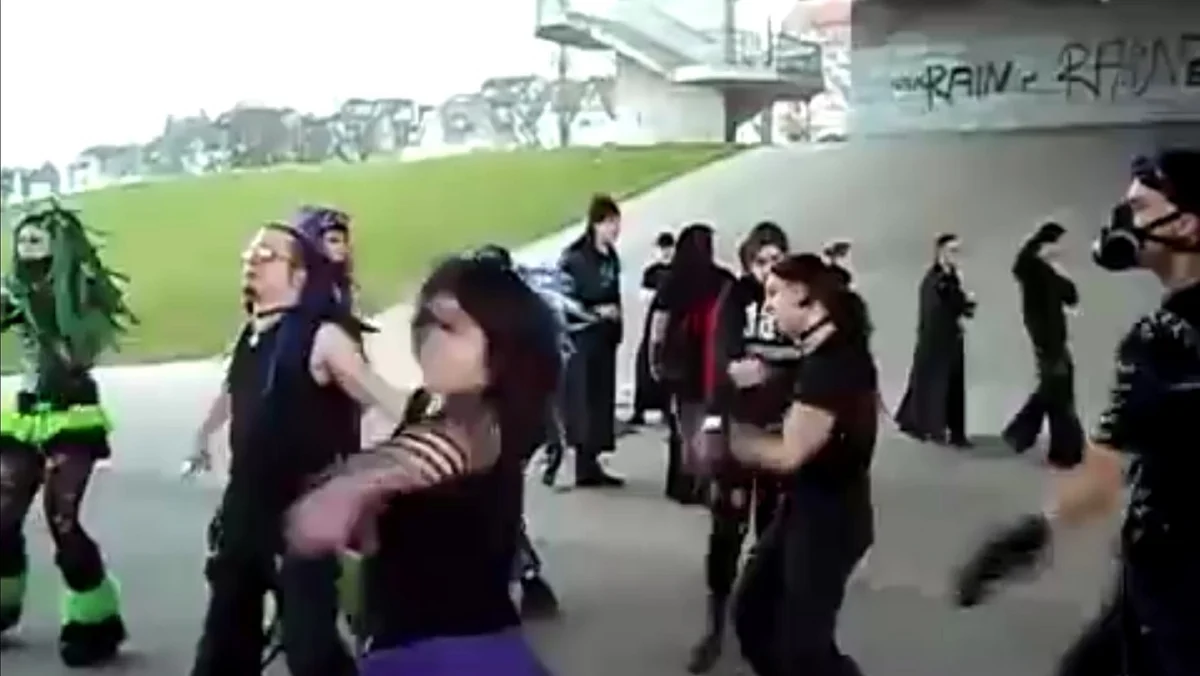
To understand the impact of the dance party video, one must first examine the cybergoth subculture from which it emerged. Cybergoth is a derivative of the broader goth subculture, heavily influenced by rave culture, industrial music, and cyberpunk aesthetics. Emerging in the late 1990s and peaking in the mid-2000s, the movement is characterized by a striking visual identity: neon-colored hair extensions (often "cyberlox" made of plastic tubing), gas masks, welding goggles, PVC clothing, and platform boots.
The dancing depicted in the viral footage is known as "industrial dance" or "ebm-dancing." It is a rhythmic, aggressive style involving sharp arm movements, fist-pumping, and leg-shuffling, designed to match the heavy, mechanical beats of industrial music. At the time the original video was filmed, these gatherings—often called "Treffen" in German—were common social outlets for members of the scene to showcase their fashion and choreography in public spaces.
The 2011 Origin: A Moment Frozen in Time
The digital life of the cybergoth dance party began on September 7, 2011, when YouTuber gNarLu cEe uploaded a video titled "Cybergoth Dance Party." The footage, captured in a gritty, industrial-looking setting beneath an overpass, featured a dozen or more participants engaged in a coordinated dance session. The original audio consisted of hard-hitting electronic beats typical of the German industrial scene. Within five years of its upload, the video had amassed over 4.2 million views, establishing itself as the definitive visual representation of the subculture for the general public.
While the original video was intended as a sincere documentation of a subcultural event, its transition into a meme began almost immediately. The contrast between the dancers’ intensely serious expressions, their elaborate "post-apocalyptic" attire, and the rhythmic precision of their movements provided a fertile ground for comedic reinterpretation.
The Rise of the "Goths Dance to Anything" Meme
The shift from subcultural artifact to internet meme was catalyzed on September 9, 2011, just two days after the original upload. YouTuber Griffin Goodwin reuploaded the footage, replacing the industrial track with "Cuban Pete," the 1944 mambo song famously performed by Jim Carrey in the 1994 film The Mask. This juxtaposition created a comedic dissonance that resonated with a broad audience. By matching the frantic, rhythmic movements of the cybergoths to the lighthearted, tropical rhythm of the mambo, Goodwin established the "unfitting music" template that would define the meme for the next decade.
In September 2012, the video reached a new demographic when it was submitted to the /r/cringe subreddit. At this stage of internet history, the "cringe" label was frequently applied to earnest expressions of niche subcultures. However, as the meme evolved, the tone shifted from mockery to a form of ironic appreciation. The dancers were no longer merely "cringe"; they were performers in a versatile visual loop that could be adapted to any musical genre.
The Vine Era and the Democratization of the Remix
The mid-2010s saw a resurgence of the cybergoth dancers through the rise of Vine, a platform built on six-second looping videos. The short, repetitive nature of Vine was perfectly suited for the rhythmic bursts of the cybergoth dance. In June 2014, prominent Viners like "babyd0ll" and "Brisk God" began pairing the footage with wildly different audio tracks.
Notable examples included the 1996 hip-hop track "Scarred" by Luke and the 1979 soft rock classic "Escape (The Piña Colada Song)." These clips garnered millions of loops and led the digital culture outlet UpRoxx to declare in July 2014 that "’Goths Dance to Anything’ is The Best Thing Happening On Vine Right Now." The platform’s constraints forced creators to find the exact moments where the dancers’ movements synced perfectly with the "drop" or the "beat" of a new song, elevating the remixing process into a form of digital art.
By 2015, the meme had achieved cultural saturation. A prominent example was a remix featuring the theme song from Bill Nye the Science Guy, which further cemented the video’s status as a "green screen" of sorts—a visual element that could be superimposed onto any auditory landscape.
Geographical Discovery and the TikTok Renaissance
After a period of relative dormancy, the cybergoth dance party experienced a massive revival in late 2022, driven by the investigative nature of TikTok’s user base and the platform’s "geoguessing" community. On December 6, 2022, TikTok user @madcow posted a video that used Google Earth to pinpoint the exact location of the 2011 dance party.
The investigation revealed that the iconic overpass was located in Düsseldorf, Germany, specifically on the Kaiser-Wilhelm-Ring (postal code 40545), near the Oberkasseler Brücke (Bridge). The identification of the "hallowed ground" of the meme resonated deeply with internet historians and nostalgic users alike. The TikTok video went viral, securing over 6.6 million views and 1.4 million likes in a single month. This discovery transformed the location into a digital landmark, with some users even traveling to the site to recreate the dance.
The Emergence of Alternate Angles and Lost Media
The fascination with the "Cybergoth Dance Party" led to the rediscovery of "lost" footage that provided more context to the original event. On March 14, 2011—months before the famous video was even uploaded—a YouTuber named CybertreffenNRW had posted a video that appeared to be extra footage taken immediately before the viral clip began.
This "alternate angle" footage showed the group preparing and dancing to Early Hardstyle music. While it languished in obscurity for years, it was rediscovered and shared on the /r/DeepIntoYouTube subreddit and later on X (formerly Twitter) in late 2022. The repost on X by user @chiweethedog gathered over 60,000 likes, as fans of the meme were fascinated to see the "prequel" to the famous footage. The existence of multiple cameras and videos suggests that the 2011 gathering was a significant event for the local Düsseldorf cybergoth community, rather than a spontaneous or isolated occurrence.
Chronological Timeline of Key Events
- March 2011: Early footage of the Düsseldorf cybergoth gathering is uploaded by CybertreffenNRW, though it remains obscure.
- September 7, 2011: The definitive "Cybergoth Dance Party" video is uploaded by gNarLu cEe.
- September 9, 2011: The first major remix ("Cuban Pete") is uploaded, initiating the "unfitting music" trend.
- September 2012: The video enters the "cringe" lexicon via Reddit, broadening its reach.
- June 2014: The meme explodes on Vine, with "Goths Dance to Anything" becoming a trending format.
- June 2015: High-profile remixes, such as the Bill Nye version, reach peak popularity on YouTube.
- December 2022: TikTok user @madcow geolocates the dance site in Düsseldorf, sparking a massive wave of nostalgia and research.
- Late 2022: Alternate angle footage is rediscovered and goes viral on X and Reddit, providing a full 360-degree view of the historical event.
Sociological and Memetic Analysis
The enduring popularity of the Cybergoth Dance Remixes can be attributed to several factors. First is the principle of incongruity. Psychological theories of humor suggest that we find things funny when there is a sharp contrast between expectation and reality. The visual expectation of a cybergoth—steeped in darkness, aggression, and industrial grit—is fundamentally at odds with the auditory reality of a pop song or a jingle.
Second is the universality of rhythm. Despite the specific subcultural origins of the dance, the movements are fundamentally rhythmic. This allows them to be mapped onto almost any time signature, making the footage an incredibly versatile "instrument" for digital creators.
Finally, there is the element of digital archaeology. As the internet ages, users have become increasingly interested in the origins of early viral content. The quest to find the location in Düsseldorf and the search for alternate angles represent a collective desire to document and preserve "internet history." What was once a simple video of teenagers dancing has become a digital monument, a piece of shared cultural heritage that connects the early era of YouTube to the modern era of TikTok.
The legacy of the cybergoth dance party serves as a reminder of how the internet can take a sincere, localized expression of identity and transform it into a global language of humor and creativity. While the cybergoth scene itself has evolved or receded into the background of fashion history, the dancers under the Oberkasseler Brücke remain perpetually in motion, dancing to whatever song the next generation of the internet chooses to play for them.

