
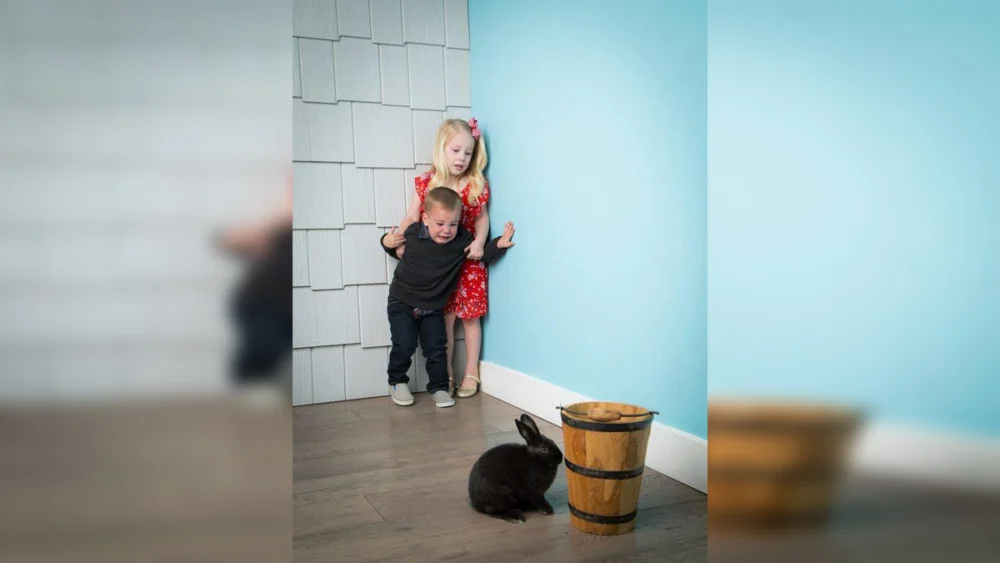
The digital landscape of the mid-2010s was characterized by the rapid emergence of "exploitable" image macros, a genre of internet memes where a single photograph serves as a versatile canvas for various captions and edits. Among the most enduring and recognizable of these is the image known colloquially as Kids Scared of Rabbit, or alternatively, Children Scared of Rabbit. This photograph captures a visceral, albeit harmless, moment of childhood terror: a young girl and her slightly younger brother cowering in a corner, their faces contorted in genuine alarm, as a small, docile black rabbit sits mere inches away next to a wicker bucket. Since its inception in 2015, the image has transcended its original context as a family portrait to become a staple of online commentary, used primarily to satirize misplaced fear or to illustrate the perceived "intimidation" of benign entities.
The Genesis of a Viral Moment: A Utah Studio Session
The photograph originated in early 2015 within the professional environment of Camera Shy, a photography service based in Utah that specializes in family and children’s portraits. In the United States, particularly within communities that observe Easter traditions, "bunny sessions"—where children are photographed with live rabbits—are a seasonal staple of the portrait industry. The goal of these sessions is typically to capture whimsical, pastoral imagery. However, the unpredictability of young children often leads to "outtakes" that diverge significantly from the intended aesthetic.
On March 14, 2015, Camera Shy uploaded the now-famous image to their official Facebook page. The studio captioned the post with a lighthearted acknowledgment of the session’s failure: "And sometimes bunny sessions go like this…" The contrast between the rabbit’s stillness and the children’s extreme distress immediately resonated with the studio’s local following. The image captured a universal truth about the irrationality of childhood fears, providing a relatable and humorous juxtaposition that was ripe for wider distribution.
Chronology of Digital Proliferation
The transition from a local studio’s social media post to a global internet phenomenon occurred within forty-eight hours. On March 16, 2015, an Imgur user identified as RockiesInOctober—purportedly the parent of the children in the photo—shared the image with the caption, "My kids during our family pictures this past weekend." The post garnered immediate traction, serving as the catalyst for the image’s migration to Reddit.
Later that same day, the photo was submitted to the subreddit /r/photoshopbattles, a community dedicated to digitally altering images for comedic effect. This was a pivotal moment in the meme’s lifecycle. By providing the raw material to a community of skilled digital editors, the image was transformed into various high-concept scenarios. One of the most popular early edits referenced the "Killer Rabbit of Caerbannog" from the 1975 film Monty Python and the Holy Grail. This specific cultural touchstone cemented the image’s association with the trope of a "monstrous" rabbit, a theme that would persist in future iterations of the meme. As of 2021, the original Reddit thread maintained a high engagement score, with over 3,000 upvotes and hundreds of derivative comments.
The Evolution of the Object-Labeling Format
While the initial wave of popularity in 2015 focused on visual alterations (Photoshop edits), the image found a second, more sustainable life through "object-labeling." In this format, text is superimposed over the subjects in the photo to represent different entities, ideas, or social groups. The children usually represent a group that is "scared" of a concept represented by the rabbit, which is often something objectively harmless or intellectually niche.
The first recorded instance of this shift occurred in January 2017 on Tumblr. A user named footnotestoplato applied the image to a discussion of existentialist philosophy. In this version, the rabbit was labeled "the absurd," while the children represented the "nausea" and "angst" described by philosopher Albert Camus. This marked a departure from simple visual gags toward using the image as a vehicle for complex, often self-deprecating, intellectual humor.
The meme reached a new peak of mainstream saturation in late 2020. On October 13, 2020, a Redditor named u/mijuzz7 posted a version to the /r/memes community that focused on the behavioral quirks of video gamers. This specific post received more than 85,000 upvotes within ten months, signaling the meme’s entry into the "pantheon" of evergreen internet templates. During this period, a recurring sub-theme emerged where the children were labeled as "Psychopaths" and "Serial Killers," while the rabbit was labeled with a mundane but "disturbing" social habit, such as "People who use the ‘crazy’ emoji" or "People who leave their eyes open while the barber cuts their hair."

The Sneaking Tiger Variant and Narrative Expansion
In August 2020, the meme underwent a significant structural evolution with the introduction of the "Sneaking Tiger" variant. In this version, an image of a tiger prowling through tall grass is photoshopped into the background, lurking behind the oblivious, terrified children. This addition changed the rhetorical function of the meme entirely.
Instead of merely mocking the children for being afraid of a rabbit, the "Sneaking Tiger" version illustrates the concept of misplaced priorities or ignored threats. The children represent a population focused on a minor, visible annoyance (the rabbit), while remaining completely unaware of a massive, looming danger (the tiger). One notable example of this variant appeared on August 15, 2020, when a Reddit user applied it to the interpersonal dynamics of the reality television show Big Brother. This adaptation demonstrated the template’s flexibility in addressing complex social and political narratives where "true threats" are often overshadowed by superficial distractions.
Quantitative Impact and Search Trends
Data from search engine analytics and social media metrics confirm the meme’s cyclical nature. Following its initial spike in March 2015, search interest remained relatively dormant until late 2019 and early 2020, coinciding with the broader "renaissance" of object-labeling memes during the global lockdowns of the COVID-19 pandemic. The 2020 resurgence saw search volume exceed the original 2015 levels, driven largely by the high-engagement posts on Reddit and Instagram.
The longevity of the Kids Scared of Rabbit meme can be attributed to several factors:
- High Emotional Contrast: The visual disparity between the children’s extreme physiological reaction and the rabbit’s complete lack of threat creates an immediate comedic hook.
- Versatility: The three distinct "nodes" of the image (the girl, the boy, and the rabbit) allow for a triad of labels, which is more dynamic than the standard two-node meme.
- Relatability: Almost every viewer can recall a moment of irrational childhood fear, making the image inherently sympathetic despite its use in mockery.
Broader Implications and Cultural Legacy
The Kids Scared of Rabbit meme serves as a case study in how private family moments are commodified and recontextualized by digital subcultures. What began as a humorous anecdote for a Utah photography studio became a tool for discussing everything from 12th-century theology to modern gaming culture.
Furthermore, the meme highlights the collaborative nature of the modern internet. The original photographer provided the "content," the parent provided the "context," and the Reddit/Tumblr communities provided the "commentary." This decentralized creation process ensures that the meme remains relevant even as the children in the photograph grow into adulthood.
In a broader sociological sense, the meme reflects a contemporary preference for "absurdist" humor. By labeling a small rabbit as "the collapse of modern civilization" or "a Bible verse that contradicts political views," users engage in a form of hyperbolic satire that is characteristic of Gen Z and Millennial digital communication. The image has effectively become a shorthand for the human tendency to panic over the wrong things—a theme that remains perpetually relevant in a fast-paced, information-heavy society.
As of the current year, the Kids Scared of Rabbit template remains a frequent sight on social media platforms, proving that even the most fleeting moments of childhood distress can find a permanent, and ironically productive, home in the archives of global internet culture. The "Killer Rabbit" of Utah continues to cower its subjects, not through physical threat, but through its enduring power as a symbol of the absurd.

