
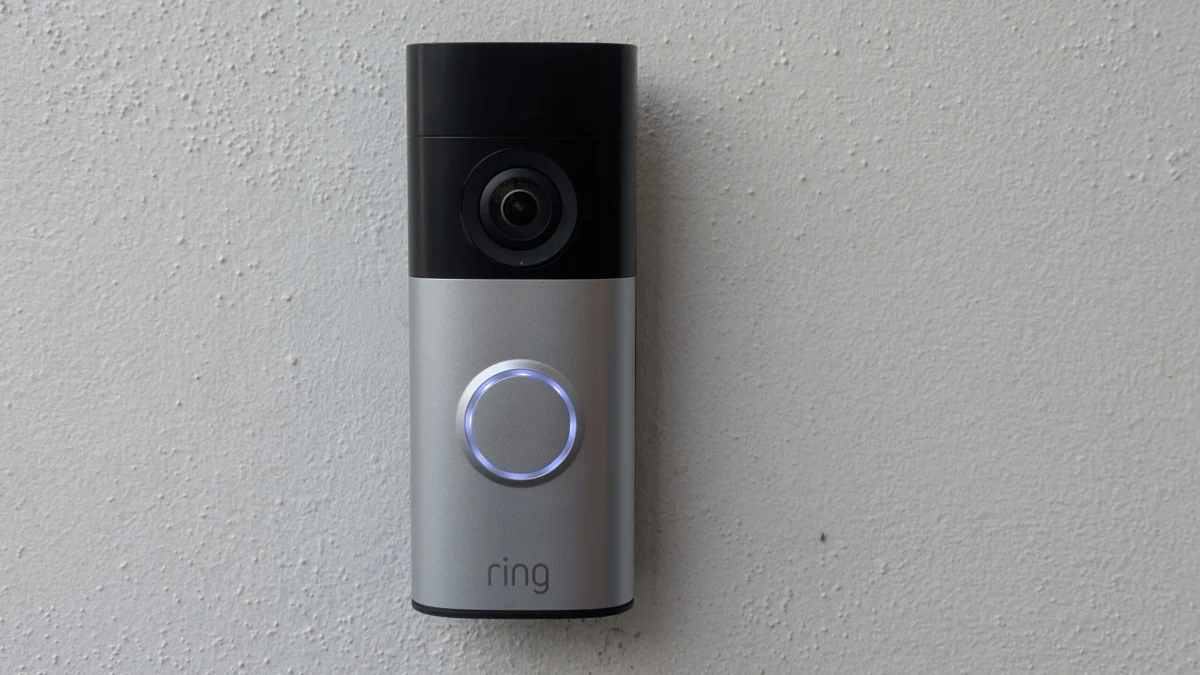
The Ring Wired Video Doorbell (2nd Gen) emerges as a compelling option in the crowded smart home security market, delivering crisp video quality and a notably generous field of view. While its affordability positions it as an accessible entry point into the Ring ecosystem, its full potential is unlocked through a subscription service, which provides crucial features like extended event history and advanced AI-powered person detection. This evolution of Ring’s foundational wired doorbell underscores the company’s strategy of integrating sophisticated technology into its more budget-friendly offerings, though it also highlights the increasing reliance on recurring revenue models for comprehensive smart home functionality.
A Significant Upgrade in Visual Fidelity and Field of View
The second generation of the Ring Wired Video Doorbell represents a substantial leap forward from its predecessor. Gone is the 1080p landscape view with its 155-degree coverage, replaced by a new square sensor that Ring brands as "Retinal 2K." This translates to a resolution of 1,920 x 1,920 pixels, offering a sharper and more detailed image. Crucially, High Dynamic Range (HDR) is now a standard feature, adept at teasing out details in both the deepest shadows and the brightest highlights, ensuring clarity in a wider range of lighting conditions. The new camera’s expanded 140-degree coverage, both horizontally and vertically, is a significant practical improvement. This wider perspective ensures that the doorbell can capture the feet of visitors standing approximately half a meter or more away, providing a more comprehensive view of doorstep activity and potentially identifying package deliveries or individuals loitering at a distance.
Navigating Naming Conventions and Installation Quirks
Ring’s product naming can sometimes lead to confusion, with this model being referred to as the "2nd Gen" by Ring itself, while Amazon often labels it as the "newest gen" or "newest model." Beyond nomenclature, the doorbell has seen a physical expansion and a switch to a new mounting design. This alteration means that users upgrading from older Ring wired models may find that the new doorbell is not backwards compatible with their existing mounting hardware, potentially requiring a slight recalibration of installation expectations.

A notable omission from the package is an integrated chime. Furthermore, unlike some conventional wired doorbells that can power existing mechanical chimes, this Ring model will not sound your existing chime if you are transitioning from a traditional setup. This necessitates either purchasing a separate Ring Chime or relying on app notifications and compatible smart speakers for audible alerts within the home.
Design and Installation: A Blend of Modern Aesthetics and Involved Setup
Despite housing no onboard battery, the Ring Wired Video Doorbell (2nd Gen) is surprisingly substantial in size, only marginally smaller than bulkier battery-powered competitors like the TP-Link Tapo Video Doorbell Camera D235. Its design, however, leans towards a more rounded and aesthetically pleasing profile, aiming to blend seamlessly with various home exteriors.
The installation process, while guided by Ring’s in-app instructions, can be more involved than some users might anticipate. The absence of an adhesive pad in the box means that the mounting bracket must be secured using the supplied screws. While an angled shim is provided to allow for a few degrees of horizontal adjustment, there is no vertical adjustment capability, which may pose challenges for installations on uneven surfaces or where precise aiming is critical. Prospective buyers must also ensure they have compatible bell wiring. The doorbell is designed to work with most existing low-power AC systems. Review samples often include a rail-mounted transformer suitable for modern consumer units, but this component is unnecessary if functional wiring is already in place.
A crucial pre-installation step involves checking the Wi-Fi signal strength at the intended doorbell location. This model exclusively supports 2.4GHz Wi-Fi networks, a practical choice as these frequencies generally offer better penetration through walls than their 5GHz counterparts. However, the user experience during setup can be hampered by minor irritations. In testing, the companion app did not handle Wi-Fi password errors gracefully, forcing a complete reset of the doorbell to restart the connection process.
Comprehensive Features, Subscription-Centric Power

The Ring application serves as the central hub for managing the doorbell’s functionalities, and it is generally well-regarded for its intuitive interface. The app provides an at-a-glance snapshot of the doorbell’s current view, with a tap leading to a dedicated page that neatly integrates a live view with a chronological timeline. This makes reviewing past events straightforward, and a calendar view allows for even deeper dives into historical footage.
Within the app, users can customize video, audio, and general settings. However, certain aspects of the camera’s operation are pre-set. There is no user selection for resolution, and the night vision mode defaults to infrared (IR) black-and-white video, automatically engaging when ambient light diminishes. Advanced features, such as AI Video Search, require Ring to analyze your video recordings. For privacy reasons, these features are disabled by default and necessitate explicit user opt-in.
Integration with Amazon Alexa is a core strength, allowing users to link the doorbell to Echo devices for instant alerts, audio, and video conversations with visitors. The doorbell can also serve as a trigger for Alexa routines, such as activating porch lights upon motion detection or when a visitor arrives. A limitation noted in testing is the inability to initiate routines based on specific caller identities, meaning a routine cannot be exclusively triggered by a household member’s approach.
While motion detection can be fine-tuned using sensitivity controls and defined motion zones, this particular model lacks the Radar-based 3D Motion Detection found in more premium Ring offerings. This advanced feature is particularly beneficial for doorbells facing busy streets, as it allows for motion detection to be precisely calibrated based on distance, significantly reducing false alarms from distant pedestrian or vehicle traffic.
The doorbell also offers the capability to detect people or even familiar faces, though the efficacy and availability of these advanced detection features are largely contingent on a Ring subscription. The subscription tiers start at approximately £5 per month or £50 per year for a single device. Without a subscription, users are limited to live view on demand, real-time motion and caller alerts, and two-way talk functionality – a somewhat restricted experience for a device intended for security.
The basic Ring Solo package enhances this by adding 180 days of video event history, video alerts, and essential person, package, and vehicle detection. For those seeking more advanced AI capabilities, the "Pro Intelligence" tier, costing an additional £3 per month per device, unlocks features like AI Video Descriptions and the aforementioned Video Search and Familiar Faces. For users with multiple Ring devices, the comprehensive £16 per month Ring Pro subscription covers these advanced features across their entire Ring ecosystem.

Performance in Real-World Conditions
In real-world testing, the Ring Wired Video Doorbell (2nd Gen) demonstrated impressive performance, even when its wiring was situated on a wall facing sideways, thus not directly confronting a busy street. The subscription-enabled features, such as Familiar Faces and Video Descriptions, proved effective in accurately identifying known individuals and providing concise summaries of captured clips.
The speed of Ring’s AI processing was evident, with notifications arriving on the user’s phone almost instantaneously upon a visitor’s arrival or the bell’s activation. While a few false alarms were encountered, primarily when pedestrians passed by while a vehicle was absent from the driveway, adjusting the motion zones significantly mitigated these occurrences, though they were not entirely eliminated.
The video quality was generally satisfactory. Footage was consistently clear enough to identify visitors during daylight, in dimly lit evenings, and under IR illumination at night. In natural light, the video was sharp and well-exposed. The doorbell did, however, exhibit some struggle in preserving highlights on exceptionally bright days, though other elements of the scene were captured effectively. At night, the exposure was optimized for the visitor, sometimes at the expense of detail in their immediate surroundings.
Conclusion: A Capable Doorbell Requiring a Commitment to Subscription
The Ring Wired Video Doorbell (2nd Gen) successfully marries commendable camera quality with a robust alert system. Its ultimate value proposition, however, is intrinsically linked to the user’s willingness to commit to a subscription. Without a paid plan, particularly the essential £5 per month tier for Video Event History, the doorbell’s utility is considerably diminished. The ability to review footage is paramount should an incident occur, making this subscription feature almost indispensable for effective security monitoring.

Opting for the additional £3 per month for Pro Intelligence introduces AI features that are highly beneficial in distinguishing relevant alerts from background noise. During a complimentary one-month trial of all features, the doorbell delivered exceptionally rich notifications and facilitated effortless searching through video and alert histories. Its user-friendly nature and the quality of its video output and alerts place it among the top-tier "fit and forget" smart home security solutions. For existing Ring users, particularly those with a Ring Alarm system, the financial equation becomes more favourable when considering the multi-camera subscription options.
Background and Broader Impact
Amazon’s Ring brand has achieved a level of market saturation where its name has become synonymous with the video doorbell category. The recent overhaul of the Ring product line, including the refresh of its wired offerings, reflects the company’s ongoing strategy to cater to a diverse range of consumer needs and budgets. The introduction of higher-resolution sensors and AI-powered features, even in its most basic wired model, signals a commitment to democratizing advanced security technology.
The emphasis on subscription services is a well-established trend across the smart home industry, enabling manufacturers to offer hardware at a lower upfront cost while generating recurring revenue for ongoing service development and cloud infrastructure. For consumers, this model presents a trade-off between initial affordability and long-term operational costs. The implications for data privacy also remain a significant consideration, with users needing to be comfortable with their video data being processed by third-party servers, albeit with privacy safeguards in place.
Testing Methodology and Long-Term Evaluation
The reviews published by The Ambient are the product of extensive, long-term testing, often involving devices being integrated into daily life for extended periods. This approach is particularly crucial for smart home technology, where devices are designed to operate within an ecosystem and their performance is best assessed through sustained use. A brief testing period is insufficient to deliver a comprehensive verdict on the reliability, feature set, and overall user experience of devices like video doorbells. The Ambient’s testing methodology prioritizes objectivity and fairness, and reviews are never directly compensated by manufacturers.

Frequently Asked Questions
Can you use the Ring Wired Video Doorbell without a subscription?
Yes, but with significantly limited functionality. Without a subscription, the doorbell primarily acts as a live intercom, offering real-time alerts and two-way talk, but lacking the crucial video event history and advanced detection features that transform it into a robust security solution.
What is the release date of the Ring Wired Video Doorbell (2nd Gen)?
The release date is March 2026.
Does the Ring Wired Video Doorbell (2nd Gen) include a chime?
No, a chime is not included in the box. Users will need to purchase a separate Ring Chime or rely on compatible smart speakers for audible alerts.
Can the Ring Wired Video Doorbell (2nd Gen) connect to a 5GHz Wi-Fi network?
No, this model exclusively supports 2.4GHz Wi-Fi networks.
Full Product Specifications
- Type (Colours and style): Smart video doorbell, silver only
- UK RRP: £60
- US RRP: $80
- Size (Dimensions): 54 x 26 x 133mm
- Weight: Not stated
- Release Date: March 2026
- Smart Home Ecosystems: Amazon Alexa

