
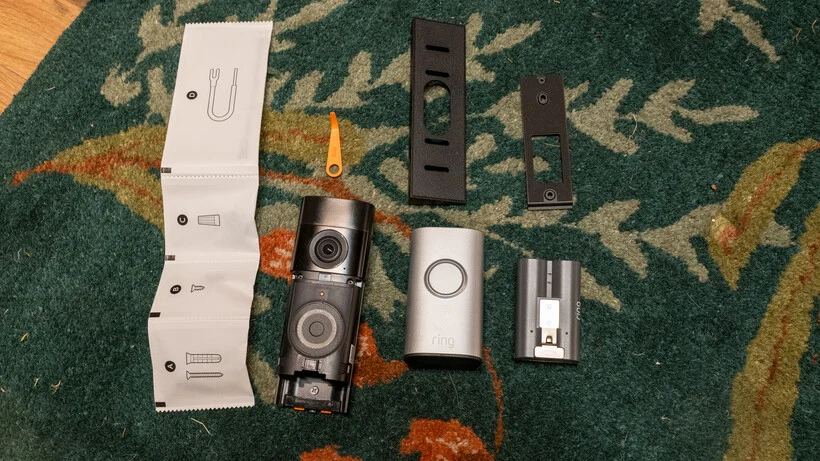
Choosing between a wired and battery-powered Ring doorbell, while seemingly straightforward, is often complicated by Ring’s product naming conventions. The critical distinction lies not just in the power source, but in how that source dictates the device’s operational capabilities and user experience. Understanding this fundamental difference is paramount for consumers seeking to make an informed decision that aligns with their home’s infrastructure and security needs.
At its core, Ring offers two primary power options for its video doorbells: fully wired models that draw continuous power from existing doorbell circuits, and battery-powered models that operate independently, albeit with the option to connect to existing wiring for trickle charging. This latter point is crucial: connecting a battery doorbell to existing wiring does not transform it into a truly wired device. Instead, the wiring serves as a supplementary power source to maintain the battery’s charge, while the doorbell itself continues to function as a battery-operated unit. This distinction is not merely semantic; it has tangible implications for performance, particularly in terms of responsiveness and the ability to capture events at the doorstep.
Genuinely wired Ring doorbells are permanently powered, allowing them to operate at peak efficiency and respond more rapidly to detected activity. Battery models, conversely, offer unparalleled ease of installation and are ideal for renters or homes lacking pre-existing doorbell wiring. However, this convenience comes with trade-offs, primarily concerning the need for periodic battery charging and potential delays in motion detection and alert delivery.
The competitive landscape of smart home security devices has seen significant evolution, with Ring refreshing its lineup substantially in 2026. This means contemporary comparisons are no longer between older 1080p wired models and newer, more feature-rich battery counterparts. The current generation of Ring Wired Doorbell 2K and Battery Doorbell 2K both boast impressive 2K resolution with head-to-toe video coverage. Higher-tier models, such as the Plus and Pro variants, offer even more advanced capabilities. Comprehensive reviews of the Ring Battery Video Doorbell 2K Plus and the Ring Wired Video Doorbell 2 have provided in-depth insights into their respective performances. For those still weighing options across different brands, a broader guide to the best smart video doorbells offers a wider perspective on the market.
Understanding the Core Differences: Wired vs. Battery Power
The fundamental divergence between Ring’s wired and battery doorbells lies in their power dependency. A battery-powered Ring doorbell is designed for standalone operation, requiring only a charged battery and a Wi-Fi connection to function. Installation typically involves attaching a mounting bracket, securing the doorbell, and configuring it via the Ring app. This self-contained nature makes them exceptionally versatile.
Conversely, a wired Ring doorbell necessitates a connection to a pre-existing doorbell transformer, drawing a constant supply of power. This continuous power flow ensures the device is always active and ready to respond. The critical difference emerges when considering what happens after installation: a truly wired doorbell relies entirely on the transformer for power. Should there be a power interruption to the transformer, the wired doorbell will cease to function.
Battery-powered doorbells, even when connected to existing doorbell wiring, still operate from their internal battery. The external wiring provides a "trickle charge," continuously topping up the battery and significantly extending the time between manual charges. This means that even with wiring connected, the doorbell’s functionality is still ultimately dependent on the battery’s charge level. If the battery depletes, the doorbell will cease to operate, regardless of whether it’s connected to external wiring.
Pricing and Model Tiers: A Look at the 2026 Lineup
Ring’s pricing strategy reflects the inherent differences in their wired and battery models. Typically, a battery-powered doorbell commands a slightly higher price point, a reflection of the cost associated with the integrated or removable battery pack. As of recent product cycles, the Ring Wired Doorbell 2K has been positioned at a more accessible price point, around $79.99 / £59.99, while its battery-powered counterpart, the Battery Doorbell 2K, is generally priced around $99.99 / £79.99. These are standard retail prices, and it’s common to find these devices available at a discount during promotional periods. For instance, during Ring’s sales events, the prices can drop significantly, with the Wired Doorbell 2K sometimes available for as low as £39.99 and the Battery Doorbell 2K for around £44.99 in the UK market.

The 2026 product refresh has standardized this tiered approach across both power types. Ring now offers entry-level 2K resolution models in both wired and battery configurations, followed by "Plus" versions and flagship "4K Pro" models. In the United States, the Battery Doorbell 4K Pro might retail for approximately $249.99, while the Wired Doorbell 4K Pro is often priced at $199.99, before any promotional discounts. This consistent structure across power sources allows consumers to prioritize their preferred power method first, and then select the desired feature set and video resolution.
Internal Chimes: A Key Differentiator
A significant functional difference that often influences consumer choice is the ability to integrate with existing internal doorbell chimes. For users who wish for their traditional indoor chime to sound when the doorbell button is pressed, a battery-powered Ring doorbell wired to an existing transformer is the required configuration. Intriguingly, Ring’s purely wired doorbell models are not designed to trigger these internal chimes. Instead, users who opt for a wired Ring doorbell and desire audible notifications within their home must rely on companion devices like Amazon Echo smart speakers or separate wireless chime accessories. This limitation can be a decisive factor for households that value the familiar sound of a traditional doorbell.
Responsiveness and the "Back of the Head" Problem: The Wired Advantage
One of the most compelling arguments for choosing a wired Ring doorbell, assuming compatible wiring is already in place, is its superior responsiveness. Battery-powered doorbells are engineered to conserve energy, which means their motion detection and camera systems operate in a more power-saving mode when idle. This can result in a perceptible delay between the initiation of motion and the device’s reaction, a phenomenon often referred to as the "back of the head" problem.
In comparative testing, wired Ring models have consistently demonstrated faster alert delivery and quicker activation of the Live View compared to their battery-powered counterparts. More critically, wired doorbells tend to be more effective at capturing individuals as they approach the door, rather than only recording them once they have reached the entrance or are already departing. The "back of the head" problem arises when a doorbell’s motion detection activates too late, leading to video clips that show a delivery person walking away rather than their face as they arrive.
While Ring has made significant strides in enhancing motion detection algorithms, incorporating pre-roll recording, and introducing radar-based features in its higher-end models, the fundamental advantage of continuous power remains. A permanently powered device generally offers a more immediate and reliable response to events. For users whose primary concern is security and comprehensive event capture, this enhanced responsiveness is a critical advantage.
Installation Simplicity: The Battery Bell’s Forte
Where battery-powered Ring doorbells undeniably excel is in their ease of installation. For homes without existing doorbell wiring, a battery model presents a vastly simpler setup. Ring estimates an installation time of approximately 10 minutes for its current Battery Doorbell 2K. This process typically involves mounting a bracket, attaching the doorbell, and connecting it to the home’s Wi-Fi network through the Ring app, with no requirement for transformers or electrical connections.
This user-friendly installation makes battery-powered doorbells an exceptionally practical choice for renters, individuals living in apartments, converted properties, or any home where a conventional doorbell was never integrated into the original construction. Ring further enhances this by offering no-drill mounting solutions for compatible battery models, making them even more suitable for temporary or rental accommodations.
While installing a wired Ring doorbell can still be a manageable DIY task if the necessary wiring is present, it requires more careful consideration. Ring’s estimated installation time for the Wired Doorbell 2K is around 15 minutes, but this assumes the presence of a compatible transformer and wiring meeting specific electrical requirements. If existing wiring is absent, the process of running new doorbell circuits can involve additional hardware costs and potentially professional installation, diminishing the cost advantage of the wired doorbell unit itself.
An alternative for wired models is the availability of plug-in adapters. The Ring Wired Doorbell 2K, for instance, can be powered continuously from a standard indoor electrical outlet using a dedicated adapter, offering a workaround for homes without traditional doorbell wiring. This adapter-equipped option can be a cost-effective solution, sometimes priced around £49.99 in the UK during sales.

Video Quality: A Narrowing Gap
Historically, older Ring Wired models sometimes compromised on video quality to achieve a lower price point. The original iteration of the wired model reviewed was limited to 1080p resolution and was noted for producing images that appeared comparatively dull and shadowed against more premium alternatives. This disparity has largely been rectified in Ring’s current product lines.
The 2026 generation of both the Wired Doorbell 2K and Battery Doorbell 2K feature Ring’s "Retinal 2K" format, delivering a head-to-toe field of view with a 140-degree horizontal and 140-degree vertical capture angle. Ring recommends an upload speed of at least 10 Mbps for optimal performance with its 2K devices. Consequently, the base models offer comparable resolution, making the choice between them less about image clarity and more about other functional differences.
This convergence in video quality extends to higher-tier models as well. Ring now offers 2K Plus and 4K Pro variants in both wired and battery configurations. This means that opting for a battery-powered doorbell no longer automatically entails accepting a lower-resolution camera. The primary differentiator now lies in the specific features available on each model, rather than a fundamental difference in video capture capabilities between wired and battery options at equivalent tiers. Advanced features such as HDR video, 3D Motion Detection, and Bird’s Eye view are typically reserved for higher-end Pro models, irrespective of their power source.
Therefore, consumers can now approach their decision by first determining their preferred power source (wired or battery) and then selecting the desired feature set and video resolution from the available options within that power category.
Battery Management and Charging Protocols
The inherent limitation of battery-powered doorbells is the necessity for periodic charging. The frequency of this requirement is contingent upon a multitude of factors, including the volume of activity in the doorbell’s vicinity, the aggressiveness of motion detection and recording settings, Wi-Fi signal strength, ambient temperature, and other environmental variables. There is no universal charging interval that applies to every installation. Notably, cold weather can also negatively impact battery performance and longevity.
The standard Ring Battery Doorbell 2K features an integrated battery. When a manual charge is required, the entire doorbell unit must be removed from its mounting and connected to a USB-C charger. During this charging period, the doorbell is effectively offline and non-operational.
More convenient designs, such as those found in the Ring Battery Doorbell Plus and Pro models, incorporate removable battery packs. This design allows users to maintain continuous doorbell coverage by keeping a second fully charged battery pack on hand and swapping it in when the primary battery is depleted. This eliminates the downtime associated with charging the entire unit.
As previously mentioned, connecting a battery-powered doorbell to existing doorbell wiring can significantly reduce the frequency of manual charging by providing a constant trickle charge. However, it is crucial to reiterate that this connection primarily serves to maintain the battery’s charge, not to bypass the battery as the primary power source. For installations where compatible wiring is already present and the doorbell is intended for permanent placement, a true wired model typically offers a more streamlined and hassle-free experience.
Demystifying Ring’s Product Naming
Ring’s product nomenclature can sometimes create confusion for consumers. For instance, the current entry-level battery model is officially designated as the "Battery Doorbell 2K," though it is also frequently referred to as the "Battery Doorbell (2nd Gen)." Ring clarifies that these are indeed the same device, with the name change reflecting a marketing update rather than a hardware revision. Above this model sits the "Battery Doorbell 2K Plus," followed by the flagship "Battery Doorbell 4K Pro."

The wired product range mirrors this tiered structure: the "Wired Doorbell 2K," the "Wired Doorbell 2K Plus," and the "Wired Doorbell 4K Pro." At the apex of its current U.S. product line, Ring also offers the "Wired Doorbell 4K Elite," which utilizes Power over Ethernet (PoE) for both data and power transmission, offering a robust and high-performance wired solution.
Therefore, a simplified way to understand Ring’s 2026 product hierarchy is: "2K" signifies the entry-level model, "2K Plus" represents a step-up offering, and "4K Pro" denotes the premium, feature-rich option. Each of these tiers is available in both wired and battery-powered configurations, allowing consumers to select their preferred power source at each performance level.
Ring Wired vs. Ring Battery: Which Should You Choose?
For households that already possess compatible doorbell wiring, a wired Ring doorbell is generally the recommended choice for most users, with one notable exception: the desire for an integrated internal chime. The primary advantage of a wired model extends beyond the convenience of never needing to charge a battery. In practical testing, wired Ring doorbells have consistently provided a more responsive user experience. They wake up faster, deliver alerts more promptly, and are more adept at capturing approaching individuals. Given that the current Wired Doorbell 2K offers the same fundamental 2K head-to-toe video resolution as its battery-powered counterpart, there is less incentive than ever to accept the inherent trade-offs of battery operation when permanent power is readily available.
However, battery-powered doorbells retain a significant role in the smart home security market. They are indispensable for renters, individuals residing in homes without pre-existing doorbell wiring, or anyone prioritizing an easily reversible installation that requires no electrical modifications. The option for trickle charging also provides a degree of flexibility should wiring be added at a later stage. It is important to avoid purchasing a battery model with the assumption that connecting it to existing wiring will transform it into a fully wired device in terms of operational performance; it will not.
Final Considerations for the Connected Home
In conclusion, if your home is equipped with suitable doorbell wiring, the Ring Wired model is the pragmatic selection. It offers the assurance of permanent power, eliminates the administrative burden of battery management, and provides a demonstrably superior responsiveness that has been consistently observed in testing. Furthermore, Ring’s latest wired models have eliminated the video quality compromises that were present in older, more budget-oriented offerings.
The Battery Doorbell remains the more appropriate solution for renters and homes lacking existing wiring, where its straightforward installation process significantly outweighs the minor inconvenience of occasional charging. However, when faced with the choice between the two in a home already wired for doorbells, the true wired Ring doorbell stands out as the superior option every time, offering a more integrated, reliable, and responsive security experience.

