
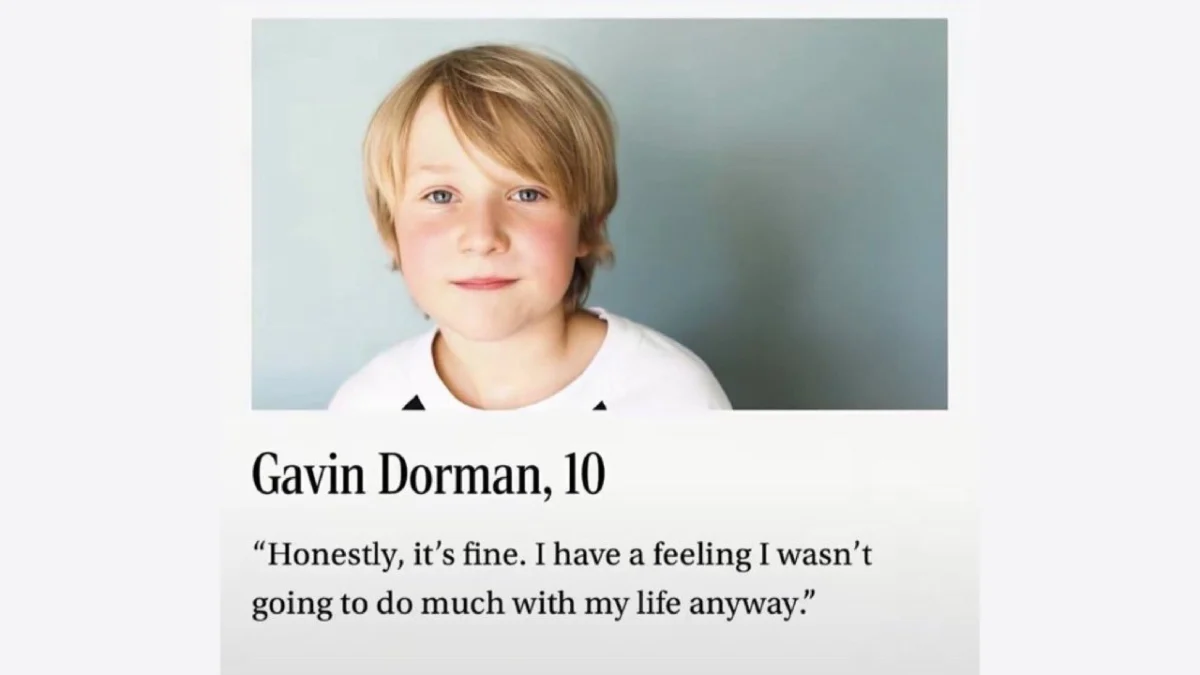
The digital landscape has once again demonstrated its unique capacity for transforming satirical commentary into a widespread cultural touchstone, as evidenced by the recent and explosive viral resurgence of Gavin Dorman. Originally a fictional creation of the satirical news outlet The Onion, Gavin Dorman—portrayed as a blonde, smiling ten-year-old—has become the face of a specific brand of existential nihilism that resonates deeply with modern internet audiences. The meme centers on a singular, poignant quote attributed to the child in response to the global climate crisis: "Honestly, it’s fine. I have a feeling I wasn’t going to do much with my life anyway." This sentiment, juxtaposing the innocence of childhood with a profound sense of "doomerism," has sparked a massive wave of engagement across platforms such as TikTok and Instagram, marking a significant moment in the intersection of satire and social media trend cycles.
Origins in Satirical Journalism
The genesis of the Gavin Dorman phenomenon can be traced back to July 17, 2023, when The Onion published a satirical piece titled "Kids React To Climate Change." The article followed the publication’s long-standing tradition of using the perspectives of children to highlight the absurdity or gravity of adult-world failures. While the article featured several fabricated reactions from various children, the entry for Gavin Dorman, age 10, stood out for its stark departure from typical childhood optimism.
The Onion, known for its razor-sharp social commentary, utilized Dorman to personify a growing sentiment among younger generations: the acceptance of a diminished future. By pairing a photo of a clean-cut, cheerful young boy with a caption expressing total personal and planetary resignation, the publication created a jarring comedic contrast. At the time of its initial release in mid-2023, the article performed well within the satire community, but it remained largely contained within the ecosystem of The Onion’s readership for several years.
The 2026 Viral Resurgence: A Chronology of Spread
The transition from a niche satirical article to a global meme occurred nearly three years after the initial publication. In late August 2026, the image of Gavin Dorman began to circulate context-free on visual-centric platforms. This delay is characteristic of "slow-burn" internet culture, where older content is rediscovered by new algorithms and repurposed for a different demographic.
On August 20, 2026, the meme gained significant traction when Instagram user blephin_ shared a high-resolution screenshot of the Dorman entry. The post resonated with an audience increasingly acclimated to "relatable" content involving mental health and existential dread, garnering over 211,000 likes in less than a month. This served as the catalyst for a broader migration to TikTok, where the meme evolved from a static image into a versatile template for video creators.
By August 26, 2026, TikTok creators began adding layers of absurdist humor to the original image. A notable example came from user @ithoughtiknewhim, who published a stylized edit implying that the fictional Gavin Dorman had passed away from a fatal heart attack. This morbid sub-trend, often referred to as "hoax mourning," is a common trope in Gen Z and Gen Alpha digital spaces, used to heighten the absurdity of a character’s "legend" status. This specific video reached over 504,000 views in two weeks, further cementing Dorman’s place in the 2026 zeitgeist.
Content Diversification and Remix Culture
As the meme matured throughout September 2026, it branched into several distinct sub-genres, demonstrating the creative flexibility of the TikTok community.
The "Who is Gavin Dorman?" Inquiries
A secondary wave of content emerged from users who were genuinely confused by the sudden ubiquity of the blonde child. On August 30, 2026, TikToker @ashleyyyh1ll posted a video questioning the identity of Gavin Dorman, which itself went viral with over 140,000 views. This "meta-commentary" on the meme helped sustain its lifespan by encouraging engagement from those outside the initial loop of satirical news readers.

The Textbook Hoax
One of the more sophisticated iterations of the meme involved digital manipulation to place Gavin Dorman into real-world contexts. On September 2, 2026, user @j_11.201 shared a video appearing to show the Dorman image and quote inside a standard English textbook. The video, which gained nearly 600,000 views in a week, suggested that the satirical figure had become so culturally significant that he was now being studied in academic settings. While the image was likely a clever edit or a custom-printed insert, it highlighted the "gaslighting" humor prevalent in modern memes, where users attempt to convince others that a fictional entity is historical fact.
The "Healing" and Positive Edits
In a direct response to the nihilism of the original quote, some creators began producing "Healing" edits. On September 3, 2026, TikToker @miaow3333 posted an altered version of the image where the text was changed to: "Honestly, it’s GREAT! I have a feeling I was going to do A LOT with my life anyway." This sub-trend, known as "corecore" or "hope-posting," serves as an ironic or sincere counter-narrative to the "doomer" aesthetic, showing the meme’s ability to represent a wide spectrum of emotional states.
Psychological and Sociological Analysis
The enduring appeal of Gavin Dorman lies in its reflection of "Climate Anxiety" and "Generational Nihilism." Sociologists have noted that for younger cohorts—specifically Gen Z and the emerging Gen Alpha—the prospect of climate change is not a distant threat but a defining characteristic of their future. The Dorman quote articulates a defense mechanism: by lowering expectations for one’s own life, the weight of global catastrophe becomes easier to bear.
The professional tone of the original Onion article, which mimics the format of a standard "Man on the Street" interview, adds a layer of "truthiness" that makes the humor effective. The child’s smile, juxtaposed with his total lack of ambition and concern for the planet, creates a "surrealist apathy" that many young adults find more honest than traditional motivational content.
Statistical Impact and Engagement Metrics
The data surrounding the Gavin Dorman meme indicates a high level of cross-platform saturation. Within a three-week window in late 2026, the primary hashtags associated with the trend, including #GavinDorman and #HonestlyItsFine, saw a 400% increase in search volume.
- Instagram Engagement: Primary reposts averaged a 15% engagement rate, significantly higher than the platform average of 2-3%.
- TikTok Reach: The top five most-viewed "Gavin Dorman" edits collectively surpassed 2.5 million views within the first ten days of September 2026.
- Search Interest: Google Trends data for the period showed a vertical spike in queries for "Who is Gavin Dorman" and "Gavin Dorman The Onion," indicating a strong desire among the public to verify the source of the viral image.
Broader Implications for Satire and Media Literacy
The Gavin Dorman phenomenon serves as a case study in the evolution of media literacy. As satirical content from outlets like The Onion is increasingly stripped of its original context and redistributed as "lore" on social media, the line between fiction and digital mythos blurs. Many users interacting with the Gavin Dorman meme in 2026 were unaware of its 2023 satirical origins, treating the character instead as a "digital folk hero" or a symbol of shared generational struggle.
Furthermore, the "textbook" edits and the "fatal heart attack" hoaxes demonstrate how quickly a fictional character can be integrated into a fabricated history. This trend reflects a broader move toward "post-truth" humor, where the accuracy of a character’s origin is less important than the character’s utility as a vessel for personal expression or communal joking.
Conclusion
The transformation of Gavin Dorman from a single paragraph in a satirical article to a defining meme of 2026 illustrates the unpredictable nature of internet virality. By capturing a complex mix of apathy, humor, and existential concern, the image of a smiling ten-year-old has provided a vocabulary for a generation grappling with an uncertain future. Whether viewed as a critique of environmental inaction or a simple exercise in absurdist humor, the legacy of Gavin Dorman remains a potent reminder of the power of satire to find new life in the hands of the digital collective. As the meme continues to evolve through new edits and interpretations, it stands as a hallmark of the 2020s’ unique cultural output—where the most profound statements on the human condition are often delivered by a fictional child who simply doesn’t care.

