
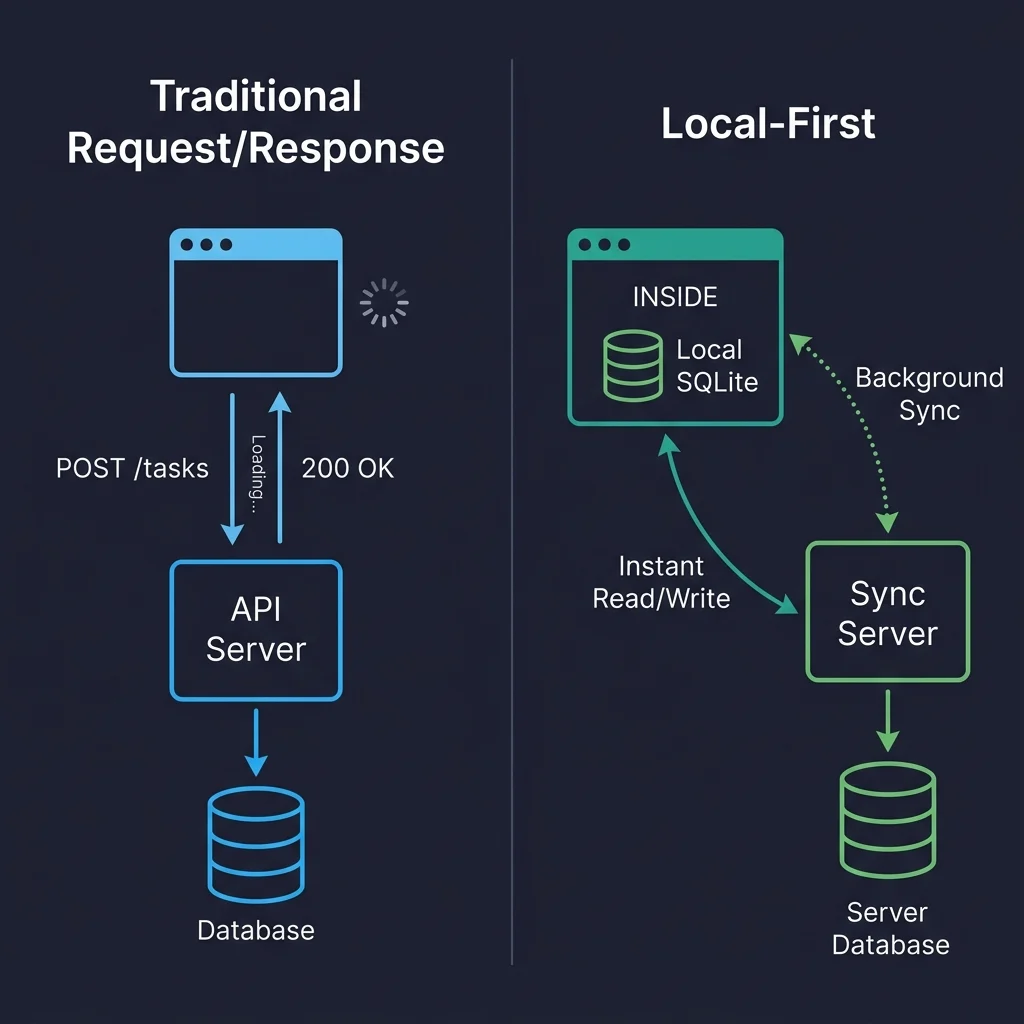
The landscape of web development in 2026 is undergoing a fundamental shift as "local-first" architecture moves from academic theory into mainstream production environments. This architectural paradigm, which prioritizes local data storage and background synchronization over traditional request-response models, is redefining how developers approach latency, offline capabilities, and user data ownership. Unlike the "offline-first" approaches of the previous decade, which treated the server as the sole source of truth, local-first architecture positions the client device as a primary node in a distributed system, possessing its own database and the authority to execute writes without immediate server permission.
The Shift from Centralized to Distributed Data Models
For decades, the standard web application model relied on a centralized server-client relationship. In this "thin-client" model, every user interaction—creating a task, editing a document, or moving a file—required a round-trip to a remote server. Industry data from 2025 suggests that even with 5G proliferation, network latency remains a significant bottleneck for user experience, particularly in high-density urban areas or regions with fluctuating connectivity.
Local-first architecture addresses this by treating the client’s local database as the primary interface. When a user performs an action, the application writes directly to a local instance of a database, such as SQLite, running within the browser. The UI updates instantaneously, eliminating "spinners" or loading states. The synchronization with the server or other peer devices occurs asynchronously in the background. This transition is often compared to the historical shift from Subversion (SVN) to Git in version control; where SVN required a server connection for every commit, Git allows for local branching and merging, with remote pushes occurring only when necessary.
Historical Context and the Ink & Switch Foundation
The conceptual framework for this shift was solidified in 2019 with the publication of the seminal paper "Local-First Software: You Own Your Data, in Spite of the Cloud" by the research lab Ink & Switch. The paper outlined seven core ideals for software: fast performance, multi-device support, offline capability, seamless collaboration, longevity, privacy, and user ownership.
While these ideals were initially viewed as engineering "wish lists," the technological landscape of 2026 has provided the necessary infrastructure to make them practical. The maturation of WebAssembly (WASM) and the Origin Private File System (OPFS) has enabled high-performance relational databases to run directly in the browser. In 2019, tooling was insufficient for production-scale local-first apps; however, by 2026, a robust ecosystem of sync engines and conflict-free replicated data types (CRDTs) has emerged to handle the complexities of distributed state.
Technical Infrastructure: WASM, OPFS, and SQLite
The primary enabler of local-first web apps in 2026 is the ability to run SQLite in the browser via WebAssembly. By persisting data to the Origin Private File System (OPFS), web applications can achieve near-native performance. OPFS provides a sandboxed file system that allows Web Workers to perform high-speed synchronous I/O operations, a requirement for traditional database engines to function efficiently.
Technical benchmarks indicate that local SQLite queries for datasets of approximately 5,000 records typically execute in under two milliseconds on modern hardware. In contrast, a traditional REST API request over a standard broadband connection averages between 50 and 200 milliseconds, excluding server-side processing time. This 25x to 100x improvement in data access speed is a primary driver for the adoption of local-first patterns in collaborative tools, project management software, and document editors.
Synchronization Strategies and Conflict Resolution
The most significant engineering challenge in local-first development remains the reconciliation of data across multiple replicas. When two users modify the same data point while offline and subsequently reconnect, the system must determine a "winner" or merge the changes without data loss.
Current industry standards utilize two primary methods for conflict resolution:
- Conflict-Free Replicated Data Types (CRDTs): These are mathematical structures designed to merge concurrent changes automatically. Libraries such as Yjs and Automerge have become the standard for real-time text collaboration, ensuring that character-level edits from multiple sources converge into a single, coherent document.
- Last-Write-Wins (LWW) and Database Replication: For structured data like task lists or inventory, many teams utilize field-level LWW. By attaching high-precision timestamps and deterministic tie-breakers (such as client IDs) to every field, sync engines can reconcile differences row by row.
However, software architects warn of "semantic conflicts"—scenarios where data merges cleanly at a structural level but creates logical errors. A common example is a double-booking in a scheduling app. While the database may accept two different meeting entries for the same time slot, the application logic must flag this as a violation. In 2026, the prevailing strategy is to validate these constraints on the server during the "write-back" phase of synchronization, allowing the server to act as an arbiter for business logic while the clients remain the primary drivers of data entry.
Market Adoption and Tooling Landscape
The market for local-first synchronization engines has seen rapid growth and consolidation. As of mid-2026, several key players dominate the landscape:
- PowerSync: A popular choice for enterprises with existing PostgreSQL backends, providing a sync layer between server-side SQL and client-side SQLite.
- ElectricSQL: An ambitious project focusing on active-active replication, allowing for complex data "shapes" to be synced selectively to specific devices.
- Yjs: The industry leader for collaborative editing, integrated into major frameworks like TipTap and Lexical.
- PGlite: A newer entrant that compiles the full PostgreSQL engine into WASM, promising identical SQL dialects across both client and server.
Despite the benefits, industry analysts point to a "complexity budget" that must be considered. Local-first architecture introduces overhead in the form of client-side migrations, larger bundle sizes (often adding 400KB or more for WASM binaries), and the need for sophisticated authentication at the sync boundary rather than the request boundary.
Security and Privacy Implications
One of the most compelling arguments for local-first architecture is its alignment with modern privacy requirements. Because the data resides primarily on the user’s device, implementing End-to-End Encryption (E2EE) becomes more straightforward. Applications can encrypt data locally before it ever reaches the synchronization server, ensuring that the service provider cannot access sensitive user information.

This "privacy-by-design" approach is increasingly becoming a competitive differentiator. With the rise of local AI models, developers are exploring "Local-First AI," where sensitive data is processed by on-device LLMs (Large Language Models) without the data ever leaving the user’s hardware.
Challenges in Testing and Observability
The distributed nature of local-first apps creates unique hurdles for Quality Assurance (QA). Traditional end-to-end testing must be expanded to include "partition testing," where network connections are intentionally severed to verify that the application remains functional and syncs correctly upon reconnection.
Furthermore, debugging "ghost bugs"—errors that occur only during specific, hard-to-reproduce sequences of offline edits—requires a shift in observability. Developers in 2026 are increasingly relying on detailed sync logs and property-based testing (using tools like fast-check) to ensure that their merge logic converges under all possible operation sequences.
Future Outlook: Toward Standardization
The absence of a universal synchronization protocol remains a point of friction. Currently, each sync engine utilizes a proprietary method for handling delta updates and state reconciliation. However, discussions within the W3C and various community groups suggest a growing interest in standardizing how browsers handle background synchronization and distributed state.
Industry experts predict that by 2030, the distinction between "client-side" and "server-side" databases may largely dissolve. In this future, developers will write standard SQL queries, and the underlying runtime will handle the movement of data across the network based on latency, cost, and security requirements.
Conclusion: A New Standard for User Experience
Building local-first web applications in 2026 is no longer an experimental endeavor but a strategic choice for high-performance software. By shifting the source of truth to the user’s device, developers are able to offer experiences that are immune to network instability and superior in speed. While the architectural complexity is higher than traditional CRUD (Create, Read, Update, Delete) models, the benefits in user retention, perceived performance, and data privacy are driving a permanent change in how the web is built. As the tooling continues to mature, the "local-first" approach is expected to become the default for any application where collaboration and responsiveness are paramount.

