
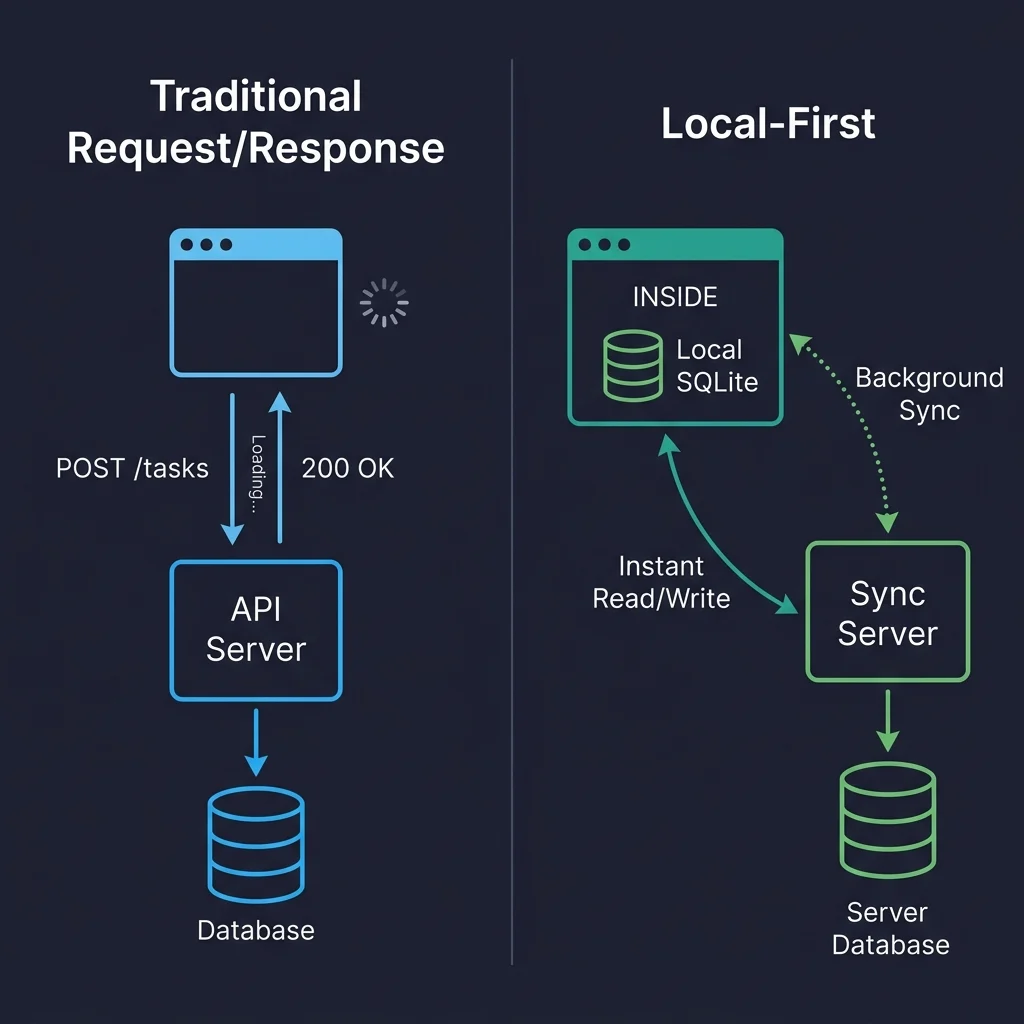
The landscape of software engineering has undergone a fundamental shift as local-first architecture moves from a niche academic interest to a standard requirement for high-performance web applications. By mid-2026, the transition from traditional request-response models to distributed client-side data systems has redefined user expectations for speed, reliability, and privacy. This evolution follows years of developer frustration with the inherent limitations of the "thin client" model, which frequently failed under suboptimal network conditions. The emergence of robust tooling, including SQLite compiled to WebAssembly (WASM) and high-performance browser storage APIs, has finally bridged the gap between the theoretical benefits of local-first software and the practicalities of production-grade engineering.
The Paradigm Shift: From Offline-First to Local-First
In the early 2020s, the industry often conflated "offline-first" capabilities with "local-first" architecture. However, by 2026, a clear distinction has been established in professional circles. While offline-first strategies typically focus on graceful degradation—using service workers to cache server responses—the server remains the ultimate source of truth. Local-first architecture, conversely, treats the client device as a primary node in a distributed system.
Under this model, the application reads and writes to a local database first. Synchronization with a central server or other peers occurs in the background, treating the server as a synchronization peer rather than a gatekeeper. This architectural change eliminates the "spinner-driven development" that plagued the previous decade, where every user interaction was gated by a round-trip to a data center. Data from 2025 performance audits suggests that local-first applications achieve an average latency of under 10 milliseconds for write operations, compared to the 200-500 millisecond average seen in traditional cloud-based REST or GraphQL architectures.
A Chronology of Adoption: 2019 to 2026
The trajectory of local-first development can be traced through several key milestones:
- 2019: The Conceptual Foundation. The research lab Ink & Switch published "Local-first software: You own your data, in sickness and in health," outlining seven ideals: fast, multi-device, offline, collaboration, longevity, privacy, and user ownership. At the time, browser technology was deemed insufficient for widespread implementation.
- 2022–2023: The Tooling Infancy. Early libraries like Yjs and Automerge gained traction for collaborative text editing, but general-purpose database synchronization remained difficult for average development teams.
- 2024: The WASM Breakthrough. The stabilization of SQLite WASM and the Origin Private File System (OPFS) provided the necessary infrastructure for running full relational databases within the browser with near-native performance.
- 2025: Production Maturity. Sync engines such as PowerSync and ElectricSQL reached version 1.0, offering reliable pathways to synchronize local SQLite instances with established backend databases like PostgreSQL.
- 2026: Standardized Implementation. Local-first becomes the default choice for document editors, project management tools, and field-service applications, supported by a mature ecosystem of reactive frameworks.
Technical Infrastructure: SQLite and the Origin Private File System
The primary driver of the local-first movement in 2026 is the maturity of SQLite running in the browser. While earlier attempts relied on IndexedDB—an API frequently criticized for its complex developer experience and performance bottlenecks—the modern stack utilizes SQLite compiled to WASM. This allows developers to use standard SQL queries, transactions, and indexes directly on the client.
The persistence layer has been revolutionized by the Origin Private File System (OPFS). OPFS provides a sandboxed file system that offers high-performance synchronous access within Web Workers. This capability is critical for database engines that require atomic writes and sophisticated locking mechanisms. According to industry benchmarks, SQLite on OPFS can handle datasets exceeding several hundred megabytes without compromising the responsiveness of the main UI thread, a feat that was previously impossible in a browser environment.

The Synchronization Challenge and Conflict Resolution
The most significant hurdle in local-first development remains the reconciliation of data across multiple devices. When two users modify the same record while offline, the system must merge those changes deterministically.
Current industry standards utilize two primary methods for reconciliation:
- Conflict-Free Replicated Data Types (CRDTs): Used primarily for collaborative text and complex nested structures, CRDTs like Yjs ensure that all replicas converge to the same state regardless of the order in which operations are received.
- Row-Based Replication with Last-Write-Wins (LWW): For standard business applications, field-level LWW has become the preferred method due to its simplicity. By attaching high-precision timestamps and client identifiers to individual fields, sync engines can resolve conflicts without user intervention in 95% of cases.
However, architects warn of "semantic conflicts," where data merges correctly at a structural level but creates logical errors, such as double-booking a meeting room. In 2026, the prevailing strategy is to validate constraints on the server during the "write-back" phase. Rather than rejecting conflicting writes—which can lead to state divergence between the client and server—modern systems accept the write but flag it with a "violation" status, prompting the user to resolve the logical inconsistency manually.
Economic and Strategic Considerations for Organizations
The shift to local-first is not merely a technical preference but a strategic decision influenced by the "complexity budget." While the architecture provides superior user experiences, it introduces new challenges in schema migrations and authorization.
In a traditional setup, migrations are performed on a single server-side database. In a local-first world, migrations must be executed across thousands of independent client databases, each potentially running a different version of the application. Professional development teams have adopted additive-only schema changes and robust client-side migration runners to mitigate the risk of data corruption.
Furthermore, authorization must be enforced at the synchronization boundary. Since the client holds a copy of the data, the sync engine must ensure that only authorized rows are replicated to specific devices. This requires a sophisticated "sync rule" layer that acts as a filter between the central Postgres database and the distributed SQLite nodes.
Comparative Performance Data
Data gathered from 2026 deployment reports highlights the performance delta between traditional and local-first architectures:

| Metric | Traditional (REST/GraphQL) | Local-First (SQLite WASM) |
|---|---|---|
| UI Latency (Read) | 150ms – 2,000ms (Network dependent) | < 2ms (Instant) |
| UI Latency (Write) | 200ms – 3,000ms (Gated by server) | < 5ms (Instant) |
| Offline Capability | Limited/Read-only | Full read/write |
| Server Load | High (Per-request processing) | Low (Background sync batches) |
| Bundle Size Impact | Negligible | +400KB – 600KB (WASM binary) |
Expert Perspectives and Industry Reactions
"The client is no longer a thin view requesting permission to show data; it is a fully-fledged node in a distributed system," says Marcus Thorne, a lead architect at a major project management platform. "This change has forced us to rethink everything from authentication to how we handle analytics. You cannot simply ‘bolt on’ local-first; it is a fundamental shift in how you treat state."
Conversely, some industry veterans remain cautious. "For systems requiring strong transactional consistency—like high-frequency trading or inventory management for limited-stock items—local-first is still a liability," notes Sarah Chen, a distributed systems consultant. "The eventual consistency model of local-first can lead to financial discrepancies if not handled with extreme care. It is a tool, not a universal replacement."
The Future of the Web: Standards and AI Integration
Looking toward the late 2020s, the industry is calling for standardized synchronization protocols. Currently, the market is fragmented, with each sync engine (PowerSync, ElectricSQL, Triplit) utilizing proprietary logic. The emergence of a "Web Sync Standard" would allow for greater interoperability and reduce the risk of vendor lock-in.
Additionally, the rise of local-first architecture coincides with the growth of on-device AI. By keeping user data local, developers can run Large Language Models (LLMs) directly in the browser using WebGPU, providing personalized AI features without ever sending sensitive data to a cloud provider. This synergy between local data and local intelligence is expected to be the primary driver of software innovation through 2030.
In conclusion, local-first web development in 2026 represents the maturation of the internet into a more resilient, private, and performant medium. While the architectural complexity is higher than traditional models, the resulting user experience—defined by instant interactions and seamless offline transitions—has set a new baseline for what constitutes a "modern" web application. For development teams, the challenge lies in managing the complexity budget and selecting the right tools to navigate this distributed future.

