
The landscape of e-commerce marketing is undergoing a seismic shift, driven by the rapid advancement and integration of generative artificial intelligence (AI) into search and shopping platforms. For decades, marketers have grappled with the concept of "intent," particularly "purchase intent" and "informational intent," seeking to understand and target consumers based on their perceived needs. However, the advent of sophisticated AI tools, such as conversational chatbots and advanced search algorithms, is poised to redefine this understanding, offering unprecedented precision and opening new avenues for product discovery and engagement. This evolution presents a significant opportunity for businesses to connect with shoppers at a deeper, more contextual level, particularly those who may not yet know precisely what they are looking for.
The traditional approach to understanding shopper intent has largely relied on keyword analysis and the categorization of search queries. A typical web search query, averaging around four words, often provides a relatively superficial glimpse into a consumer’s needs. For instance, a search for "small simple coffee grinder" indicates a desire for a compact and straightforward appliance. While this provides a starting point for marketers, it leaves much room for interpretation and targeted product showcasing.
However, the interaction paradigm is fundamentally changing with the rise of generative AI. Consider the difference in how a consumer might articulate their needs when using a traditional search engine versus engaging in a conversation with an AI assistant like Google’s Gemini, OpenAI’s ChatGPT, or Anthropic’s Claude. A recent analysis by Semrush, published in 2026, highlighted that queries directed at AI chatbots, such as ChatGPT, are significantly more verbose, averaging approximately 23 words. This increased length and complexity allow for the inclusion of nuanced details and contextual information that were previously difficult to capture.
Imagine the same shopper seeking a coffee grinder. In a traditional search, they might type "small simple coffee grinder." This query, while functional, offers limited insight beyond basic size and simplicity. In contrast, a conversation with an AI might unfold as follows: "I live in a small apartment and need a quiet coffee grinder that’s easy to use for my pour-over coffee routine. It also needs to be easy to clean and not create too much mess." This extended query, rich with specific constraints and use-case details—such as the need for quiet operation, suitability for pour-over, ease of cleaning, and the context of a small living space—provides a much clearer picture of the shopper’s ideal product. While the underlying need—a coffee grinder—remains the same, the AI’s ability to process and understand this complex request unlocks a far greater opportunity for marketers to present a highly relevant solution.
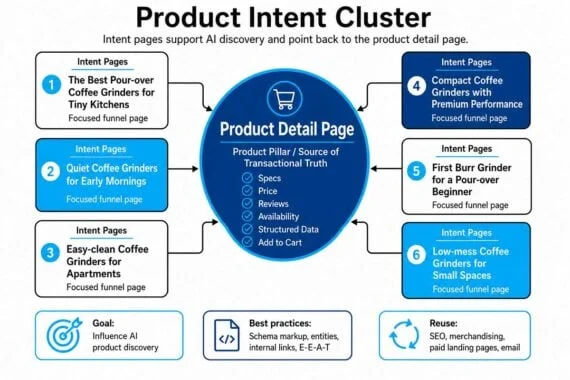
This evolution in query behavior directly fuels the concept of "product intent clusters," a strategic approach to content creation and website architecture designed to influence AI-driven product discovery. These clusters function similarly to traditional SEO topic clusters, but with a refined focus on specific information, practical use cases, and distinct customer scenarios that collectively guide users toward a particular product. At the heart of each cluster lies the product detail page, which serves as the ultimate source of truth for purchase decisions, encompassing specifications, pricing, reviews, and availability.
The structure of these product intent clusters can be visualized as a hub-and-spoke model. The central "Product Detail Page" acts as the core, replete with crucial purchasing information. Radiating outwards are various "intent pages," each meticulously crafted to address a specific shopper scenario or information need. For example, for a coffee grinder, these intent pages might include titles like "The Best Quiet Coffee Grinders for Small Apartments," "Effortless Pour-Over Grinders for Apartment Dwellers," or "Compact Coffee Grinders for Minimalist Kitchens." These pages are designed not just for human readability but also for AI bots to understand and extract valuable information, thereby influencing how AI systems recommend products.
The strategic advantage of product intent clusters lies in their ability to anticipate and satisfy the intricate informational needs that emerge from AI-driven conversations. When a shopper provides a detailed query to an AI, the AI is likely to search for articles, reviews, and informational content that thoroughly addresses the nuances of their request. By proactively creating content that aligns with these detailed queries, e-commerce marketers can ensure their products are surfaced and recommended. This mirrors the effectiveness of long-tail content in traditional SEO, where niche articles helped optimize organic search rankings by targeting specific user needs.
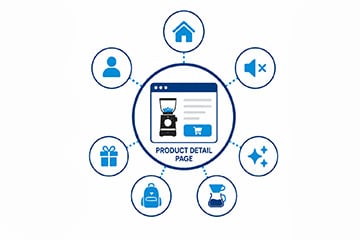
The components of a well-structured product intent cluster extend beyond simple blog posts. They encompass:
- Informational Content: Articles, guides, and blog posts that delve into specific product features, benefits, and use cases relevant to the shopper’s query.
- Use-Case Specific Pages: Content tailored to address how a product solves a particular problem or fits into a specific lifestyle, such as "coffee grinders for early morning quiet" or "travel-friendly grinders."
- Comparison Pages: Content that helps shoppers compare different models or types of products within the context of their specific needs, for instance, "conical burr vs. blade grinders for pour-over."
- Troubleshooting and FAQ Sections: Addressing common questions and concerns that arise during the consideration phase.
- Expert Reviews and Testimonials: Content that builds trust and credibility by showcasing positive experiences and expert opinions related to the product’s intended use.
- Visual Content: High-quality images and videos demonstrating the product in action within relevant scenarios.
Crucially, the product detail page remains the cornerstone of the conversion process. It must continue to be optimized for direct sales, providing all necessary information for a purchase decision. However, it can now be strategically linked to these supporting intent pages, creating a cohesive ecosystem that guides the shopper from initial inquiry to final purchase. This approach does not necessitate turning every product page into an exhaustive buying guide. Instead, it advocates for focused product pages that leverage rich, interconnected content to clarify use cases, answer related questions, and provide comprehensive support for a diverse range of shopper needs.
The shift towards AI-powered search necessitates a recalibration of content strategy, moving beyond broad keywords to deeply specific scenarios. For example, a generic search for "best pour-over coffee grinders" is less effective than an intent page that addresses a specific consumer situation, such as "best pour-over coffee grinders for tiny kitchens." This more granular approach acknowledges that a shopper might be looking for not only pour-over quality but also solutions for limited counter space, a desire for quiet operation, and ease of cleaning.
Each intent page within a product cluster should be designed to guide the shopper seamlessly towards a purchase. This involves:
- Clear Value Proposition: Articulating how the product meets the specific needs outlined in the intent.
- Problem/Solution Framing: Presenting the shopper’s challenge and demonstrating how the product offers an effective solution.
- Feature-Benefit Alignment: Highlighting product features that directly address the user’s expressed requirements.
- Call to Action (CTA): Guiding the user to the product detail page for more information or to make a purchase.
- Internal Linking: Strategically linking to the central product detail page and other relevant intent pages within the cluster.
Furthermore, these intent pages must adhere to traditional search engine optimization (SEO) best practices, including the implementation of Schema.org structured data markup and the use of entities. While the content should be engaging and readable for humans, its primary purpose is to be easily understood and processed by AI bots. This ensures that when an AI system encounters a query related to a specific intent, it can accurately identify and surface the most relevant content, leading to the product detail page. The goal is to create dozens, if not hundreds, of such intent pages per product to comprehensively cover the spectrum of potential shopper needs.
The true "AI unlock" for e-commerce marketing emerges from the ability of generative AI to automate and scale the creation of this specialized content. Before the widespread adoption of generative AI, the prospect of researching, outlining, writing, optimizing, and meticulously maintaining individual content pieces for highly niche use cases, such as "the best pour-over coffee grinders for tiny kitchens," was often cost-prohibitive and labor-intensive. The narrowness of the use case, coupled with the high cost of manual content creation and the uncertainty of its return on investment, made such strategies impractical for many e-commerce businesses.
However, with the advent of advanced automation and generative AI platforms, this paradigm has shifted dramatically. These technologies can now produce and maintain an extensive library of high-quality intent pages, each carefully and precisely prompt-engineered to address specific shopper scenarios. This process can even be informed by AI itself. By feeding structured customer feedback, such as support tickets, product reviews, and customer service chat logs, into a generative AI platform, marketers can identify emerging intent topics and consumer pain points. The AI can then be utilized to generate content that directly addresses these identified needs, creating a dynamic and responsive content strategy.
The implications of this evolution are profound. Shoppers who are unsure of their precise needs are increasingly turning to generative AI for guidance and recommendations. These AI systems, in turn, require rich, contextually relevant information to provide accurate and helpful responses. Product intent clusters, powered by AI-generated content, provide precisely this information. They give AI systems a compelling reason to connect a shopper’s expressed need and their willingness to buy with a specific product. As AI continues to permeate the consumer journey, e-commerce marketers who embrace this strategic approach to understanding and influencing shopper intent will be best positioned to capture attention, drive engagement, and ultimately, secure conversions in the evolving digital marketplace. The ability to anticipate and cater to granular user needs, amplified by the power of AI, marks a new frontier in e-commerce marketing, promising a more personalized and effective shopping experience for consumers and a significant competitive advantage for businesses.

