
The rapid proliferation of artificial intelligence across the global technology landscape has encountered an unexpected obstacle: the end-user. While Silicon Valley and corporate boardrooms have operated under the assumption that consumers and employees are eager for a "generative revolution" in every application, recent market data and user experience (UX) research suggest a growing "adoption gap." Companies are investing billions into AI-powered features, yet retention rates remain significantly lower than anticipated, revealing a fundamental disconnect between the AI leaders’ vision and the practical needs of the workforce. This phenomenon suggests that AI is currently suffering from a value proposition crisis, where the novelty of the technology is failing to outweigh the friction it introduces into established workflows.
The Emergence of the AI Adoption Gap
Since the public release of ChatGPT in late 2022, the technology industry has been locked in an arms race to integrate Large Language Models (LLMs) into every conceivable product, from word processors to household appliances. However, a 2024 study by IBM and MindStudio highlighted a concerning trend: while 80% of CEOs believe AI will transform their business, the actual adoption rate among front-line staff remains under 25% in several key sectors. This discrepancy is often attributed to the "bolt-on" nature of current AI implementations.
Rather than solving specific user pain points, many AI features are perceived as additional layers of complexity. When a tool is "AI-first," it often requires the user to step out of their primary workflow to interact with a chatbot or a generative prompt. This creates a fragmented experience where the user must manage multiple disconnected systems. For the average employee already struggling with digital fatigue and "app switching," a new AI tool is frequently seen not as a helper, but as another system to monitor, manage, and ultimately, fix.
A Chronology of the AI Hype Cycle and the Shift to Skepticism
The trajectory of AI integration has moved through several distinct phases over the last 24 months, leading to the current climate of user resistance.
- The Wonder Phase (Q4 2022 – Q2 2023): Following the launch of GPT-3.5 and GPT-4, the public was captivated by the generative capabilities of AI. Adoption was driven by curiosity, and early users experimented with "magic box" interfaces for creative and academic purposes.
- The Integration Rush (Q3 2023 – Q1 2024): Enterprise software providers—including Microsoft, Google, and Adobe—rushed to include "Copilots" and AI assistants. During this period, "Powered by AI" became the primary marketing slogan for almost every software update.
- The Reality Check (Q2 2024 – Present): Organizations began to realize that AI features often amplify existing organizational shortcomings rather than fixing them. Issues such as poor data quality, technical debt, and broken internal cultures became more visible when AI-generated outputs reflected these inconsistencies. This phase has been characterized by "AI fatigue," where users began to actively disable AI features that interfered with their productivity.
Data Analysis: The Hidden Costs of AI Productivity
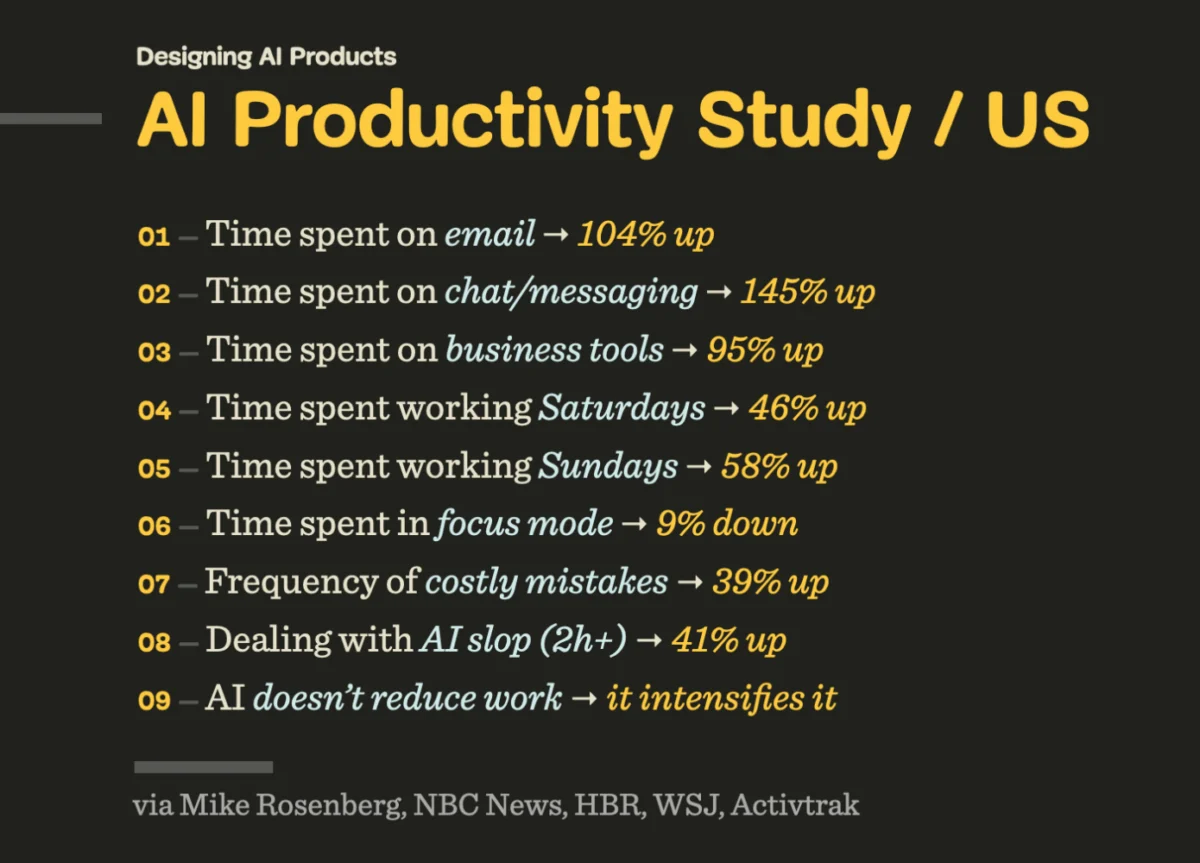
While the narrative from AI developers focuses on "speed of delivery," empirical data suggests that AI may actually be intensifying work rather than reducing it. A compilation of productivity studies from sources including NBC News, Harvard Business Review, and the Wall Street Journal indicates that the introduction of AI in the workplace has led to several unintended consequences:

- Communication Overhead: Time spent on email has increased by 104%, and chat/messaging volume has surged by 145% as users utilize AI to generate more—but not necessarily better—content.
- Quality Control Burdens: Costly mistakes and "AI slop" (low-quality, hallucinated, or irrelevant content) have increased by 39%. This forces human workers into the role of "AI editors," a task that is often more mentally taxing than writing from scratch.
- The Erosion of Focus: Time spent in "focus mode" has decreased by 9%, while the pressure to work outside of standard hours has risen, with Saturday work increasing by 46% and Sunday work by 58%.
These statistics suggest that AI, in its current form, acts as a "work intensifier." By making it easier to produce content, it has increased the total volume of information that must be processed, vetted, and managed by humans.
The Failure of AI as a Value Proposition
In the world of product design, a value proposition is a promise of value to be delivered. Expert analysis from groups such as the Nielsen Norman Group argues that "AI" itself is not a value proposition. Users do not buy products because they contain AI; they buy products to solve problems. When companies prioritize the technology over the utility, they often create features that take people away from their regular ways of working.
Furthermore, the "hallucination" problem remains a significant barrier to trust. Unlike traditional software features, which are expected to be predictable and reliable, LLMs are inherently probabilistic. For a professional whose reputation depends on accuracy—such as a lawyer, a doctor, or an engineer—an unreliable feature is not just a nuisance; it is a liability. The time saved by using AI to generate a first draft is often lost during the rigorous fact-checking process required to ensure the AI has not invented citations or data points.

Human Sentiment and the Resistance to "Vibe-Coded" Changes
Beyond the metrics of productivity, there is a profound psychological element to the current resistance. For many, AI has arrived "uninvited," imposed by leadership at a pace that disregards human adaptability. This has fostered a sense of deep anxiety regarding job security and the value of human intuition.
Prominent industry voices, such as Bo Young Lee, have articulated a growing sentiment: the desire for AI to handle "physical and mental labor" rather than creative and social experiences. There is a burgeoning backlash against AI-generated art, AI-narrated books, and AI therapists. Users are expressing a preference for human-to-human connection, particularly in fields that require empathy, taste, and a unique point of view. The "reward" of work—the feeling of achievement that comes from solving a difficult problem or creating something original—is being eroded by what some call "vibe-coded" changes, where the human element is replaced by a machine-generated approximation.
Official Responses and the Move Toward "AI-Second" Design
In response to these challenges, a new school of thought is emerging among UX designers and product strategists. Vitaly Friedman and other design leaders are advocating for a shift from "AI-first" to "AI-second" or "ambient AI" interfaces. This philosophy suggests that AI should be:

- Integrated, Not Bolt-On: AI should exist within the existing tools and workflows, acting as a supportive background layer rather than a separate destination.
- Predictable and Reliable: Features must work consistently. If a "smart" feature fails 10% of the time, users will eventually stop trusting it entirely.
- Task-Specific: Rather than a general-purpose chatbot, AI should be tuned to automate the most mundane, repetitive, and "boring" tasks—such as data entry, scheduling, or basic formatting—freeing humans for higher-level decision-making.
Companies that have successfully navigated the adoption gap are those that treat AI as a "Key Activity" or "Key Resource" within their business model, rather than the "Value Proposition" itself. By focusing on how AI can augment human capability rather than replace it, these firms are seeing higher retention rates and genuine productivity gains.
Broader Implications and the Future of Work
The long-term impact of this shift in user sentiment will likely force a consolidation in the AI market. The "gold rush" of generic AI wrappers is expected to give way to highly specialized, deeply integrated tools that respect the user’s mental models and time.
The Brookings Institution and GovAI have noted that while software developers and public relations specialists are "most exposed" to AI automation, these roles also require the highest degree of human "taste" and intuition—qualities that current AI models cannot replicate. The future of the labor market may not be a wholesale replacement of roles, but a reconfiguration where the "boring parts" are automated, and the "human parts" are elevated.

The ultimate irony of the AI revolution is that it may lead to a renewed appreciation for human imperfection and connection. As the digital world becomes saturated with synthetic content, the value of human-authored stories, human-led education, and human-made art is likely to increase.
Conclusion
The current data suggests that the world does not need "more AI"; it needs "better AI." People are not seeking a magical box to speak to; they are seeking tools that make their lives easier, predictable, and more rewarding. The path forward for AI leaders is not to push for more features, but to focus on the "ambient" and "supportive" roles that AI can play. By automating the labor that taxes the human spirit, AI can provide the one thing users truly crave: more time and headspace to engage with the people and activities they love. The successful AI products of the next decade will likely be the ones that are so well-integrated that users forget they are using AI at all.

