
A seemingly minor pipe burst or an unattended overflowing washing machine can escalate into a homeowner’s worst nightmare, potentially causing thousands of pounds in damage before the first signs of trouble—a tell-tale puddle—even appear. In an era where smart home technology is increasingly integrated into our lives, water leak detectors have emerged as one of the most cost-effective and impactful additions to safeguarding properties against the insidious threat of water damage. These compact, often battery-powered devices are designed to offer an early warning system, sensing the slightest trace of moisture the moment it manifests and instantly relaying an alert to a connected smartphone. Their ease of installation, often taking mere minutes, and their affordability have cemented their status as a vital component of modern home security.
The underlying technology that powers these vigilant guardians of our homes, however, is not a monolithic concept. Depending on the specific type of detector, the mechanisms at play can vary significantly. For homeowners seeking to make informed purchasing decisions, resources such as The Ambient’s comprehensive guide to the best smart home sensors serve as an invaluable starting point, offering insights into a wide array of devices, including those focused on motion detection, security, and window/door monitoring, alongside the critical water leak sensors.
The vast majority of consumer-grade water leak detectors, including popular models from reputable brands like Aqara, GoveeLife, and SwitchBot—all featured in The Ambient’s dedicated guide to the best water leak sensors—operate on a fundamental principle: electrical conductivity. These devices eschew complex flow measurement in favour of a much simpler, yet highly effective, approach. At their core, many of these sensors feature two exposed metal contacts positioned on their underside, separated by a small gap. In their normal state, this gap represents an open circuit, meaning no electrical current can flow.
Domestic water, even in relatively small quantities, possesses sufficient conductivity to bridge this gap. When water comes into contact with both metal probes, it completes the electrical circuit. This instantaneous completion of the circuit is the trigger mechanism, signalling the presence of a leak and initiating the alert sequence.
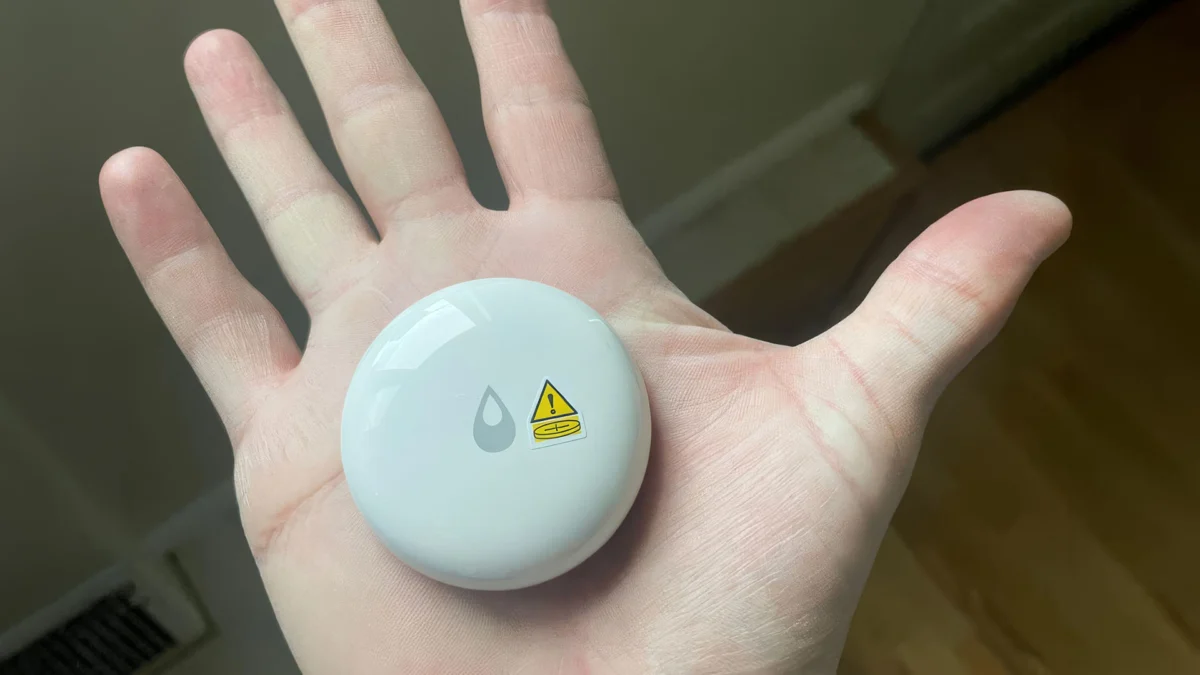
The physical design of these sensors plays a crucial role in their practical application and effectiveness. Compact, disc-shaped or "puck" style sensors, exemplified by the Aqara Water Leak Sensor, typically concentrate their detection probes on the underside. This design necessitates that the device be placed flat on a surface, and it will only register a leak once water has pooled beneath it to bridge the contacts. Consequently, such sensors may not be ideal for detecting a drip landing directly on the top surface of the device, potentially missing early signs of a leak originating from directly above.
To address this limitation, some water leak sensors incorporate additional contacts on their upper surfaces. This dual-contact design allows them to detect moisture from above, which can be particularly useful in scenarios such as a boiler situated overhead beginning to leak.

Another design philosophy focuses on expanding the sensing area rather than concentrating it in a single point. Cable-based water leak detectors achieve this by extending the detection capabilities via a flexible cable. The GoveeLife Smart Water Leak Detector 1S, for instance, pairs its main sensor unit with a nearly five-foot cable adorned with conductive contacts on both sides. This configuration enables a single device to effectively monitor a much larger area, such as the entire space beneath a washing machine or dishwasher.
The SwitchBot Water Leak Detector occupies a middle ground, offering detection on both faces of its slightly more substantial housing. Furthermore, it provides an optional cable accessory that can be configured for "dry alerts." This innovative feature allows the sensor to detect a drop in water level, rather than a rise, which can be useful for monitoring applications like fish tanks where a sudden decrease in water volume might indicate a problem. The primary advantage of a cable-based sensor is its ability to cover a broader perimeter, reducing the need for hyper-precise placement and increasing the likelihood of detecting a leak over a larger potential spill zone.
Advanced Leak Detection: Beyond Simple Conductivity
While conductivity-based sensors are effective for detecting pooled water, they represent only one facet of leak detection technology. More sophisticated systems offer broader coverage and different detection methodologies, addressing the limitations of point-of-use sensors.
Whole-Home Flow Monitors: These systems are installed at the main water line entering a property and continuously monitor water flow patterns throughout the entire house. Instead of waiting for water to reach a specific sensor, they detect anomalies in flow, such as a continuously running toilet or a burst pipe hidden within a wall. They operate by identifying when water is being drawn when no fixtures are in use.
These monitors typically employ one of two primary technologies:
- Mechanical Impellers: These devices utilize a small, rotating component (an impeller) that is directly driven by the water flow. The speed of the impeller’s rotation is measured to determine the volume and rate of water usage. Mechanical impeller systems are generally more affordable.
- Ultrasonic Sensors: In contrast, ultrasonic sensors do not have moving parts. They work by emitting sound waves and measuring how they are affected by the water flow through the pipe. This method can be more sensitive to detecting very small leaks, as it can identify subtle disruptions in the sound wave pattern.
The primary advantage of whole-home flow monitors is their comprehensive coverage, effectively overseeing all connected plumbing. However, a significant trade-off exists. While point-of-use sensors are typically inexpensive and designed for easy DIY installation, whole-home systems, particularly those integrated with an automatic shut-off valve, represent a more substantial investment and often require professional plumbing expertise for installation. Furthermore, while these systems can alert homeowners to a leak, identifying the precise location of the leak can still necessitate further investigation.
LeakBot: A Thermally-Driven Sentinel
The LeakBot system distinguishes itself by not fitting neatly into either the conductivity-based or whole-home flow monitor categories. This innovative device clips directly onto the incoming water pipe, typically near the stopcock, requiring no special tools or plumbing knowledge for installation. Its unique detection mechanism, patented Thermi-Q technology, operates by monitoring the pipe’s temperature. It compares the pipe’s thermal signature against the ambient air temperature to identify the subtle thermal anomaly created by a hidden leak.

A continuous leak draws colder water from the underground supply, establishing a small but persistent temperature difference. Ordinary household water usage, which is intermittent, does not generate this specific thermal signature. LeakBot’s advanced thermal sensing can detect leaks as small as 5 millilitres per minute, including those concealed within walls or beneath floors, areas inaccessible to conventional contact sensors. In the United Kingdom, LeakBot has gained significant traction through partnerships with home insurers, such as British Gas HomeCare and Direct Line. It is often offered to policyholders at no additional cost, and in the event of a confirmed leak, a qualified plumber can be scheduled directly through the associated app.
Smart Features: Amplifying Protection with Connectivity
While a basic, non-smart water leak sensor might simply sound a local alarm, the true value proposition of smart water leak detectors lies in their connectivity and advanced features. The most fundamental smart capability is the ability to send push notifications directly to a user’s smartphone, providing real-time alerts regardless of the homeowner’s location. This immediate notification allows for swift intervention, potentially averting catastrophic damage.
Some smart sensors retain an integrated speaker, offering an audible alert within the home, ensuring that occupants are aware of a leak even if they are not actively monitoring their phones. The pinnacle of smart leak detection functionality, however, is achieved when sensors are paired with an automatic shut-off valve. Systems like Aqara’s ecosystem allow its Water Leak Sensor to communicate with a separate Valve Controller T1. When a leak is detected, this integration can trigger an automated routine that physically shuts off the main water supply to the property, providing a crucial layer of protection against escalating water damage.
Strategic Placement: Maximizing Sensor Effectiveness
The effectiveness of any water leak detector is significantly influenced by its placement. Homeowners often underestimate the importance of strategic positioning. In the United Kingdom, the most commonly identified areas prone to leaks include kitchens, bathrooms, boiler rooms, and lofts. Hands-on testing and real-world incidents consistently highlight specific high-risk zones: directly beneath washing machines and dishwashers, behind toilets, and in close proximity to water heaters. While basements are less prevalent in UK housing stock compared to North America, they remain a significant concern in older terraced houses. Similarly, ground-floor flats warrant careful consideration due to their increased vulnerability to flooding from above.
The Value Proposition: Are Water Leak Detectors Worth the Investment?
For the typical homeowner, water leak detectors offer a compelling return on investment, particularly given their relatively low cost. However, it is crucial to understand their limitations. Contact-based spot sensors, by their nature, can only react to water that physically comes into contact with their probes. This means that slow, insidious leaks occurring within wall cavities, beneath concrete slabs, or behind sealed units could persist for extended periods before the moisture reaches a sensor. This is precisely the scenario that whole-home flow monitors and LeakBot’s thermal detection method are designed to address, as they do not rely on water pooling in a specific location.
Another factor to consider is the potential for false alarms. These are most commonly triggered by ambient humidity or condensation rather than an actual water leak. Homeowners should also investigate the Matter compatibility of potential purchases. As smart home platforms evolve, older sensors that do not adhere to newer standards can become obsolete, leaving users without support, a situation that some SmartThings users have experienced with discontinued device handlers.
Recommendations for Purchase: Navigating the Market
Understanding the diverse technologies and functionalities of water leak detectors is the first step; selecting the most appropriate device for a specific home is the next. For those seeking a Matter-compatible option with integrated shut-off capabilities, The Ambient’s review of the Aqara Water Leak Sensor provides valuable insights. For individuals prioritizing the widest single-sensor coverage, the GoveeLife Smart Water Leak Detector 1S stands out. And for those looking for a hub-free solution that connects directly to Wi-Fi, the SwitchBot Water Leak Detector offers a robust and convenient option. By carefully considering these options and understanding the underlying technology, homeowners can significantly enhance their property’s resilience against the costly and disruptive threat of water damage. The proliferation of these smart devices marks a significant advancement in proactive home protection, offering peace of mind and substantial savings in the face of potential water-related disasters.

