
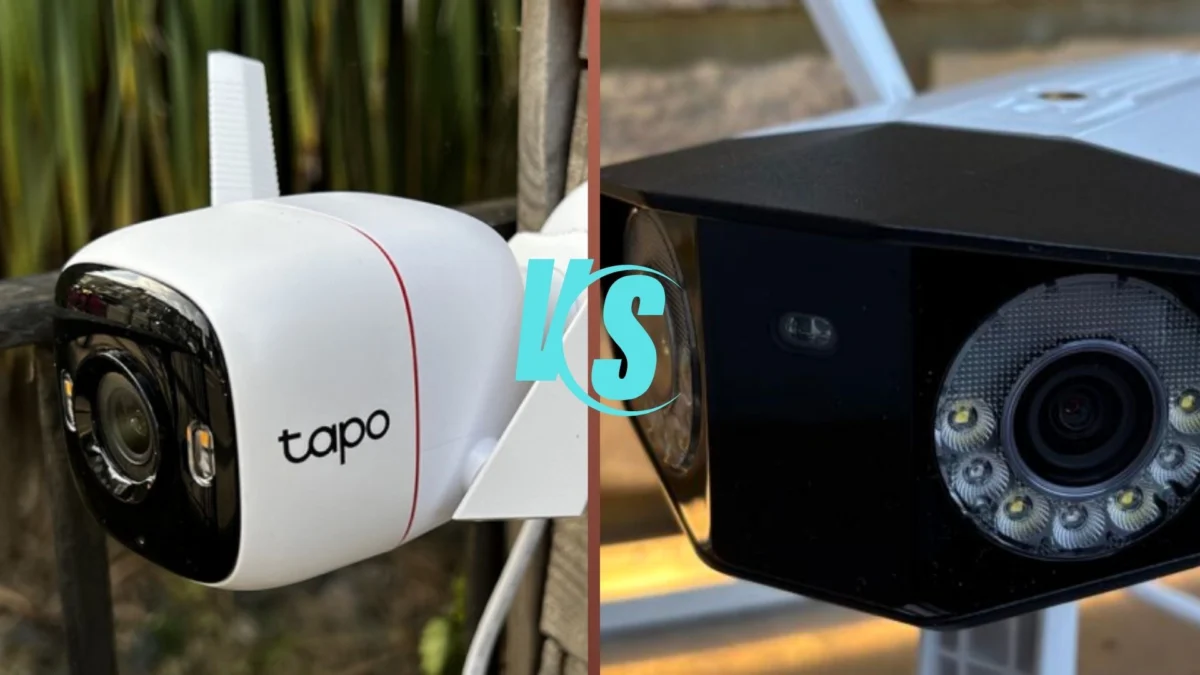
The selection process between wired and wireless security cameras often presents a fundamental misunderstanding of the term "wireless." A camera advertised as wireless may still require a power cable, while a truly wire-free camera operates solely on battery power. A third option, Power over Ethernet (PoE), uniquely transmits both power and video data through a single Ethernet cable. For clarity within this analysis, a "wired camera" will refer to those utilizing an Ethernet port for connectivity, and a "wireless camera" will denote those employing Wi-Fi. For a broader overview of tested models, consult our comprehensive guides on the best outdoor security cameras and the best smart home security cameras, which delve into real-world performance. This article addresses the overarching question: which connection type best suits your home security needs?
Understanding the Core Differences: Wired vs. Wireless vs. Wire-Free
At its heart, a wired security camera relies on a physical cable to transmit video data and, depending on the system configuration, its power supply. Modern PoE systems represent a significant advancement, consolidating both power and data transmission into a single Ethernet cable. This cable connects to a PoE switch or a Network Video Recorder (NVR), ensuring a consistent and reliable power source and network connection for the camera.
Conversely, a wireless security camera, in common parlance, typically signifies that the video transmission occurs wirelessly, usually via Wi-Fi. However, these cameras often still necessitate a power cable plugged into a standard wall outlet.
The genuinely wire-free camera is the device that operates without any attached cables during normal usage. These cameras are powered by rechargeable batteries, and some models incorporate solar panels to maintain battery charge, offering unparalleled placement flexibility.
| Camera Type | Data Transmission | Power Source | Continuous Recording Potential | Installation Complexity | Placement Limitations | Maintenance Requirements | Ideal Use Cases |
|---|---|---|---|---|---|---|---|
| Wired / PoE | Ethernet/Coax | Mains/Ethernet Cable | High (Product Dependent) | Highest | Limited by cable routing | Low | Permanent, high-security systems |
| Plug-in Wi-Fi | Wi-Fi | Mains | High (Product Dependent) | Moderate | Limited by power outlet and Wi-Fi signal strength | Low | General home use, easy DIY installations |
| Battery/Wire-Free | Wi-Fi/Cellular | Battery | Low (Typically Motion-Triggered) | Lowest | Minimal, often anywhere with Wi-Fi/cellular signal | Battery charging/replacement | Renters, hard-to-wire locations, temporary monitoring |
Cost Considerations: Beyond the Initial Purchase Price
The market offers a vast spectrum of prices across all camera types. However, it is imperative to consider the total cost of ownership, which can include necessary supporting infrastructure like servers or mandatory subscription services for cloud storage and advanced features.
For instance, a high-resolution 4K 8-megapixel RLC-810A PoE camera from Reolink is priced at approximately $99.99 in the United States. This model supports 24/7 continuous recording, motion-triggered events, and scheduled recording, with footage capable of being stored locally on a microSD card, a Reolink NVR, or an FTP server. Complementing this, Reolink offers a 24-channel RLN16-410 PoE NVR for around $459.99, representing a significant investment for a comprehensive system.
At the other end of the pricing spectrum, Arlo’s Essential 2nd Gen camera, a battery-powered outdoor model available in 2K or HD resolutions, features a 130-degree field of view, an integrated spotlight, and color night vision. Arlo currently lists this camera for sale starting at $49.99. However, to unlock advanced features such as cloud storage and AI-powered person detection, a subscription to Arlo Secure is required, with plans starting at $7.99 per month.
Ring employs a similar tiered approach. Their Outdoor Cam Battery is available from $79.99, while the more advanced Outdoor Cam Plus offers a variety of power options, including battery, plug-in, wired, solar, and PoE.
This disparity highlights the importance of looking beyond the sticker price of individual cameras. A seemingly more expensive wired camera might offer long-term cost savings if it supports local storage, thereby eliminating recurring monthly fees associated with cloud-based services.
The Uninterrupted Gaze: Wired Cameras for Continuous Recording
The fundamental advantage of a wired camera lies in its constant power supply, eliminating the need for it to enter a low-power, motion-detection-only mode. When paired with an NVR, local storage, or a suitable subscription plan, wired cameras can facilitate continuous, uninterrupted recording. This capability is invaluable for capturing events that might fall outside the parameters of a motion detection system.
Consider a scenario where an individual moves slowly across a driveway, approaches from the periphery of the frame, and pauses for an extended period. While a motion-triggered camera might capture the event, its effectiveness hinges on the accuracy and promptness of its detection system to activate recording and sustain it for the duration of the incident.
With continuous recording, the question of "did it record that?" becomes obsolete. Users can seamlessly navigate through the timeline to review events that occurred immediately before and after a specific incident, providing a complete and unfragmented record.
Battery-powered cameras, by design, prioritize power conservation. Continuous recording would rapidly deplete their batteries, leading most to operate based on short, motion-triggered clips. Exceptions do exist; some newer battery cameras can support continuous recording when connected to an external power source. The Reolink Altas, for example, is an outlier, designed with a substantial battery and solar charging capability yet supporting continuous recording. However, utilizing battery cameras for 24/7 recording significantly diminishes battery life compared to motion-activated operation.

For users whose primary requirement is the ability to review all activity within a specific timeframe, such as "I need to see everything that happened between 2 PM and 4 PM," prioritizing cameras that explicitly advertise "24/7 continuous recording" is crucial, rather than relying solely on "wireless" or "battery-powered" labels.
Installation and Placement: The Uncontested Domain of Wireless
The installation of wired cameras, particularly those requiring Ethernet cabling for outdoor placement, necessitates considerable planning and effort. Depending on the property’s layout, routing cables may involve traversing attics, running beneath eaves, penetrating exterior walls, or concealing them along existing cladding. If the desired camera location is on the opposite side of the house from the router or network infrastructure, the cable must be meticulously routed to that point.
Power over Ethernet (PoE) simplifies this process by consolidating power and data into a single cable, but it does not eliminate the physical presence of the cable itself. However, once installed, the permanence and reliability of a wired connection are key advantages. A camera discreetly mounted under a soffit with a well-hidden Ethernet run offers a robust, "set it and forget it" solution. There is no need for regular battery charging or the inconvenience of removing and replacing batteries periodically.
Wireless cameras offer a stark contrast. A plug-in Wi-Fi camera can often be installed within minutes, provided a suitable power outlet is accessible and robust Wi-Fi coverage is available. Battery-powered cameras represent the pinnacle of ease of installation: mount the camera, connect it to the accompanying mobile application, and it is ready for operation. This is particularly advantageous for renters, where permanent Ethernet cable installations may require landlord permission or be deemed impractical.
Furthermore, wireless cameras excel in challenging locations. Detached garages, sheds, gates, or temporary surveillance points can be difficult to wire effectively. A battery-powered camera resolves these issues without transforming a straightforward camera installation into an extensive cabling project. The trade-off for this ease of installation is the necessity of ongoing battery maintenance.
Latency and Performance: The Wired Advantage in Real-Time Monitoring
While modern Wi-Fi cameras can exhibit impressive responsiveness, wired connections inherently possess an advantage when dealing with live video feeds and rapidly moving subjects. This stems from the absence of factors that can introduce delay in wireless transmission, such as Wi-Fi signal strength fluctuations, wireless interference from other devices, or competing network traffic.
This difference becomes palpable when an object moves swiftly across the camera’s field of view. Consider a vehicle reversing into a driveway or an individual jogging past a camera. A camera that is continuously powered and connected can react and begin recording instantaneously. In contrast, a battery-powered camera may first need to exit a low-power state before initiating video capture, potentially resulting in missed frames or an incomplete record of the event.
It is crucial to note that a wired connection does not automatically guarantee superior video quality. The performance of the camera’s sensor remains a primary determinant of image clarity, irrespective of the connection method. Similarly, resolution plays a significant role; a $100 wired 1080p camera will not inherently outperform a high-quality 4K wireless model. The true advantage of wired systems lies in their consistency—they are best suited for environments where the camera is expected to be perpetually active, connected, and recording.
Network Interruption: Data Storage is Key
Regardless of whether a security camera is wired or wireless, its ability to record footage during an internet outage hinges entirely on its data storage mechanism. If the camera relies solely on cloud storage, a loss of internet connectivity will render it incapable of recording. However, cameras equipped with local storage (e.g., microSD card) or those that save footage to an on-premises server will continue to capture video even when the internet connection is disrupted. Therefore, the distinction between "wired" and "wireless" is less critical in this context than the camera’s inherent recording capabilities.
Informed Decision-Making: Choosing the Right Connection for Your Needs
The ultimate decision between wired and wireless security cameras is contingent upon individual requirements and priorities.
For those prioritizing the most reliable and consistent connection, wired cameras offer a distinct advantage. The ease of running Ethernet cables to camera locations provides a robust, interference-free connection with minimal latency, resulting in optimal performance for live viewing and continuous recording.
Plug-in Wi-Fi cameras represent a compelling middle ground, offering a simpler DIY installation process without the need for extensive Ethernet cabling. They benefit from a continuous power supply, negating battery management concerns, and allow for relatively easy repositioning compared to fully wired systems. This option strikes a balance between ease of setup and reliable, uninterrupted power.
For individuals seeking the utmost flexibility in placement and a genuinely cable-free installation, battery-powered cameras are the ideal choice. These are particularly well-suited for locations lacking convenient power outlets, such as sheds, gates, detached garages, and certain rented properties. However, it is essential to understand that battery-powered cameras typically do not support 24/7 continuous recording. Their operation is primarily based on motion-triggered recording, and battery life is heavily influenced by the frequency of motion events within the camera’s view.
Verdict: Balancing Reliability with Convenience
Wired security cameras provide an unparalleled level of connection stability and reliability, but their installation can be complex and time-consuming. For the majority of homeowners, a wireless camera solution often strikes the right balance between functionality and convenience. When evaluating options, prioritizing cameras with a mains power connection, whether plug-in Wi-Fi or PoE, eliminates the ongoing burden of battery management. However, for those who prioritize ultimate ease of installation and maximum flexibility, battery-powered cameras offer a compelling solution, provided their limitations regarding continuous recording are understood and accepted. The "best" choice is ultimately a personalized one, dictated by a careful assessment of security needs, installation capabilities, and desired maintenance levels.

