
Nearly four years after the groundbreaking launch of ChatGPT and a few months later for its counterpart Claude, the digital landscape is still grappling with a significant data gap: understanding the intricacies of consumer prompts and the response methodologies employed by these powerful generative AI platforms. Until recently, the primary avenue for inferring user interactions with AI has been through the analysis of traditional search query data. However, a recent revelation from Google, confirmed by its own Search Engine Optimization (SEO) expert, John Mueller, indicates that Google’s AI Mode is now meticulously recording initial and follow-up prompts as search queries within Google Search Console, offering an unprecedented window into user engagement with AI.
The scarcity of direct data on generative AI prompts and platform responses has been a persistent challenge for SEO professionals, marketers, and researchers alike. While platforms like Bing have made strides in AI transparency by explicitly reporting "Grounding Queries" that lead to "fan out" responses, the broader ecosystem has largely remained opaque. This lack of direct insight has necessitated a reliance on indirect methods, primarily by analyzing search query logs to infer the nature of user interactions with AI tools. The assumption has been that if a user is interacting with an AI, their queries might manifest in traditional search in a way that reflects their AI engagement.
A significant shift in this understanding has emerged with the confirmation that Google’s own AI integration, specifically within its AI Mode, is now classifying these AI-driven interactions as search queries within Search Console. This crucial piece of information was brought to light by Anastasia Kourou, an SEO Manager at Relevance Digital Agency based in Greece. Ms. Kourou, observing unusual query patterns in Search Console, such as simple affirmative responses like "yes" and "yes, pricing," took to LinkedIn to seek clarification. She directly tagged John Mueller, a prominent figure in Google’s Search team, posing the question about why these seemingly conversational and often incomplete phrases were being categorized as search queries.
Mr. Mueller’s response was definitive and illuminating. He confirmed that these entries in Search Console were indeed indicative of follow-up prompts from users engaging with Google’s AI Mode. This confirmation validates the observation that the platform is capturing these conversational exchanges, effectively treating them as a new form of search behavior. This development is monumental because it opens up a previously inaccessible dataset for analysis, allowing for a more granular understanding of how users interact with AI through search.

Navigating the New Frontier: Identifying AI Prompts in Search Console
The implications of Google’s AI Mode recording prompts as search queries are far-reaching, particularly for SEO professionals tasked with understanding user intent and optimizing content for discoverability. The challenge now lies in effectively identifying and leveraging this new data stream. Search Console, a primary tool for website owners to monitor their site’s performance in Google Search, is the key to this endeavor.
Utilizing Regular Expressions for Prompt Detection
One of the most effective methods for sifting through the vast amount of data in Search Console and isolating potential AI prompts is through the strategic use of regular expressions (regex). Regex provides a powerful way to define patterns within text, allowing for sophisticated filtering of search queries. To begin this process, users can navigate to the "Performance" section of Search Console, then select "Add filter." From there, they should choose "Query" and then "Custom (regex)."
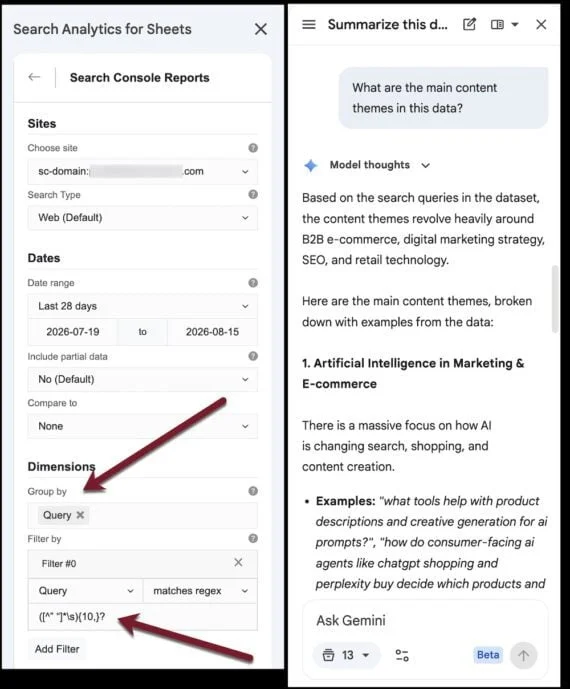
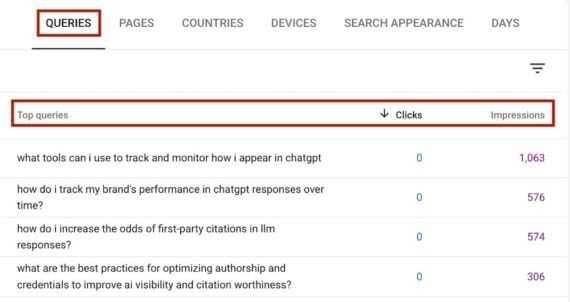
A foundational regex pattern that has proven useful in identifying longer, more conversational queries – often characteristic of AI prompts – is: ([^" “]*s)10,?. This pattern is designed to capture queries that consist of ten or more words, separated by spaces. By applying this filter, users can uncover queries that are significantly longer and more descriptive than typical short-tail search terms. These longer queries often resemble natural language questions or instructions, which are hallmarks of how users interact with generative AI.
The visual output of applying such a regex filter in Search Console typically reveals a list of queries with a high number of impressions but often with zero clicks. This pattern is significant because it suggests that the user is not necessarily clicking through to a website in the traditional sense. Instead, they might be receiving a direct answer or a summary from the AI, rendering a click-through unnecessary. Examples of such queries might include phrases like "what tools can I use to track and monitor how I appear in ChatGPT" or detailed requests for information that an AI would be well-suited to synthesize.
Beyond this initial regex, SEO strategist Jean-Christophe Chouinard, an SEO Strategist at Tripadvisor, has proposed a more refined regex. This advanced pattern aims to capture not only initial, longer prompts but also the subsequent, often shorter, follow-up prompts that are characteristic of a conversational AI interaction. This includes phrases like "yes, please" or "tell me more," which, when viewed in isolation, might seem insignificant but, in the context of a prior AI interaction, provide crucial information about user engagement depth and intent. The development of these specialized regex patterns underscores the evolving nature of SEO and the need for adaptive analytical techniques.
Leveraging External Tools for Deeper Analysis
While Google Search Console’s interface offers valuable filtering capabilities, its front-end limitations can be overcome by utilizing its API. The Search Console API provides access to a richer dataset than what is readily available through the user interface. To harness this extended data without requiring custom development, third-party tools have emerged as indispensable resources. These tools offer a more comprehensive view of search performance, including the ability to analyze query lengths and patterns more effectively.
The primary benefit of these external tools lies in their ability to process and present Search Console data in more advanced ways. They often provide sophisticated filtering options, advanced analytics, and robust export capabilities, making it easier to identify and analyze patterns that might otherwise be missed. While the use of third-party tools necessitates sharing confidential website data, the advantages in terms of data depth and analytical features often outweigh this concern for many organizations.
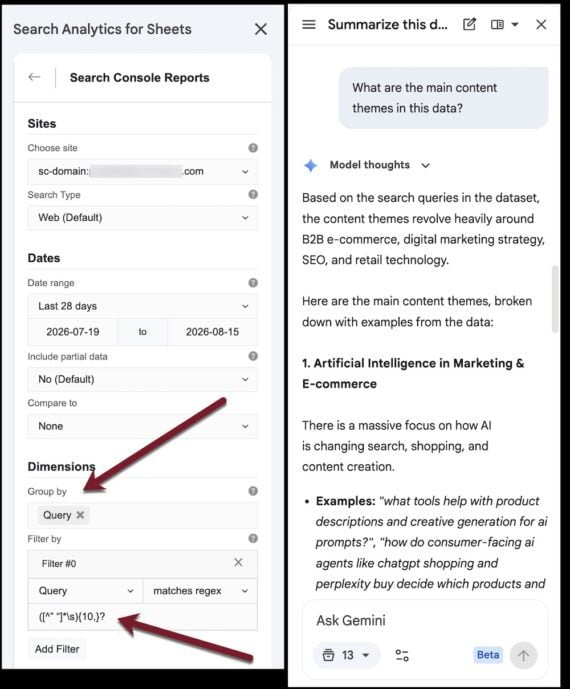
Among the readily available and free tools that facilitate this enhanced analysis are "Search Analytics for Sheets" and "Google Sheets" themselves, integrated with the Search Console API. "Search Analytics for Sheets," for instance, allows users to export their Search Console data directly into Google Sheets. This integration enables the application of complex regex filters within a familiar spreadsheet environment. The image accompanying this analysis showcases the sidebar of "Search Analytics for Sheets," demonstrating how queries can be filtered by length using regex. Crucially, this tool can also work in conjunction with AI-powered features within Google Sheets, such as Gemini, to summarize the resulting query data into thematic content areas. This allows for a more intuitive understanding of the topics and types of questions users are posing to AI systems.
Applying the Data for Strategic Optimization
The data emerging from Search Console, even with its current limitations, offers valuable insights for content creators and SEO strategists. While Search Console does not explicitly label queries as "AI prompts," the linguistic characteristics of these queries often make their origin discernible. Long, detailed, and conversational phrasing is a strong indicator.
It is important to note that some long queries might not originate from direct user interaction with AI but could be generated by prompt-tracking software used by competitors. However, even this indirect data is valuable, as it reveals what competitors are monitoring and how they are attempting to understand AI-driven search behavior. This information can inform competitive analysis and strategy.
The nature of AI prompts is typically characterized by their uniqueness and detail. They often fall outside conventional search categories and metrics, posing a new challenge for traditional SEO optimization tactics. The process of interpreting and applying this data is still in its nascent stages, but several key considerations are emerging:
- Understanding User Intent at a Deeper Level: By analyzing the specific wording of AI prompts, businesses can gain a more nuanced understanding of what users are truly seeking. This goes beyond keyword analysis to grasp the underlying intent, context, and desired outcome. For example, a prompt like "explain the ethical implications of using AI in healthcare for a layperson" reveals a specific need for simplified, ethically-focused information.
- Content Strategy Refinement: The insights gleaned from AI prompts can directly inform content creation. If users are consistently asking AI detailed questions about a particular topic, it signifies an unmet need for comprehensive, accessible content on that subject. This data can guide the development of in-depth articles, FAQs, explainer videos, and other content formats designed to directly address these user inquiries.
- Optimizing for Conversational Search: As AI becomes more integrated into search, the emphasis is shifting towards conversational and natural language queries. Websites that can answer questions in a clear, concise, and conversational manner are likely to perform better. This means optimizing not just for keywords but for the way users ask questions.
- Identifying Emerging Topics and Trends: The types of questions users pose to AI can highlight emerging trends and areas of interest that might not yet be fully reflected in traditional search data. By monitoring these prompts, businesses can gain a competitive edge by being early adopters and content creators in nascent fields.
- Enhancing User Experience: By understanding the detailed questions users are asking AI, businesses can proactively provide answers and information on their own platforms. This can lead to a more seamless and satisfying user experience, as users can find the information they need quickly and efficiently, whether through direct AI interaction or by visiting a well-optimized website.
The confirmation that Google Search Console is now capturing AI Mode prompts as search queries marks a pivotal moment in our understanding of human-AI interaction within the search ecosystem. While the tools and methodologies for analyzing this data are still evolving, the potential for gaining unprecedented insights into user behavior, content needs, and emerging trends is immense. As this new era of AI-driven search unfolds, the ability to effectively interpret and act upon this data will become an increasingly critical component of digital strategy. The journey to fully understand and leverage these AI interactions has just begun, and the insights gleaned from tools like Search Console will be instrumental in navigating this transformative landscape.

