
The landscape of digital interaction has been fundamentally reshaped by the rapid ascent of generative artificial intelligence (AI). Since the public debut of ChatGPT nearly four years ago, and Claude following suit a few months later, these advanced AI models have transitioned from novelties to integral tools for millions. However, a significant data void has persisted, leaving marketers and SEO professionals with limited insight into the specific prompts users employ to interact with these platforms and the intricate methodologies through which these AI models formulate their responses. This opacity has necessitated a reliance on traditional search query data, forcing inferences about generative AI interactions through established search engine metrics.
A notable exception to this data scarcity has been Bing, which, in its pursuit of AI transparency, began reporting the "Grounding Queries"—the prompts that initiate and guide its "fan out" responses. This initiative provided a crucial, albeit singular, window into AI-driven user behavior. Yet, recent developments indicate a significant shift in how Google is capturing and presenting this data, offering a new frontier for SEO intelligence. It has now been confirmed that Google’s AI Mode actively records both initial and follow-up prompts as discernible search queries within its Search Console.
This revelation, brought to light by Anastasia Kourou, SEO Manager for Greece-based Relevance Digital Agency, marks a pivotal moment for understanding AI-driven search. Kourou observed an anomaly in her Search Console data: seemingly conversational, short-phrase queries like "yes" and "yes, pricing" appearing alongside traditional search terms. Puzzled by their inclusion and lack of typical search intent, she reached out to Google’s John Mueller on LinkedIn for clarification. Mueller’s response confirmed that these were indeed follow-up prompts from users engaging with Google’s AI Mode, thereby validating the presence of AI interaction data within Search Console. This confirmation has profound implications for how SEO professionals can now approach keyword research, content optimization, and competitive analysis in an AI-augmented search environment.
Identifying AI-Generated Prompts: The Power of Regex in Search Console
The ability to identify these AI-driven prompts within the vast dataset of Search Console opens up new avenues for strategic SEO. Traditionally, Search Console data has been invaluable for understanding how users find websites through organic search. Now, it offers a glimpse into how users are interacting with AI, a critical component of the evolving search ecosystem. The challenge lies in effectively isolating these AI prompts from conventional search queries, which often exhibit different characteristics.
To address this, SEO professionals can leverage the power of regular expressions (regex) within Search Console’s performance reporting. Regex provides a sophisticated method for filtering and identifying patterns within text data. By applying specific regex patterns to the "Query" filter, users can effectively pinpoint longer, more conversational, and often grammatically unconventional phrases that are indicative of AI prompts.

The initial step involves navigating to the "Performance" section of Search Console, followed by selecting "Add filter." Within the filter options, users choose "Query" and then select "Custom (regex)." A foundational regex pattern that can be employed to identify longer queries, often characteristic of AI prompts, is:
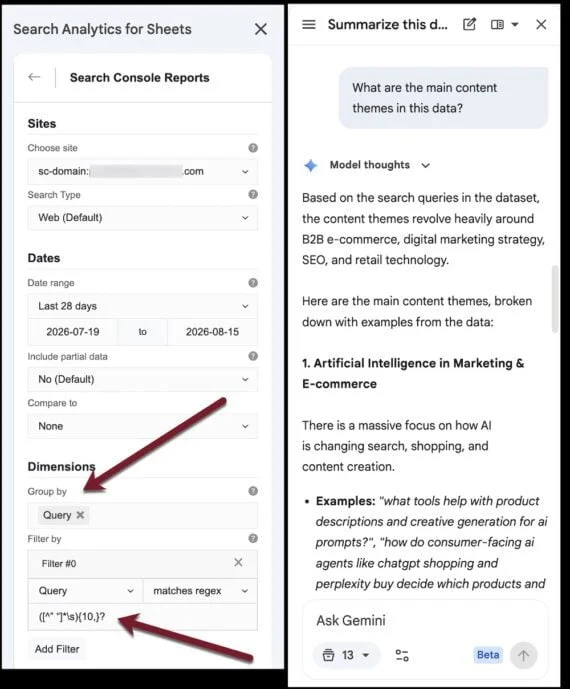
([^'"]*s)10,?
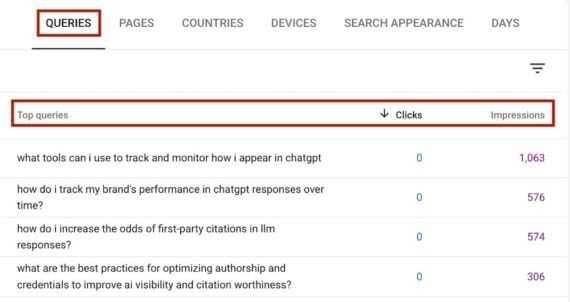
This regex is designed to identify queries containing at least ten words, separated by spaces. The rationale is that AI prompts, particularly those that are more detailed or conversational, tend to be longer and more descriptive than many traditional search queries. For instance, a prompt like "what tools can I use to track and monitor how I appear in chatgpt" is significantly longer and more complex than a typical keyword search such as "SEO tools."
Upon applying this regex, Search Console will display a list of queries that match the pattern. These will often appear as long, detailed phrases, sometimes with zero clicks but a substantial number of impressions. This characteristic—high impressions with low clicks—can be a strong indicator of an AI interaction. The impressions might stem from the AI model processing the prompt and generating a response that is then displayed to the user, even if the user doesn’t directly click through to a specific website from that AI-generated summary.
The utility of regex extends beyond simple length filtering. SEO strategists are developing more nuanced regex patterns to capture a wider spectrum of AI prompt behaviors. For example, Jean-Christophe Chouinard, an SEO strategist at Tripadvisor, has shared more advanced regex expressions. These sophisticated patterns can account for follow-up prompts, which are often shorter and more direct responses to the AI’s initial output. Examples of such follow-up prompts include "yes, please," "tell me more," or even simple affirmative or clarifying phrases. Identifying these follow-up prompts is crucial for understanding the iterative nature of user engagement with AI.
Leveraging External Tools for Deeper AI Prompt Analysis
While Search Console provides direct access to query data, its front-end interface has limitations in terms of advanced filtering and data export. For deeper analysis of AI prompt data, the Search Console API offers a more comprehensive data stream. However, accessing and manipulating this data directly through the API often requires technical expertise or the involvement of a developer.
Recognizing this challenge, a variety of third-party tools have emerged to bridge this gap. These external platforms provide user-friendly interfaces for accessing and analyzing Search Console data, including AI-related prompts, without the need for custom coding. While the use of such tools involves sharing confidential Search Console data with a third party, the benefits—including enhanced data visualization, advanced filtering capabilities, and easy export options—can significantly outweigh this consideration for many SEO professionals.
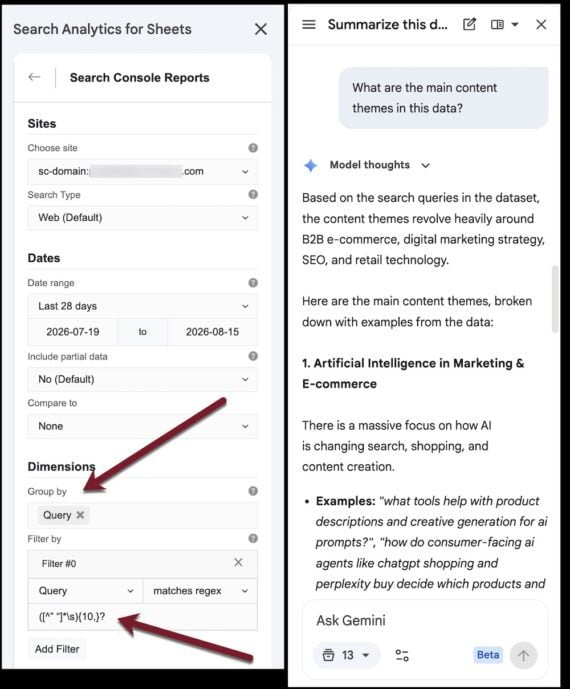
Among the readily available and often free tools, "Search Analytics for Sheets" stands out. This particular tool integrates directly with Google Sheets, allowing users to export their Search Console data into a familiar spreadsheet format. Once the data is in Sheets, users can then apply various analytical techniques, including the regex patterns discussed earlier, to filter and segment their queries. This process enables a more granular examination of query lengths, conversational patterns, and other characteristics indicative of AI prompts. The visual representation of data in Google Sheets, combined with the filtering capabilities, makes it easier to identify trends and anomalies that might be missed in the standard Search Console interface.
The integration of these tools with AI capabilities themselves is also becoming more prevalent. For example, some platforms can now analyze the exported Search Console data and, using AI, summarize content themes derived from identified prompts. This is particularly valuable for understanding the underlying intent and subject matter that users are exploring through AI interactions. The visual accompaniment often shows a sidebar in Google Sheets, allowing users to filter queries by length using regex, alongside a Gemini panel that summarizes the resulting query data into content themes. This exemplifies the synergy between data analysis tools and generative AI, creating a feedback loop for SEO strategy.
Applying AI Prompt Data for Strategic SEO Optimization
The influx of AI prompt data into Search Console, though not explicitly labeled as such, presents a significant opportunity for SEO professionals. While Google does not yet provide a definitive flag for "AI prompt" queries, the linguistic patterns and conversational nature of these phrases often make them discernible. The key lies in interpreting this data and applying it to actionable optimization tactics.
One of the primary observations is that these AI prompts are typically detailed, unique, and do not conform to traditional, short-tail keyword categories. They often represent complex questions, nuanced requests for information, or conversational exchanges. This distinction is vital for understanding user intent in an AI-driven search environment.
Consider the implications for content strategy. If Search Console reveals a pattern of long, detailed prompts related to a specific topic, it suggests that users are seeking comprehensive and in-depth information from AI. This can inform the creation of long-form content, detailed guides, FAQs, and even conversational chatbot scripts that directly address these complex queries. Websites that can provide thorough, well-structured answers to these AI-generated questions are likely to be favored in AI-driven search results.
Furthermore, the presence of some long queries with high impressions and zero clicks, even if they appear to originate from prompt-tracking software rather than direct human interaction, offers valuable competitive intelligence. If competitors or other entities are monitoring how they appear in AI responses, this data can reveal their areas of interest and strategic focus. Understanding what aspects of your online presence are being scrutinized by AI can inform your own competitive analysis and help you identify potential gaps or areas for improvement.
The application of this data can be multifaceted:
- Content Gap Analysis: By identifying AI prompts that your existing content does not adequately address, you can pinpoint content gaps and opportunities for creating new, relevant material. This is particularly important for complex or niche topics where user queries become highly specific.
- Refining Content for Conversational Search: As AI models become more sophisticated, search queries are increasingly becoming conversational. Analyzing AI prompts can help businesses understand the language and structure of these conversations, enabling them to optimize their content to sound more natural and responsive.
- Understanding User Journey Nuances: Short, follow-up prompts like "yes, please" or "tell me more" indicate an ongoing interaction. Analyzing sequences of prompts can reveal more about the user’s journey and their evolving information needs as they engage with AI. This can help in mapping out more comprehensive user flows and anticipating subsequent questions.
- Competitive Benchmarking: The insight into what aspects of a website or brand are being queried by AI, even indirectly through third-party tracking, provides a unique form of competitive intelligence. It can highlight areas where competitors are focusing their AI-driven information gathering.
- Improving Structured Data: While not directly addressed by the current prompt analysis, understanding the nature of AI queries can indirectly inform the creation and optimization of structured data. Richer, more comprehensive structured data can help AI models better understand and utilize website content in their responses.
The Evolving Landscape of Search and AI
The confirmation that Google’s Search Console is now capturing AI Mode prompts as search queries marks a significant evolutionary step in SEO. It moves beyond inferring AI interactions to directly observing them, albeit through the lens of existing search data structures. This development is not merely an incremental change; it signifies a fundamental shift in how search engines are integrating and reporting on AI-driven user behavior.
The timeline of these advancements is rapid. Generative AI tools like ChatGPT and Claude have only been publicly accessible for a few years, yet they have already profoundly impacted how people seek and consume information. The initial lack of transparency from major search engines like Google regarding AI interactions created a blind spot for the SEO industry. Bing’s proactive approach to "Grounding Queries" offered a partial solution, but the broader implications of Google’s data capture are far more extensive due to its dominant market share.
The confirmation from John Mueller, a prominent figure at Google, lends significant weight to this revelation. His acknowledgment validates the observations made by SEO professionals like Anastasia Kourou and underscores the importance of this data for the future of search engine optimization. The ongoing work by individuals like Jean-Christophe Chouinard in developing more sophisticated regex patterns demonstrates the industry’s rapid adaptation to this new paradigm.
The broader impact of this increased transparency is substantial. For businesses, it means an opportunity to gain a deeper understanding of user intent in an AI-augmented world. For SEO professionals, it necessitates a re-evaluation of keyword research, content creation, and analytical methodologies. The ability to identify and interpret AI prompts will become a critical skill, allowing for more targeted and effective optimization strategies. As AI continues to evolve and integrate more deeply into search, the data available through tools like Search Console will become an indispensable resource for navigating this complex and dynamic digital landscape. The era of understanding AI-driven search interactions has truly begun, and the insights gleaned from these prompts will shape the future of online visibility and engagement.

