
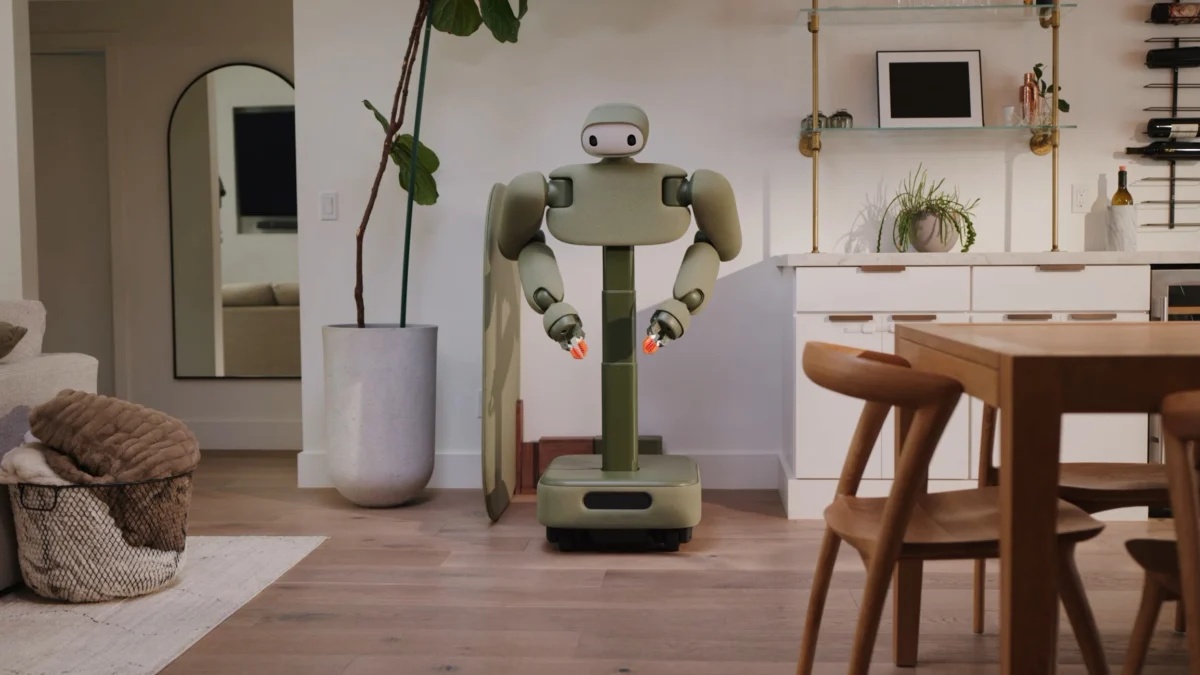
San Francisco, CA – Weave Robotics has officially commenced pre-orders for its groundbreaking home robot, the Isaac 1, a sophisticated machine engineered to tackle the perennial chores of laundry and daily tidying through an intuitive companion mobile application. This marks a significant advancement in the nascent field of domestic robotics, aiming to alleviate household burdens for consumers. The company, headquartered in San Francisco, has adopted a comprehensive, full-stack development approach for the Isaac 1, meticulously designing its own actuators, remote actuation systems, and crucial safety mechanisms, eschewing the common industry practice of adapting pre-existing robotic hardware. This commitment to in-house engineering extends to the robot’s distinctive physical architecture.
The Isaac 1 features a robust internal structure that provides its fundamental form, complemented by swappable, soft fabric shells. These interchangeable exteriors not only contribute to passive safety by cushioning potential impacts but also allow for aesthetic customization, enabling the robot to blend seamlessly into diverse home décors. Functionally, the Isaac 1 possesses a collapsible torso that extends to human-like height when performing tasks, retracting discreetly when idle. Integrated physical indicators within its design clearly communicate the robot’s operational status, distinguishing between active and powered-off modes. The robot’s stability during operation is maintained by a wheeled base, ensuring it remains steady while executing its assigned duties. Equipped with two articulated arms, each boasting six degrees of freedom, and a versatile neck and torso with two axes of motion, the Isaac 1 demonstrates an impressive reach, capable of extending up to 80 inches vertically and 38 inches horizontally, allowing it to access a wide range of household areas.
Core Capabilities and Everyday Application
The Isaac 1 is designed to address two primary functional domains: Laundry Flow and Daily Reset. The Laundry Flow system is engineered to autonomously locate, collect, and neatly fold dirty clothes, as well as manage loaded laundry hampers. This feature aims to automate a traditionally time-consuming and often tedious household chore. Simultaneously, the Daily Reset capability focuses on tasks such as making beds and returning misplaced items like toys, shoes, and general clutter to their designated locations, thereby promoting a consistently organized living environment.
The operational paradigm for Isaac 1 is designed for autonomous execution by default. However, to ensure task completion and address unforeseen complexities, the system incorporates a teleoperation fallback mechanism. This allows for remote human assistance when required, providing a safety net for the robot’s functionality. Users will interact with and control the Isaac 1 via a dedicated smartphone companion application. This app will enable on-demand task initiation or the scheduling of chores for specific times, offering flexibility whether users are at home or away. This remote control capability underscores the integration of the robot into a connected home ecosystem.
Market Entry and Pricing Strategy
Weave Robotics has adopted a tiered pricing strategy for the Isaac 1, reflecting different consumer preferences and financial models. The robot is available through a monthly subscription plan priced at $449. Alternatively, a one-time upfront purchase option is offered at $7,999. For consumers interested in securing an early unit, pre-orders are currently open, requiring a fully refundable deposit of $250. This refundable deposit strategy aims to gauge market interest and secure early adopters while mitigating financial risk for potential buyers.
The company has outlined a phased rollout plan for the Isaac 1. Initial deliveries are slated to commence in the autumn of 2026, exclusively for customers located in California. This targeted initial launch will allow Weave Robotics to refine logistics, gather customer feedback, and address any operational challenges in a concentrated geographic area before expanding. Following this initial phase, broader availability across the United States is anticipated to begin in 2027, signaling a significant step towards wider consumer adoption of advanced home robotics.
Context and Background: The Evolving Landscape of Home Robotics
The introduction of Isaac 1 arrives at a pivotal moment in the development of domestic robotics. While robotic vacuum cleaners and lawnmowers have achieved widespread consumer acceptance, more complex, multi-functional robots capable of interacting with and manipulating objects in a dynamic home environment have remained largely in the realm of research and development or prohibitively expensive niche markets. Companies like Amazon with its Astro robot, and various startups, have been exploring this frontier, but the challenge of creating robots that are safe, reliable, affordable, and genuinely useful for everyday chores has proven formidable.
Weave Robotics’ full-stack approach is a noteworthy departure from many competitors who often rely on off-the-shelf components. By developing proprietary actuators, actuation systems, and safety protocols, Weave Robotics appears to be aiming for a higher degree of integration and control over the Isaac 1’s performance and safety features. This vertical integration can lead to more optimized hardware-software interactions and potentially a more robust and reliable product, though it also carries the inherent risks and costs associated with developing entirely new technologies. The company’s emphasis on passive safety through soft fabric shells also suggests a design philosophy prioritizing human-robot coexistence in shared living spaces.
The history of home robotics has been a narrative of incremental progress, punctuated by ambitious visions that sometimes outpaced technological feasibility. Early attempts at household robots in the late 20th century often struggled with navigation, manipulation, and affordability. The recent surge in AI and machine learning advancements, coupled with improvements in sensor technology and robotic manipulation, has reignited interest and accelerated development. Weave Robotics’ focus on specific, high-impact tasks like laundry and tidying, rather than aiming for a general-purpose humanoid robot from the outset, is a pragmatic strategy that could lead to more tangible user benefits sooner.
Chronology of Development and Launch
While specific dates for the initial conceptualization and early development phases of Isaac 1 are not publicly detailed in the announcement, the company’s current pre-order phase signifies the culmination of a significant development cycle. The timeline provided by Weave Robotics indicates:
- Present: Pre-orders are open, with a $250 refundable deposit.
- Autumn 2026: Initial deliveries commence for customers in California. This period will likely involve extensive testing, user feedback collection, and logistical fine-tuning.
- 2027: Broader availability across the United States is planned. This phase will see the expansion of manufacturing, distribution, and customer support networks.
The YouTube video embedded in the original announcement, titled "Launching Isaac 1: our most capable home robot," suggests a formal unveiling and marketing push around this pre-order period, acting as a critical moment in their product launch strategy.
Supporting Data and Market Potential
The market for domestic robots is projected for substantial growth. According to various market research reports, the global home robots market is expected to expand significantly in the coming years, driven by factors such as increasing disposable incomes, a growing demand for convenience and automation, and advancements in AI and robotics technology. While precise figures vary, estimates often project the market to reach tens of billions of dollars by the end of the decade.
The specific segment of robots designed for chores like laundry and tidying represents a largely untapped market. The sheer volume of time dedicated to these tasks globally suggests a significant potential demand if the technology can deliver on its promises effectively and affordably. For instance, a study by the OECD found that women, on average, spend significantly more time on unpaid domestic work than men, highlighting a demographic that could particularly benefit from such automation. If Isaac 1 can demonstrably reduce the time and effort households spend on these chores, its value proposition becomes compelling.
The subscription model adopted by Weave Robotics is a strategy increasingly seen in the consumer electronics and technology sectors. It lowers the initial barrier to entry for consumers, making a high-ticket item like a sophisticated robot more accessible. This model also provides a recurring revenue stream for the company, which can be used for ongoing software development, maintenance, and customer support, crucial for a product that will likely require continuous updates and service.
Official Statements and Industry Reactions (Inferred)
While direct statements from competitors or industry analysts are not provided in the original article, the launch of Isaac 1 is likely to generate considerable interest and potentially reactions from other players in the robotics and smart home industries. Companies that have invested in similar domestic automation technologies will undoubtedly be monitoring Weave Robotics’ progress closely.
Weave Robotics’ own statement, as conveyed through the article, emphasizes their innovative approach and commitment to a full-stack development. The company’s clear articulation of Isaac 1’s capabilities—laundry handling and daily tidying—suggests a strategy focused on delivering concrete, tangible benefits rather than abstract promises of future functionality. The company’s confidence in its proprietary systems is a key message, positioning them as innovators rather than followers in the home robotics space.
Industry analysts might offer perspectives on the viability of the pricing model, the effectiveness of the autonomous versus teleoperation system, and the long-term reliability and maintenance needs of such a complex machine. Questions may arise regarding the robot’s ability to handle the vast diversity of clothing types, laundry conditions, and home layouts encountered in real-world scenarios. Furthermore, the competitive landscape, which includes both established tech giants and emerging startups, will likely see increased activity in this segment as the potential of domestic robotics becomes clearer.
Broader Impact and Implications
The successful widespread adoption of a robot like Isaac 1 could have profound implications for household management and labor division. It has the potential to:
- Reclaim Time: By automating time-consuming chores, Isaac 1 could free up significant hours for individuals and families, allowing for more leisure, professional development, or family engagement.
- Alleviate Physical Strain: Laundry and tidying can involve bending, lifting, and repetitive motions, which can be physically taxing. A robot performing these tasks could reduce the physical burden, particularly for the elderly or those with mobility issues.
- Transform Household Dynamics: The division of domestic labor has long been a societal issue. If robots can effectively manage these tasks, it could lead to a renegotiation of roles and responsibilities within households, potentially promoting greater equity.
- Drive Technological Innovation: The demand for and success of Isaac 1 could spur further investment and innovation in areas such as advanced manipulation, human-robot interaction, and home automation AI, accelerating the development of even more capable domestic robots.
- Raise New Ethical and Societal Questions: As robots become more integrated into our homes, questions about data privacy, job displacement (in domestic help sectors), and the impact on human skills and social interaction will become increasingly relevant.
The development and rollout of Isaac 1 represent a significant step in the ongoing quest to bring advanced robotics into the everyday lives of consumers. Its success will depend not only on its technological prowess but also on its ability to deliver consistent, reliable, and valuable assistance in a way that resonates with the practical needs and financial realities of households. The coming years will be critical in determining whether Isaac 1 fulfills its promise of ushering in a new era of home automation.

