
The modern web development landscape is currently undergoing a significant shift as browser engines achieve unprecedented levels of feature parity and standardization. For years, developers have relied on a massive ecosystem of npm packages to fill gaps in browser functionality—tasks ranging from date formatting and HTTP requests to complex UI behaviors like focus trapping and modal management. However, recent data from the WebDX Community Group and major browser vendors suggests that a substantial portion of these external dependencies may now be redundant. Industry experts estimate that a typical mid-sized JavaScript application currently carries between 60KB and 90KB of minified and gzipped code that could be entirely replaced by native browser APIs. As the "Baseline" initiative gains traction, the technical necessity of maintaining these "zombie dependencies" is being called into question, prompting a movement toward leaner, platform-first development.
The Rise of the Baseline Standard
The move toward native features is spearheaded by the Baseline initiative, a collaborative project involving the WebDX Community Group, including representatives from Google, Apple, Mozilla, and Microsoft. Baseline was established to provide developers with clear, non-ambiguous information about which web features are safe to use across all major engines: Chrome, Edge, Firefox, and Safari.
A feature is categorized into one of two primary states. "Newly Available" refers to features that have recently become supported across all major engines, while "Widely Available" describes features that have been supported for at least 30 months. This 30-month buffer is critical for developers, as it represents the point at which a feature can typically be used without polyfills for the vast majority of global users. This standardization effort addresses a long-standing grievance in the developer community: the "Can I Use" fatigue, where checking browser compatibility for every small feature became a bottleneck in the development cycle.
The Hidden Cost of Dependency Bloat
While the installation of an npm package like Axios or Lodash is often seen as a low-cost convenience, the cumulative impact on performance and security is significant. Every dependency added to a package.json file increases the surface area for security vulnerabilities, requires ongoing maintenance, and adds to the total bundle size that a user must download and parse.

In mobile-first markets, where network conditions can be volatile and device processing power is limited, an extra 90KB of gzipped JavaScript—which can expand to nearly 300KB of uncompressed code—can add seconds to the "Time to Interactive" (TTI) metric. By auditing dependencies against modern Baseline features, organizations can reduce their carbon footprint, improve SEO rankings through better Core Web Vitals, and simplify their build pipelines.
Chronology of Platform Convergence: 2022–2026
The timeline of browser feature releases over the last few years illustrates how rapidly the platform has evolved.
- 2022: The
<dialog>element reached broad cross-browser support, providing a native way to handle modals and focus management. - 2023:
Object.groupByandMap.groupBywere introduced to the ECMAScript specification, followed by rapid implementation in engines, rendering several Lodash utilities obsolete. - 2024: The Popover API and advanced
Setmethods (union, intersection, difference) became "Newly Available," offering native alternatives to complex UI libraries and manual data manipulation. - 2025:
Intl.DurationFormatachieved support across major engines, completing theIntlsuite for internationalization. - 2026: CSS Anchor Positioning is slated to become a cornerstone of the platform, potentially replacing heavy positioning libraries like Popper.js and Tippy.js.
Cluster 1: The Internationalization (Intl) Revolution
The Intl namespace has arguably become the most powerful tool for reducing bundle size. Historically, libraries like moment.js, numeral.js, and timeago.js were essential for creating user-friendly interfaces. Today, the native Intl API handles these tasks with superior performance and built-in localization data.
For example, Intl.RelativeTimeFormat allows developers to convert timestamps into human-readable strings like "3 days ago" or "in 2 weeks" without an external library. Similarly, Intl.NumberFormat supports currency, percentages, and compact notations (e.g., "1.2M" instead of "1,200,000") across dozens of locales. The data suggests that migrating from a suite of internationalization libraries to the native Intl API can save approximately 14KB gzipped in a standard application.
Cluster 2: Networking and the Fetch API Evolution
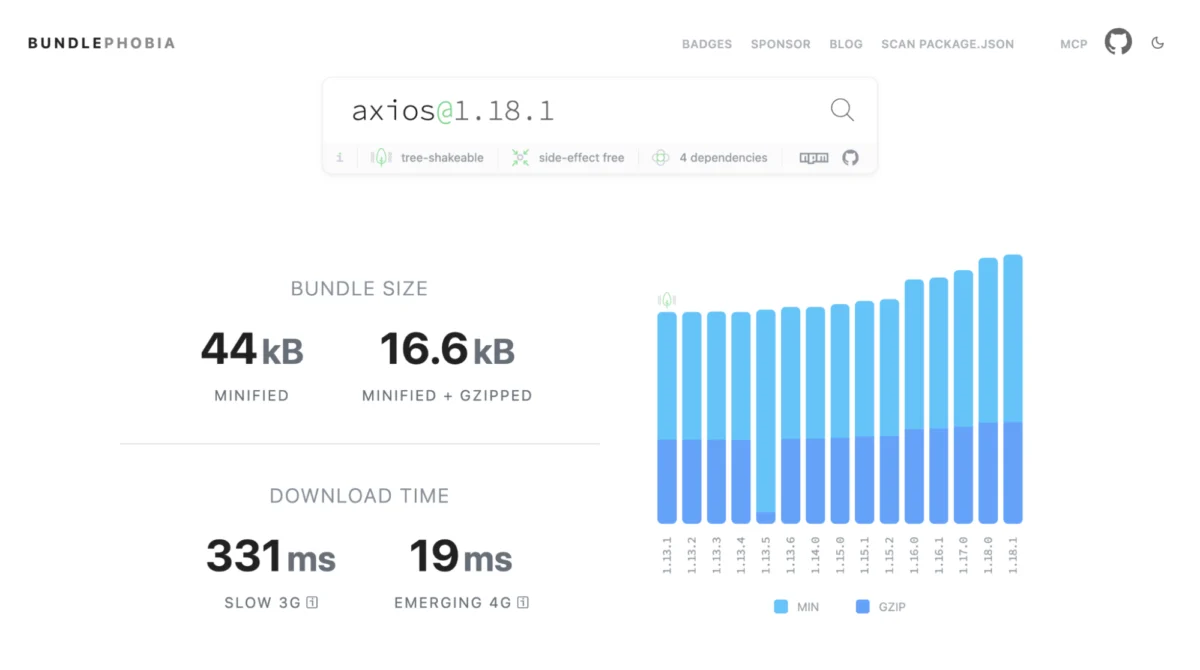
For nearly a decade, axios has been the industry standard for HTTP requests due to its intuitive API and automatic JSON parsing. However, the native fetch API, combined with AbortController, has matured significantly. While axios remains roughly 17KB gzipped, fetch is built into the browser and requires zero overhead.

Recent updates to the platform have added AbortSignal.timeout(), allowing developers to implement request timeouts—a feature previously cited as a reason to stick with axios—in a single line of code. While specialized use cases like request interceptors and progress tracking still benefit from libraries, the vast majority of CRUD applications can now operate entirely on native networking primitives.
Cluster 3: UI Primitives and the "Top Layer"
One of the most complex aspects of web development is managing the "Top Layer"—the space where modals, tooltips, and dropdowns live. Historically, this required "z-index" wars and complex "focus-trap" libraries to ensure accessibility for screen readers.
The introduction of the <dialog> element and the Popover API has fundamentally changed this. The <dialog> element, when opened with showModal(), automatically handles focus trapping, dismisses on the Escape key, and renders in the browser’s top layer, making it impossible for other elements to overlap it incorrectly. Combined with CSS Anchor Positioning—which allows an element to be pinned to a "target" element without JavaScript—the need for 24KB of UI positioning and modal libraries is rapidly disappearing.
Data Manipulation and the Decline of Lodash
Lodash was once the most downloaded package on npm, but its dominance is fading as JavaScript’s standard library expands.
- Deep Cloning: The
structuredClone()method is now Widely Available, replacinglodash.clonedeep. Unlike older hacks involvingJSON.parse,structuredClonecorrectly handles circular references and complex data types likeDate,Map, andSet. - Array Grouping:
Object.groupByprovides a native, performant way to categorize data, a task that previously requiredlodash.groupby. - Set Operations: New methods like
Set.prototype.intersection()andSet.prototype.union()remove the need for manual loops or external helpers when comparing collections.
A Case Study in Caution: The Temporal API
Despite the momentum toward native features, the transition is not always immediate. The Temporal API, designed to replace the notoriously flawed Date object, serves as a cautionary tale for dependency management. While Temporal offers a vastly superior developer experience, it has not yet reached "Widely Available" status as of early 2026.

Using a polyfill for Temporal currently adds approximately 44KB gzipped to a bundle, whereas a lightweight library like dayjs is only 3KB. In this specific instance, the platform audit suggests that keeping the library is the more responsible choice for performance until browser support is ubiquitous. This highlights the importance of the "Three-Question Framework" before removing any dependency:
- Is the native feature safe for the specific audience?
- Does the swap increase the bundle size via polyfills?
- Does the platform feature cover the specific, real-world use case?
Official Industry Responses and Implications
The shift toward native APIs has drawn support from various sectors of the tech industry. Performance advocates argue that the best code is the code that doesn’t have to be shipped. Engineering managers at major tech firms have noted that reducing dependencies simplifies the "onboarding" process for new developers, as they can rely on MDN documentation rather than learning proprietary library APIs.
Furthermore, there is a growing realization that native features are inherently more accessible. Browser-native modals and popovers are developed with accessibility (A11Y) standards built-in, ensuring that users with disabilities receive a consistent experience regardless of which site they are visiting. This reduces the legal and ethical burden on developers to "hand-roll" accessible components.
Implementing a Dependency Audit
To capitalize on these platform advancements, organizations are encouraged to implement a quarterly dependency audit. This process involves:
- Inventory: Listing all production dependencies using tools like
npm ls --omit=dev. - Cost Analysis: Using tools like Bundlephobia or Vite Bundle Visualizer to identify the largest contributors to the JavaScript payload.
- Compatibility Check: Cross-referencing large libraries against the Baseline status of their native equivalents on
webstatus.dev. - Progressive Enhancement: For features that are "Newly Available," implementing feature checks (e.g.,
if ('showModal' in HTMLDialogElement.prototype)) to serve native code to modern browsers while providing fallbacks for older devices.
Conclusion: The Future of the Web Platform
The gap between what the web platform provides and what developers need is smaller than it has ever been. By handing responsibilities back to the browser, developers can create faster, more secure, and more accessible applications. While libraries will always have a place for cutting-edge or highly specialized functionality, the era of using 100KB of JavaScript to format a date or center a modal is coming to an end. As the Baseline standard continues to evolve, the most successful engineering teams will be those that view the browser not just as a runtime, but as a robust, built-in library of features ready to be leveraged.

