
The traditional lifecycle of a website has long been characterized by a brief moment of perfection followed by a slow, inevitable decline into obsolescence. On the day of launch, every asset is optimized, every link is functional, and the messaging is perfectly aligned with the corporate strategy. However, the industry consensus is shifting toward the realization that this "peak" is actually a failure of current maintenance models. As digital environments become more complex, the concept of the autonomous website—one that self-optimizes and evolves through the use of intelligent agents—is emerging as a solution to the phenomenon of "digital decay."
The Problem of Post-Launch Stagnation
In the current technological landscape, a website is rarely "broken" in the mechanical sense. Instead, it suffers from a lack of relevance. Market conditions fluctuate, brand identities evolve, and competitors introduce new features. While the underlying code of a site may remain stable, the gap between the site’s content and the company’s reality widens every day. This phenomenon, often referred to as "bit rot" or "content drift," usually forces organizations into expensive, comprehensive redesigns every two to three years.
Industry data suggests that the average lifespan of a corporate website is approximately 2 years and 7 months. During this period, performance metrics—such as SEO rankings, page load speeds, and accessibility compliance—often degrade by as much as 15% to 20% annually if not actively managed. The bottleneck is rarely a lack of technology; it is a lack of human bandwidth. Maintenance tasks are often deprioritized in favor of new product launches or high-level strategic initiatives.
The Evolution of Web Management: A Chronology
To understand the shift toward autonomy, one must examine the progression of web development over the last three decades:
- The Static Era (1991–1999): Websites were hand-coded HTML files. Updates required manual file transfers via FTP. Maintenance was slow, and sites remained static for years.
- The CMS Revolution (2000–2010): The rise of Content Management Systems like WordPress and Drupal allowed non-technical users to update content. However, the structural integrity and performance optimization still required manual developer intervention.
- The Headless and Cloud Era (2011–2020): Decoupled architectures and CI/CD (Continuous Integration/Continuous Deployment) pipelines streamlined the technical side of updates but increased the complexity of managing multiple platforms and data streams.
- The Autonomous Era (2024–Present): The integration of Large Language Models (LLMs) and agentic workflows allows for websites that can identify their own flaws—such as uncompressed images, broken links, or outdated metadata—and correct them without human prompting.
The Psychology of Control in Automation
Pierre Burgy, a pioneer in the autonomous website space and a key figure behind the Fimo platform, notes that the primary obstacle to full autonomy is not technical capability, but human trust. When developers and designers are presented with a system that can change a website entirely on its own, the initial reaction is often one of hesitation.
The resistance stems from the fact that a website is a multi-stakeholder asset. A designer views the site as a visual brand ambassador; a developer views it as a performance-driven application; a marketer views it as a lead-generation tool. Because each stakeholder has a different "line" regarding what should be automated, a "one-size-fits-all" approach to AI autonomy fails.
Categorizing the Three Pillars of Web Autonomy
Research into autonomous systems has identified three distinct categories of tasks that determine how and where the "line" of automation should be drawn.
1. Rule-Bound Maintenance (The "No-Brainer" Tasks)
The vast majority of website maintenance—estimated at nearly 80% of the total workload—consists of repetitive, rule-based chores. This includes:
- Ensuring accessibility (WCAG) compliance as new pages are added.
- Optimizing image assets for different screen resolutions.
- Propagating design system updates (e.g., updating a primary brand color across all components).
- Fixing "link rot" and broken redirects.
Agents are inherently better at these tasks than humans because they are defined by logic rather than subjective taste. In professional settings, delegating these chores is seen as a net positive, freeing up human talent for higher-value creative work.
2. High-Judgment Assets (The "Untouchable" Tasks)
At the opposite end of the spectrum are tasks that define the "soul" of a brand. An AI agent can confirm that a headline is grammatically correct and fits within a UI container, but it cannot determine if that headline resonates emotionally with a specific target audience. These tasks involve "taste"—a human quality that integrates culture, empathy, and strategic foresight. This category remains firmly under human control in any viable autonomous model.
3. The Subjective Middle Ground
The most significant challenge in autonomous web design lies in the middle ground, where tasks may be perceived as either a "chore" or a "decision" depending on the observer’s role. A classic example is the implementation of a "Dark Mode" default. To a developer, this might be a technical preference based on user system settings—a task easily delegated to an agent. To a brand designer, however, the default theme is a fundamental statement of identity.
The solution, as implemented in platforms like Fimo, is to move away from a global "on/off" switch for autonomy and instead allow for granular, agent-specific permissions.
Supporting Data and Technical Implications
The impact of autonomous optimization is measurable. In preliminary trials of autonomous agents, websites saw a marked improvement in Core Web Vitals (CWV) scores. For instance, automated image compression and script deferral agents can maintain a "Good" rating on Google’s PageSpeed Insights indefinitely, whereas manually maintained sites often slip into the "Needs Improvement" category within six months of launch due to unoptimized content uploads.
Furthermore, accessibility is a growing legal and financial concern. In 2023, ADA-related digital lawsuits in the United States reached record highs. Autonomous agents that run continuous accessibility audits and apply "self-healing" patches to code (such as adding missing ARIA labels or correcting color contrast) represent a significant reduction in legal risk for enterprise-level organizations.
Official Responses and Industry Sentiment
While some segments of the web development community express concern over job displacement, many leading agencies are pivoting toward a "human-in-the-loop" model.
"The goal is not to replace the designer, but to prevent the designer from becoming a glorified maintenance worker," says one lead UI/UX consultant. "If an agent can handle the 500 pages of a site that need basic SEO tags, the designer can focus on the five pages that actually convert the customer."
This sentiment is echoed by CMOs who are increasingly frustrated by the "launch and forget" cycle. The ability to have a site that stays "current" without requiring a dedicated internal team to monitor every minor update is seen as a major competitive advantage.
The Architecture of Trust: Earning Autonomy
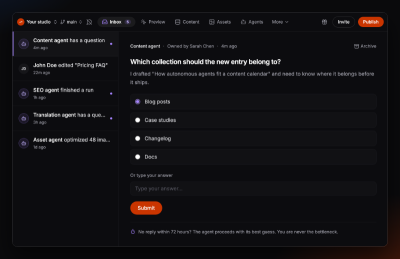
The transition to autonomous websites is expected to follow a "trust-earning" trajectory. Most organizations begin by deploying agents in a "suggestion mode," where the agent flags an issue and proposes a fix, requiring a human click to approve.
As the agent’s accuracy is proven through logs and before-and-after comparisons, organizations move toward "conditional autonomy," where the agent is allowed to make changes within specific parameters. The final stage is "full delegation" for specific maintenance categories, where the human only intervenes if the agent flags a conflict it cannot resolve.
Broader Impact and the "Living Web"
The move toward autonomous websites signals a broader shift in how we perceive digital real estate. For decades, a website was treated like a building: you build it, you move in, and you occasionally repair a leak. In the age of AI agents, a website is more akin to a garden—a living entity that requires constant, micro-level attention to thrive.
The real risk in the modern digital economy is no longer the risk of an agent making a minor error; it is the risk of the "frozen site." A site that does not change is a site that is dying. By delegating the mechanical aspects of maintenance to autonomous agents, companies can ensure that their digital presence remains as dynamic as the markets they serve.
As these technologies mature, the definition of a "successful launch" will change. Success will no longer be measured by how a site looks on day one, but by how much better it has become by day one hundred. The era of the static, decaying website is coming to a close, replaced by a new paradigm of continuous, autonomous evolution.

