
The traditional lifecycle of a corporate website is defined by a paradox of immediate obsolescence: a digital asset is at its absolute peak performance the moment it launches, only to begin a process of gradual decay the second it goes live. This phenomenon, often referred to as "digital entropy," occurs not because the underlying code fails, but because the pace of market evolution, messaging shifts, and competitive maneuvers outstrips the ability of human teams to provide continuous updates. In a landscape where digital presence is synonymous with brand authority, the industry is now witnessing a pivot toward autonomous websites—platforms powered by AI agents designed to optimize, repair, and evolve themselves in real-time. However, as the technology matures, developers and stakeholders are discovering that the primary obstacle to full automation is not technical capability, but the fundamental human need for granular control.
The Mechanics of Digital Decay
In the current web development paradigm, a website is a snapshot in time. On launch day, every asset is optimized, every link is functional, and the messaging is perfectly aligned with the company’s strategic goals. Yet, within months, most sites become "period pieces." Industry data suggests that the average lifespan of a website before a major redesign is roughly two to three years, but the erosion of its effectiveness begins much sooner.
According to various industry audits, over 90% of websites suffer from "content rot" within the first year, characterized by broken outbound links, outdated pricing, or legacy imagery that no longer reflects the brand’s visual identity. Furthermore, performance metrics often slide as new, unoptimized components are added by non-technical staff. The emergence of autonomous web agents aims to solve this by shifting the website from a static product to a living organism that self-corrects while the human team focuses on high-level strategy.
The Rise of Autonomous Web Agents: A Chronological Perspective
The journey toward autonomous websites has moved through several distinct phases over the last three decades:
- The Static Era (1990s–Early 2000s): Websites were hand-coded HTML files. Updates required a developer to manually edit code and re-upload files via FTP. Maintenance was slow and highly technical.
- The CMS Revolution (Mid-2000s–2010s): The rise of Content Management Systems like WordPress and Drupal democratized updates. Non-technical users could change text and images, but the structural health and performance of the site still required manual oversight.
- The Headless and Component Era (2010s–2020s): The shift toward API-first architecture allowed for more modular sites. While this increased flexibility, it also increased complexity, as updates to one component could inadvertently break accessibility or performance standards elsewhere.
- The Autonomous Era (2024–Present): With the integration of Large Language Models (LLMs) and specialized AI agents, platforms like Fimo are beginning to offer "agentic" workflows. These systems do not just host content; they monitor the site, identify regressions, and propose or execute fixes autonomously.
The Fimo Experiment: Lessons in Autonomy
Pierre Burgy, a prominent figure in the web development space and a driver behind the Fimo autonomous website platform, notes that the initial industry assumption—that users wanted a "set it and forget it" website—was largely incorrect. When presented with a platform capable of full autonomy, stakeholders frequently hesitated.
The hesitation stemmed from a lack of clear ownership. A modern website is rarely the domain of a single individual; it is a collaborative space shared by designers, developers, marketing managers, and legal teams. Each stakeholder has a different threshold for what they are willing to delegate to an AI. This led to the realization that the goal of web automation should not be "full autonomy," but "contextual delegation."
The Three-Tier Framework of Web Tasks
To successfully implement autonomous systems, the work of maintaining a website must be categorized based on the level of human judgment required.
1. The Rule-Bound Chores (The "No-Brainers")
Approximately 80% of website maintenance involves tasks that are repetitive and governed by objective rules. These include:
- Accessibility Compliance: Ensuring every image has an alt-attribute and that color contrast meets WCAG standards.
- Asset Optimization: Automatically compressing images or converting them to modern formats like WebP to maintain load speeds.
- Link Integrity: Scanning for 404 errors and updating redirected URLs.
- SEO Hygiene: Fixing missing meta tags or ensuring header hierarchies are logical.
In these areas, AI agents are objectively more efficient than humans. They do not suffer from fatigue and can monitor thousands of pages simultaneously. Industry analysts suggest that automating these "chores" can reduce the operational cost of website maintenance by up to 60%.
2. The Subjective Pillars (The "Untouchables")
At the opposite end of the spectrum are tasks involving "taste" and "brand feel." An AI can determine if a page is functional, but it cannot yet determine if a design is "inspiring" or if a piece of copy captures a specific brand’s "voice" in a way that resonates emotionally with a human audience. This remains the exclusive domain of human creators. The resistance to automation often comes from the fear that AI will encroach on this creative territory, leading to a homogenized, "soulless" web.
3. The Gray Area (The "Negotiables")
The most complex category involves tasks where the line between a chore and a creative decision shifts depending on the user. For a developer, changing a global theme setting like "Dark Mode" might be a routine technical update. For a brand designer, that same change is a significant aesthetic shift that requires approval.
Data-Driven Justification for Autonomy
The move toward autonomous optimization is backed by compelling data regarding user experience and conversion. According to research by Google, a one-second delay in mobile load times can impact conversion rates by up to 20%. As websites "drift" over time—accumulating unoptimized scripts and large assets—they inevitably slow down.
Furthermore, accessibility is no longer just an ethical consideration but a legal one. In 2023, web accessibility lawsuits in the United States reached record highs, with over 4,500 cases filed. An autonomous agent that ensures 24/7 compliance provides a layer of legal protection that manual audits, which are typically performed only quarterly or annually, cannot match.
Reactions from the Tech Community
The introduction of autonomous agents has met with a mix of optimism and caution from industry professionals.
"The value of AI in the web stack isn’t about replacing the developer; it’s about eliminating the ‘technical debt’ that accumulates between major updates," says Marcus Thorne, a senior systems architect. "If an agent can handle the routine patches and performance tuning, I can spend my time building new features rather than fixing things that shouldn’t have broken in the first place."
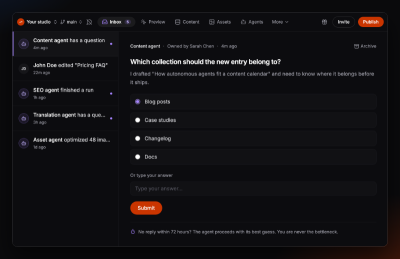
Conversely, marketing executives express concerns regarding brand safety. "We need to know exactly what is changing," says Elena Rodriguez, a Chief Marketing Officer. "The idea of a site ‘quietly optimizing itself’ is great for performance, but it’s terrifying for brand consistency unless there are very clear guardrails and audit logs."
The Future of the "Living Website"
The ultimate goal of autonomous technology is to eliminate the "frozen" state of the web. In this new model, trust is earned through transparency. Modern autonomous platforms are being designed with detailed "history logs" and "before-and-after" visualizations, allowing human overseers to review every action an agent has taken.
As trust grows, the "line of delegation" is expected to move. Tasks that require manual approval today may become fully automated tomorrow as agents learn the specific preferences and "taste" of their human counterparts.
Implications for the Workforce
The shift toward autonomy will inevitably change the role of web agencies and in-house digital teams. The focus will move away from "maintenance retainers"—where clients pay for a set number of hours for basic updates—toward "strategic evolution." Developers and designers will become "agent orchestrators," responsible for configuring and training the AI systems that keep the digital infrastructure running.
Conclusion: The Risk of the Status Quo
While the integration of autonomous agents presents new challenges in terms of control and oversight, the alternative is a return to the cycle of decay. A website that remains static is a website that is actively losing value. The real risk to a brand is not an agent that makes a small, reversible error in the pursuit of optimization, but a "frozen" site that fails to adapt to a changing world.
The point of autonomy is not to remove the human from the process, but to remove the friction of decay. By allowing AI to handle the objective, rule-bound eighty percent of web maintenance, human teams are finally free to focus on the subjective, creative twenty percent that defines a brand’s true value. The "perfect" launch day no longer has to be a website’s best day; it can simply be the starting point of a continuous upward trajectory.

