
The Rise of the Baseline Initiative
The Baseline initiative was established by the WebDX Community Group—which includes representatives from Google, Mozilla, Apple, and Microsoft—to solve the "can I use this?" dilemma that has plagued web development since the early 2000s. Previously, developers had to manually track support across Chrome, Edge, Firefox, and Safari, often leading to "defensive coding" where libraries were installed unnecessarily to ensure cross-browser compatibility.
Baseline categorizes web features into three distinct tiers. The first is "Limited Availability," where a feature is only supported in one or two engines. The second is "Newly Available," which marks the point when a feature becomes supported across all four major engines. The third and most critical tier for enterprise developers is "Widely Available," which occurs 30 months after the "Newly Available" milestone. This 30-month window serves as a safety buffer, ensuring that the vast majority of users have updated their browsers to versions that support the feature. This structured timeline allows engineering teams to move away from the "install once, never look back" mentality and instead adopt a cyclical audit process for their package.json files.
Chronology of Web Platform Evolution
To understand why so many libraries have become redundant, one must look at the timeline of browser convergence over the last five years.
- 2015–2018: The Fetch and Promise Era. The introduction of the Fetch API began the slow decline of older HTTP libraries like XHR and early versions of SuperAgent.
- 2020–2021: The Internationalization (Intl) Expansion. Browsers began shipping robust support for
Intl.RelativeTimeFormatandIntl.NumberFormat, targeting the territory held by Moment.js and Numeral.js. - 2022: The Interop Initiative. Major browser vendors committed to the "Interop" project, specifically aiming to fix top-level compatibility issues in CSS and JavaScript, leading to the stabilization of the
<dialog>element. - 2023–2024: Data Handling and UI Primitives. Features like
Object.groupByand the Popover API reached "Newly Available" status, directly challenging the utility of Lodash and positioning libraries like Popper.js. - 2025–2026: The Modern Anchor and Temporal Shift. The latest phase of the platform involves CSS Anchor Positioning and the Temporal API, which seek to eliminate the remaining "big" dependencies in the web ecosystem.
Supporting Data: The Cost of Excess JavaScript
The argument for removing dependencies is not merely aesthetic; it is rooted in performance data. While a 90KB gzipped dependency might seem negligible on a high-speed fiber connection, its impact on mobile devices is substantial. JavaScript is the most "expensive" part of a web page because it must be downloaded, uncompressed, parsed, compiled, and finally executed.

According to HTTP Archive data, the median mobile page currently ships over 400KB of JavaScript. By removing 60KB–90KB of redundant libraries, developers can reduce their total bundle size by 15–20%. This reduction correlates directly with improvements in Core Web Vitals, specifically Interaction to Next Paint (INP) and Total Blocking Time (TBT). Furthermore, native browser features are implemented in C++ within the browser engine, making them significantly more memory-efficient than their JavaScript-based library counterparts.
Redefining the Dependency Audit: A Decision Framework
Industry experts suggest that teams should no longer view npm audit solely as a security tool. Instead, a "Baseline Audit" should be performed quarterly. This process involves a three-question framework designed to mitigate the risks of moving to native features.
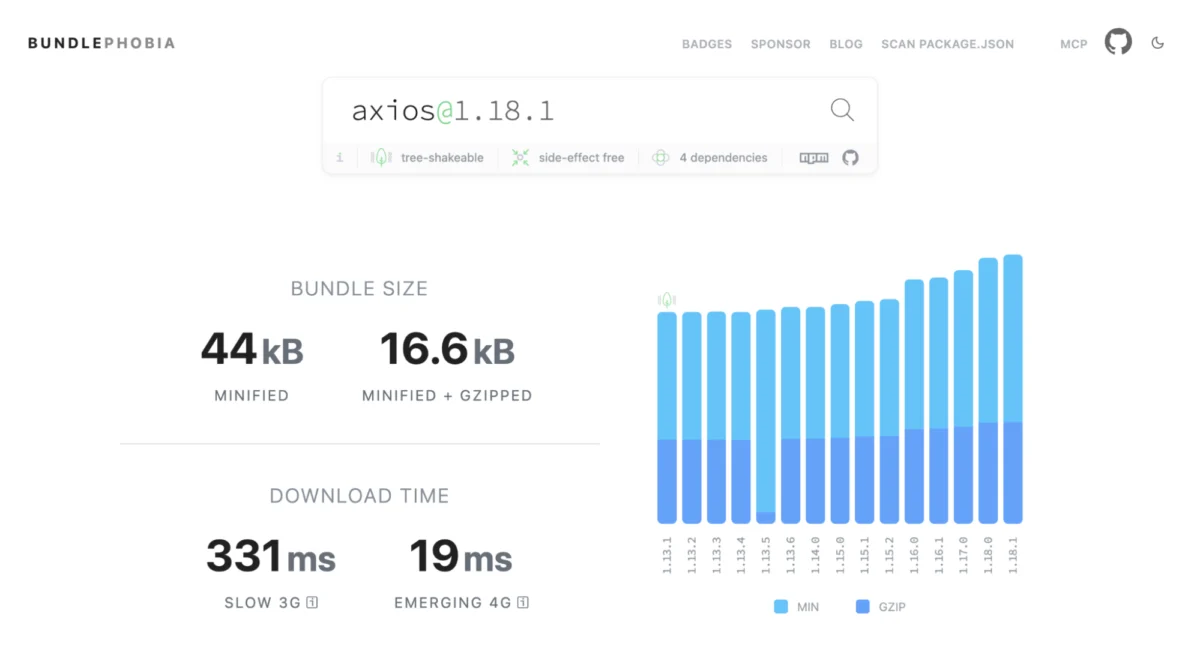
First, developers must ask if a replacement is "Baseline-safe" for their specific audience. While a feature might be "Widely Available" globally, a B2B application supporting legacy systems might require a more conservative approach. Second, the "cost of the swap" must be evaluated. If removing a 3KB library requires adding a 40KB polyfill for older browsers, the swap is counterproductive. Third, teams must ensure the platform feature covers the specific use case. For instance, while the native fetch API handles HTTP requests, it lacks the automatic interceptors and retry logic found in Axios. If an application relies heavily on those specific features, the library remains the more efficient choice.
Analysis of Key Redundancy Clusters
Internationalization and Formatting
The Intl namespace is perhaps the most significant "library killer" in modern web development. Libraries like timeago.js, numeral, and pluralize are often used for basic string transformations. The Intl.RelativeTimeFormat API, now Widely Available, handles localized strings like "3 days ago" with built-in support for dozens of languages. Similarly, Intl.ListFormat handles the complex grammar of joining arrays into sentences, including the "Oxford comma" and localized conjunctions, features that previously required custom helper functions.
UI Primitives and Accessibility
The introduction of the <dialog> element and the Popover API represents a major shift in how UI components are built. Historically, modal dialogs required libraries to handle "focus trapping"—the practice of preventing a user from tabbing out of a modal. The native <dialog> element, when opened via showModal(), handles focus trapping, background inertness, and the "Escape" key behavior automatically. This replaces the need for packages like focus-trap and a11y-dialog.

Furthermore, the new CSS Anchor Positioning API (Newly Available as of early 2026) allows developers to pin tooltips and menus to trigger elements using pure CSS. This targets the functionality of tippy.js and Popper.js, which often add significant weight to bundles due to the complexity of viewport-overflow calculations.
Data Manipulation and Lodash
Lodash has been a staple of JavaScript development for a decade, but its necessity is dwindling. The structuredClone API is now the standard for deep-cloning objects, handling circular references and complex data types that JSON.parse(JSON.stringify()) would fail on. Additionally, Object.groupBy has standardized one of the most common data-transformation tasks in frontend development. While Lodash functions like debounce and throttle still lack native equivalents, the "Lodash-first" mindset is being replaced by "Native-first, Lodash-cherry-pick."
The Case Study of Temporal: Why Caution is Necessary
The Temporal API serves as a vital case study in the risks of premature adoption. As the designated successor to the flawed Date object, Temporal offers a sophisticated, immutable API for time and date handling. However, because it has not yet reached "Widely Available" status across all browsers (notably Safari stable versions as of early 2026), it requires a substantial polyfill.
The official Temporal polyfill can exceed 40KB gzipped, whereas a lightweight library like dayjs is only 3KB. In this instance, the platform-native solution is currently "heavier" for the end-user than the library it intends to replace. This highlights the importance of the Baseline timeline; until a feature is Widely Available, libraries often remain the more performant choice for public-facing websites.
Official Responses and Industry Implications
The shift toward native features has been met with positive reactions from the developer relations teams at major tech firms. "The goal of Baseline isn’t to say ‘libraries are bad,’" noted a member of the WebDX Community Group during a recent summit. "The goal is to provide a predictable target for developers so they can stop shipping code that the browser already knows how to execute."

This trend is also influencing the development of modern frameworks like Next.js, Nuxt, and Remix. These frameworks are increasingly integrating Baseline checks into their build tools, potentially alerting developers when a dependency in their package.json could be replaced by a native feature based on their browserslist configuration.
Broader Impact and Long-term Sustainability
The long-term impact of the Baseline initiative extends beyond performance. By relying on the web platform rather than a fragmented ecosystem of npm packages, codebases become more sustainable. Libraries can become unmaintained, suffer from security vulnerabilities, or undergo breaking API changes. In contrast, the web platform is built on the principle of "don’t break the web." Once a feature is implemented in the browser, it is effectively permanent.
In conclusion, the era of the "bloated bundle" is facing a coordinated challenge from the very platforms that host the code. By adopting a disciplined approach to auditing dependencies and respecting the Baseline timeline, developers can ship significantly less JavaScript. This results in faster load times, better accessibility, and a more robust web experience that leverages the full power of the modern browser. The directive for the modern developer is clear: before running npm install, check the platform. The solution may already be there.

