
The global technology sector is currently navigating a significant disconnect between corporate strategy and consumer sentiment regarding the integration of Artificial Intelligence (AI). While Silicon Valley and enterprise leadership have pivoted toward an "AI-first" philosophy, recent market data and user experience (UX) research suggest that a majority of users do not desire more AI features in their current form. This phenomenon, often referred to as the AI adoption gap, highlights a growing friction between the rapid deployment of generative tools and the practical requirements of the modern workforce. Industry analysts observe that many companies have operated under the assumption that AI is a self-evident value proposition, yet the reality in the workplace reveals a preference for reliability, predictability, and the preservation of human-centric workflows over the novelty of automated assistants.
The Value Proposition Crisis and the Adoption Gap
A critical challenge facing the technology industry is the misconception that "Powered by AI" serves as a standalone benefit for the end-user. According to research from the Nielsen Norman Group, AI is not a value proposition in itself; rather, it is a functional component that belongs in the categories of "Key Activities" or "Key Resources" within a business model. When AI features are marketed as the primary draw of a product, they often fail to meet user needs because they do not address specific pain points. Instead, these features frequently act as "bolt-ons"—external tools that require users to deviate from their established workflows to engage with a separate interface.
The financial implications of this disconnect are substantial. IBM’s recent studies on AI adoption indicate that while enterprise investment in AI continues to surge, retention rates for these new features remain unexpectedly low. This disparity creates a high cost of delivery for developers and a significant risk of reputational damage for brands that release unpolished or intrusive AI tools. Users report that rather than simplifying their lives, many current AI implementations introduce new layers of complexity, such as the need to verify facts for "hallucinations" or the requirement to manage a fragmented ecosystem of disconnected AI agents.
A Chronology of the AI Integration Hype Cycle
To understand the current state of resistance, it is necessary to examine the timeline of AI’s integration into the mainstream consumer market.
- The Emergence (Late 2022): The public release of large language models (LLMs) like ChatGPT sparked an immediate "gold rush" among software providers. The focus was on raw capability—demonstrating that a machine could generate text, code, and images.
- The Integration Surge (2023): Major software suites began "bolting on" AI sidebars and chat interfaces. This era was defined by the "AI-first" mentality, where the presence of a chatbot was seen as a mandatory requirement for any competitive digital product.
- The Efficiency Paradox (Early 2024): Data began to emerge showing that AI was not necessarily reducing the workload. Instead of saving time, employees found themselves spending more time managing the output of AI, leading to a phenomenon known as "work intensification."
- The Strategic Pivot (Late 2024 and Beyond): A shift in UX philosophy began to emerge, moving away from "AI-first" toward "AI-second" or "Invisible AI." This approach prioritizes deep integration into existing mental models rather than forcing users to adapt to the machine’s logic.
Data Analysis: The Hidden Costs of AI Productivity
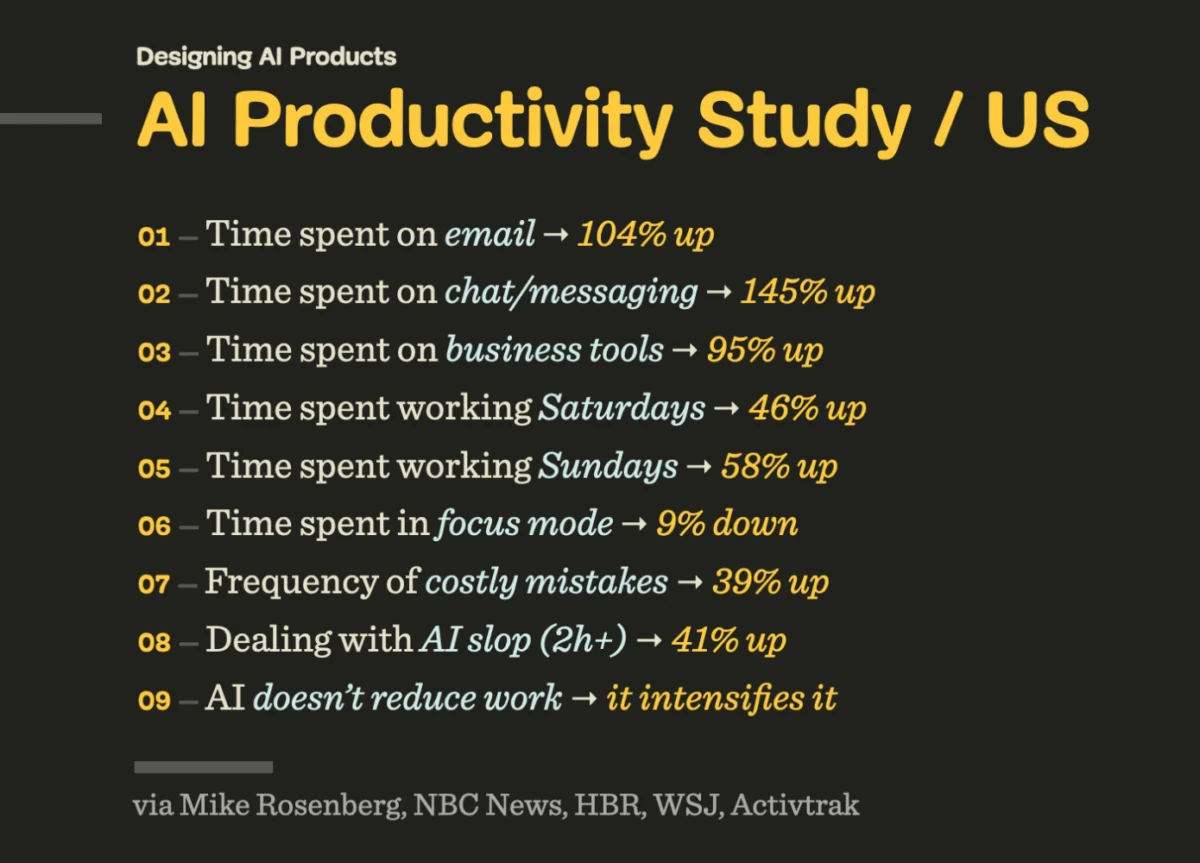
While the narrative surrounding AI often focuses on "unprecedented productivity," empirical data suggests a more nuanced reality. Studies compiled from sources including Activtrak, NBC News, and the Harvard Business Review indicate that AI may actually be intensifying the workday rather than streamlining it. Key metrics from recent productivity studies in the United States reveal a troubling trend:

- Communication Overhead: Time spent on email has increased by 104%, and chat/messaging usage has risen by 145%. This is largely attributed to the "AI slop" phenomenon, where users must spend additional time editing and refining AI-generated drafts that lack the necessary nuance or accuracy.
- Work-Life Balance Erosion: The ease of generating content has led to a 46% increase in Saturday work and a 58% increase in Sunday work. Because AI allows for a higher volume of output, the expectation for delivery speed has increased, forcing employees to work longer hours to keep up with the machine-augmented pace.
- Quality Control Issues: Costly mistakes in professional environments have risen by 39%. The psychological phenomenon of "automation bias" often leads users to trust AI output without sufficient verification, resulting in errors that are more difficult to catch than those made by humans.
- Focus Depletion: User focus mode has seen a 9% decrease, as the constant presence of "helpful" AI suggestions acts as a source of digital distraction.
These statistics suggest that AI is currently amplifying shortcuts and shortcomings within organizations. It exposes technical debt and broken internal cultures rather than fixing them. When an organization has poor data quality or conflicting priorities, AI tools often hand these inconsistencies directly to the user, who is then left to reconcile the "mess" themselves.
Professional and Psychological Resistance
The resistance to AI is not merely a technical hurdle but a deeply psychological one. For many employees, AI is an "uninvited guest" that arrives at the behest of senior leadership without a clear mandate for how it improves the daily lives of the staff. This creates a climate of anxiety rather than excitement. According to a report by the Brookings Institution and the Washington Post, jobs in software development and public relations are among the most "exposed" to AI automation. This exposure breeds a sense of liability; unlike traditional software features which are predictable, AI is inherently probabilistic and unreliable.
Furthermore, there is a growing sentiment that AI is encroaching on the most rewarding aspects of human labor. Users have expressed a clear desire for AI to handle "the boring stuff"—mundane tasks such as data entry, scheduling, or basic filing—while leaving the creative, strategic, and "taste-based" decisions to humans. The current market trend of AI-generated art, AI-narrated books, and AI-driven social interaction is often met with skepticism because it attempts to automate the very activities that humans find most fulfilling.

Industry Reactions and the Shift to "AI-Second" Design
In response to these challenges, a new school of thought in product design is gaining traction. This "AI-second" approach argues that the most successful implementations of technology are those that are subtle, humble, and ambient. Instead of a "magical box" that users must speak to, designers are looking at ways to integrate AI so deeply into existing workflows that it becomes invisible.
Industry leaders in UX design, such as Vitaly Friedman, suggest that AI should adapt to how people think and make decisions, rather than forcing people to change themselves. This means matching the existing mental models that professionals have spent decades refining. For example, a "smart" feature in a spreadsheet that predicts a formula based on user intent is often more highly valued than a separate chatbot that requires a complex prompt to achieve the same result.
Statements from various industry stakeholders echo this sentiment. Bo Young Lee, a prominent voice in organizational culture, has noted that the goal of technology should be to "do all the physical and mental labor that taxes me so I can read books written by humans and go to art galleries to engage with art made by humans." This highlights a fundamental truth: people do not want more time with AI; they want more time with other people.

Future Implications and the Path Forward
As the initial hype surrounding generative AI begins to stabilize, the long-term success of the technology will depend on its ability to prove its utility in a human-centric context. The transition from "AI-first" to "AI-utility" will likely involve several key shifts in the coming years:
- From Generative to Integrative: The focus will move from tools that generate vast amounts of new content to tools that synthesize and organize existing information within a user’s specific context.
- Reliability over Novelty: Software providers will be forced to prioritize the "boring" metrics of reliability and predictability. A feature that works 100% of the time is more valuable to a professional than a "magical" feature that works 80% of the time but requires constant supervision.
- The Rise of Calm Technology: We are likely to see a move toward "calm" AI—interfaces that do not demand attention but support the user from the background, only intervening when a specific, high-value automation opportunity is identified.
- Human-in-the-Loop as a Feature: Rather than trying to replace the human, successful products will market themselves as "human-augmentation" tools, specifically highlighting how they protect the user’s time and headspace.
In conclusion, the technology industry is at a crossroads. The assumption that everyone craves more AI is being debunked by the reality of low adoption and increased workplace stress. The path to successful AI integration lies not in creating more features, but in creating more time. By focusing on automating the mundane and respecting the human element of work, developers can bridge the adoption gap and create tools that users truly need. The ultimate metric of success for AI will not be how much time we spend using it, but how much time it allows us to spend away from our screens, engaging with the world and the people around us.

