
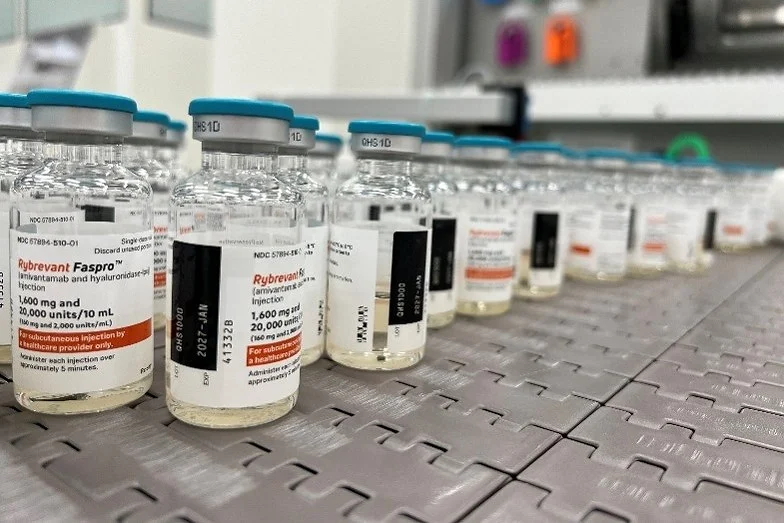
The U.S. Food and Drug Administration has granted accelerated approval to Johnson & Johnson’s Rybrevant Faspro as a standalone treatment for adults suffering from advanced head and neck squamous cell carcinoma (HNSCC). This regulatory milestone addresses a critical gap in the oncology landscape, specifically for patients whose disease has progressed following standard-of-care treatments, including platinum-based chemotherapies and PD-1/PD-L1 immunotherapies. By expanding the utility of this bispecific antibody, the FDA has provided a new therapeutic avenue for an aggressive form of cancer that has historically been associated with poor long-term prognoses and limited second-line options.
Rybrevant Faspro (amivantamab-vmjw) represents a significant evolution in the delivery of oncology therapeutics. Unlike the original intravenous formulation of Rybrevant, which requires several hours of infusion time, the Faspro version utilizes recombinant human hyaluronidase PH20 technology licensed from Halozyme Therapeutics. This allows the drug to be administered via subcutaneous injection in approximately five minutes. The shift to a subcutaneous delivery system not only improves the patient experience by reducing the burden of clinic visits but also mitigates the risk of infusion-related reactions, which were a known challenge with the original intravenous delivery.
Mechanism of Action and Clinical Efficacy
At its core, Rybrevant is a bispecific antibody engineered to target two distinct pathways: the epidermal growth factor receptor (EGFR) and the mesenchymal-epithelial transition (MET) receptor. Both receptors are frequently overexpressed or mutated in various solid tumors, including lung and head and neck cancers. By simultaneously blocking these two signaling pathways, Rybrevant aims to overcome the primary mechanism of drug resistance that often occurs when only one receptor is targeted.
The FDA’s decision to grant accelerated approval was based on compelling data from a Phase 1b/2 clinical trial involving patients with recurrent or metastatic HNSCC. The trial demonstrated a 42% overall response rate (ORR) among participants, a figure that is particularly notable in a patient population that has already failed multiple lines of systemic therapy. Furthermore, 15% of patients achieved a complete response, meaning no detectable signs of cancer remained following treatment. The durability of these responses was also significant, with 56% of responders maintaining their clinical benefit for more than six months.
Under the accelerated approval pathway, the continued authorization of Rybrevant Faspro for this indication may be contingent upon the results of a confirmatory Phase 3 trial. This ongoing study is designed not only to validate the initial findings but also to explore the potential of the drug as a first-line treatment option. Notably, the current approval excludes patients with oropharyngeal squamous cell carcinoma associated with the human papillomavirus (HPV), as the molecular drivers of HPV-positive and HPV-negative cancers differ significantly.
Strategic Importance for Johnson & Johnson
The expansion into head and neck cancer is a cornerstone of Johnson & Johnson’s broader oncology strategy. The company has positioned the Rybrevant franchise as a primary driver of its pharmaceutical growth through the end of the decade. For the first nine months of 2026, J&J reported combined global sales of Rybrevant and Lazcluze reaching $866 million, representing a 67.4% year-over-year increase. Analysts and company executives have projected that the franchise could eventually achieve peak annual sales of $5 billion as it secures more indications and moves into earlier lines of therapy.
This latest approval follows the 2024 FDA nod for Lazcluze (lazertinib), an oral EGFR inhibitor used in combination with Rybrevant for non-small cell lung cancer (NSCLC). By creating a comprehensive portfolio of EGFR-targeting agents, J&J is attempting to establish a new standard of care in several high-prevalence cancer types, challenging incumbent therapies and addressing the persistent issue of therapeutic resistance.
Broader Regulatory Trends in Oncology
The FDA’s active week extended well beyond Johnson & Johnson, with several other pharmaceutical giants securing label expansions or new approvals for oncology products.
GSK received an expanded label for its PD-1 inhibitor, Jemperli (dostarlimab), to include the treatment of advanced rectal cancer. Initially approved for endometrial cancer in 2021, Jemperli has become a focal point of GSK’s oncology pipeline. The expansion into rectal cancer follows impressive clinical data showing high rates of clinical complete response, potentially allowing some patients to avoid invasive surgery or radiation.
Pfizer also achieved a regulatory win with Tukysa (tucatinib), which is now approved as a front-line treatment for HER2-positive metastatic breast cancer. This small-molecule inhibitor was acquired through Pfizer’s $43 billion purchase of Seagen in 2023. Moving Tukysa from a second-line setting into the front-line space significantly increases the addressable patient population and reinforces Pfizer’s position in the competitive HER2-positive market.
In the realm of hematologic malignancies, Eli Lilly’s Jaypirca (pirtobrutinib) saw its approval expanded to include the first-line treatment of chronic lymphocytic leukemia (CLL) and small lymphocytic lymphoma (SLL). As a non-covalent BTK inhibitor, Jaypirca offers a unique therapeutic profile for patients who may not tolerate or who have progressed on traditional BTK inhibitors. Meanwhile, Elevar Therapeutics secured approval for Lyrfigtu (lirafugratinib) for cholangiocarcinoma patients harboring FGFR2 genetic signatures, providing a targeted option for a rare and difficult-to-treat bile duct cancer.
Breakthroughs in Infectious Disease and Global Health
The regulatory landscape also saw major movements in infectious disease management. A landmark decision was made regarding lenacapavir, the long-acting HIV medication developed by Gilead Sciences. The FDA granted tentative approval to a generic version produced by Dr. Reddy’s Laboratories under the President’s Emergency Plan for AIDS Relief (PEPFAR). This move is designed to facilitate access to the twice-yearly injectable in 120 low- and middle-income countries, marking a significant step forward in the global effort to end the HIV epidemic.
In the fight against chronic Hepatitis B, GSK received approval for Hibsago, an antisense oligonucleotide. Hibsago works by targeting viral messenger RNA to reduce the levels of viral proteins and DNA. Clinical trials have sparked optimism in the medical community, as some patients achieved what is described as a "functional cure," where the virus is suppressed to undetectable levels without the need for ongoing medication. Furthermore, Asahi Kasei’s Hovilpri was approved for resistant herpes simplex virus lesions, offering relief to patients who have failed multiple standard antiviral therapies.
Neuroscience and Digital Health Innovation
The FDA also signaled its support for innovation in neuroscience and digital therapeutics. AbbVie’s Juvmo (tavapadon) was approved for the treatment of Parkinson’s disease. Acquired through the $8.7 billion purchase of Cerevel Therapeutics, Juvmo is a selective partial agonist of the D1 and D5 dopamine receptors. This selectivity is intended to provide the motor benefits of dopamine stimulation while minimizing the side effects, such as dyskinesia, often associated with less selective treatments.
In a first-of-its-kind decision, Click Therapeutics received clearance for Motvista (CT-155), a digital therapeutic designed to treat the "negative" symptoms of schizophrenia. While traditional antipsychotics are effective at managing "positive" symptoms like hallucinations, negative symptoms—such as social withdrawal and lack of motivation—have remained largely untreatable. Motvista, a smartphone-based application, serves as an adjunct to drug therapy, using cognitive exercises to improve patient outcomes.
Autoimmune and Metabolic Advancements
The immunology sector saw several label expansions, including Sun Pharma’s Ilumya for psoriatic arthritis and AstraZeneca’s Ultomiris for IgA nephropathy. Novartis also gained approval for Rhapsido in treating symptomatic dermographism, a chronic hive condition, while Roche’s Gazyva was approved for idiopathic nephrotic syndrome, marking its second autoimmune indication in a year.
In the highly competitive diabetes market, Eli Lilly secured FDA approval for Onswik, a once-weekly basal insulin. This sets up a direct market confrontation with Novo Nordisk’s Awiqli, as both companies race to simplify treatment regimens for adults with type 2 diabetes. Additionally, Bristol Myers Squibb’s Camzyos was approved for pediatric use in obstructive hypertrophic cardiomyopathy, expanding the reach of this first-in-class cardiac medication.
Regulatory Setbacks and Safety Monitoring
Despite the wave of approvals, the week was not without its challenges. The FDA placed a partial clinical hold on Bright Minds Biosciences’ Phase 2 trial of BMB-101 due to toxicity concerns observed in animal studies. Similarly, Gilead Sciences faced a partial hold on its KITE-753 CAR T-cell therapy program while investigating safety discrepancies between early-phase trials. These actions underscore the FDA’s rigorous focus on patient safety even as it moves to accelerate the availability of innovative therapies.
As the pharmaceutical industry moves into the final quarter of the year, these regulatory decisions reflect a broader trend toward precision medicine, long-acting formulations, and the integration of digital tools into traditional clinical practice. For Johnson & Johnson, the approval of Rybrevant Faspro in head and neck cancer is not just a win for the company’s balance sheet, but a pivotal moment for patients facing an aggressive disease with few remaining options.

