
The primary tension in modern front-end development lies in the distinction between local simplicity and system-wide complexity. When a developer replaces a ResizeObserver script with a CSS Container Query, the immediate result is a "red diff"—the deletion of code—which is traditionally viewed as a positive metric. However, this local reduction in code volume does not always equate to a simpler system. In a professional architectural context, CSS now acts as a "roommate" to JavaScript, the CSS Cascade, and the browser’s rendering engine. The stability of a web application depends not on the isolation of these features, but on their interaction within a shared environment.
The Evolution of the CSS-JavaScript Logic Split
The transition from JavaScript-led layouts to CSS-native logic has been a decade-long journey. In the early 2010s, developers relied heavily on jQuery and eventually React or Vue to handle responsive behaviors that CSS could not manage alone. The introduction of Flexbox and Grid reduced some of this reliance, but complex conditional styling—such as changing a component’s layout based on its parent’s size—still required JavaScript observers.
By 2024 and 2025, the wide browser support for Container Queries and the :has() selector signaled a paradigm shift. However, as Shoyombo notes, migrations are rarely "clean sweeps." In many enterprise codebases, legacy JavaScript remains active while new CSS features are layered on top. This creates a "behavior with two owners," where logic is fragmented across different files and languages. If a ResizeObserver is left running in a legacy utility file while a new @container rule is added to a stylesheet, a single component may find itself governed by two competing logic sets. If these sets disagree—for instance, if a developer updates a breakpoint in CSS but misses the corresponding value in JavaScript—the component can enter "impossible states" that were never intentionally programmed.
Technical Side Effects: The Hidden Impact of Containment
One of the most significant technical hurdles in adopting modern CSS is the unintended creation of Block Formatting Contexts (BFC). When a developer applies container-type: inline-size to an element, they are technically telling the browser to allow child elements to query the parent’s width. However, the browser interprets this declaration as an instruction to apply style and inline-size containment.
This containment triggers several layout behaviors that can disrupt a site’s existing design:
- Margin Collapse Interruption: In standard CSS, vertical margins between adjacent blocks often "collapse" into a single space. An element defined as a container prevents this collapse, potentially doubling the intended spacing between components.
- Float Interaction: Elements that establish a new BFC do not overlap with floats. This can cause components to unexpectedly shift horizontally or shrink when placed near floated images or sidebars.
- Content-Sized Collapse: Size containment prevents an element from deriving its width from its children. In scenarios where a card is set to
fit-contentor resides within a flex-row, adding container queries can cause the element’s width to collapse to zero pixels, effectively making the component vanish from the viewport.
These side effects represent a form of "system complexity" that a simple code diff fails to capture. The logic may be simpler, but the layout engine’s behavior becomes more volatile.

The Cascade and Specificity: "Loud Housemates" in the Stylesheet
The CSS Cascade remains one of the most powerful yet misunderstood aspects of web development. Modern features like native nesting and the :has() selector have introduced new ways for selectors to "borrow" weight and reach further than intended.
According to MDN’s guidelines on nesting and specificity, the & nesting selector takes on the specificity of the most specific element in its associated selector list. This is identical to the behavior of the :is() pseudo-class. For example, if a developer nests a link selector inside a list that includes both a class (.card) and an ID (#featured), the resulting specificity for all nested links becomes that of the ID. This can lead to "specificity wars," where developers are forced to use !important or increasingly complex selectors to override styles that were unintentionally elevated.
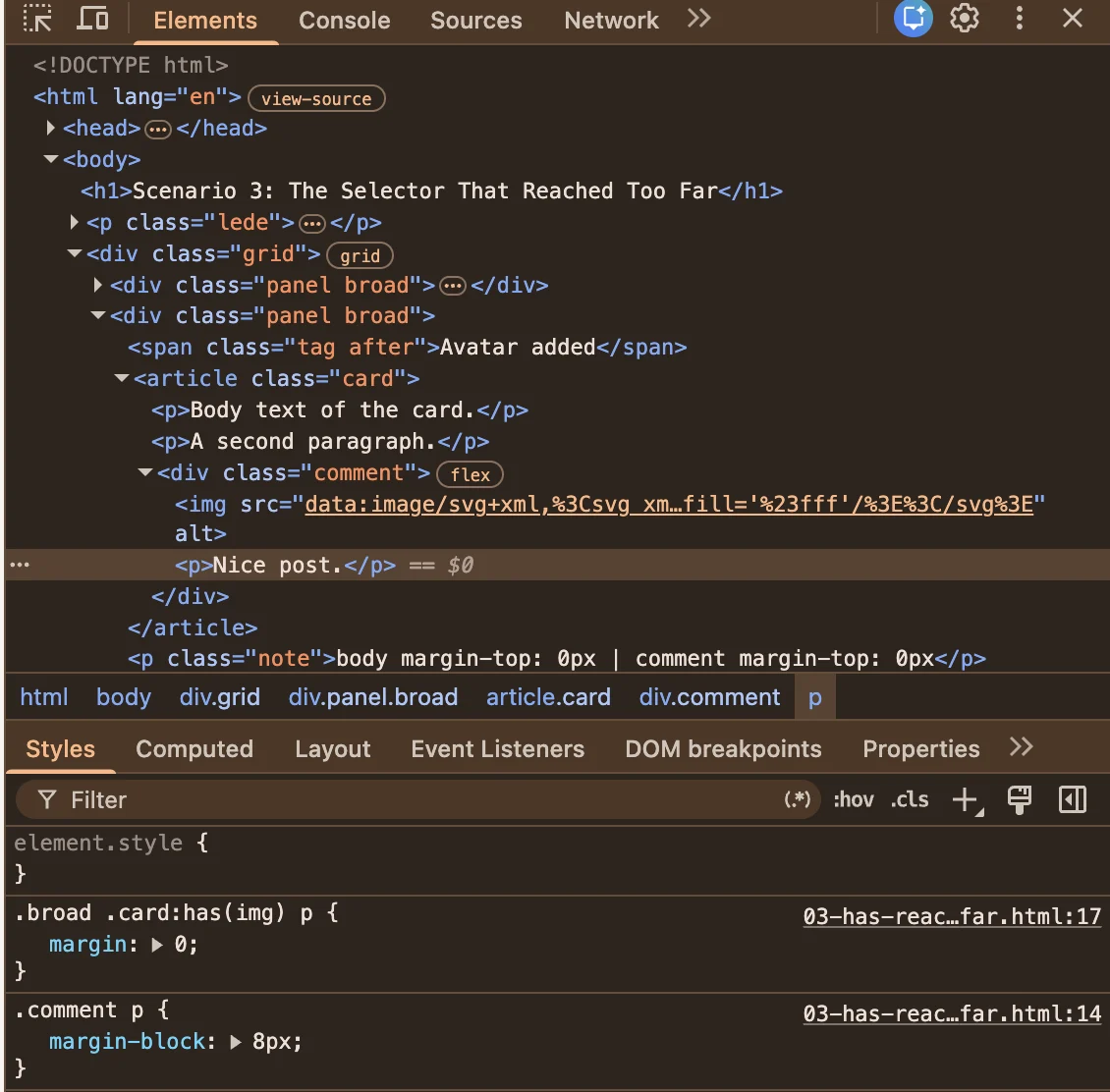
Furthermore, the :has() selector, while powerful, can be "loud." A selector like .card:has(img) p targets paragraphs within any card containing an image. However, if not constrained with child combinators (e.g., .card:has(> img) > p), the rule can reach deep into nested components, stripping margins from comment sections or avatars that the developer never intended to touch. This global reach makes debugging "runtime styling issues" significantly more difficult, as the state of one component may be affected by the presence of an element in a completely different part of the DOM tree.
Performance Analysis: Measuring the Cost of CSS Logic
A common justification for moving logic from JavaScript to CSS is performance. While often true, this is not a universal rule. In October 2026, performance tests conducted on Chromium-based browsers revealed surprising data regarding the rendering cost of complex CSS selectors.
In a test environment featuring a list of 5,000 rows, researchers measured the time required to toggle a "selected" state. The results showed a stark contrast between isolated rules and combined rules:
- JavaScript Toggle: Toggling a class on a single toolbar element via script took under 0.1ms, restyling only 1 element.
- Isolated
:has()Rule: A rule likebody:has(.row.is-selected) .toolbartook approximately 1.4ms. - Combined Rules: When two seemingly harmless
:has()rules were present in the same stylesheet, the time jumped to 7ms, and the browser was forced to restyle all 5,001 elements on every single toggle.
When the list was scaled to 20,000 rows, the combined CSS rules required 31ms per toggle—nearly two full frames of animation at 60Hz. This suggests that while CSS is generally efficient, the browser’s "Recalculate Style" phase can be overwhelmed by relational selectors that force the engine to check the entire DOM tree for potential matches.
Industry Reactions and Expert Perspectives
The discourse surrounding modern front-end complexity has divided the developer community. In a widely discussed essay titled "Modern Frontend Complexity: Essential or Accidental?", Igor Roztropiński questioned whether the current trajectory of web development is truly serving the end-user.

On platforms like Reddit’s r/programming, the debate has intensified. Some developers, such as the user "Kwantuum," argue that many "less is more" approaches simply result in "doing less" rather than achieving true efficiency. Conversely, proponents of "CSS-first" development argue that the industry has become overly reliant on JavaScript frameworks, introducing "accidental complexity" that native browser features are finally equipped to solve.
The consensus among senior architects is that native features only reduce complexity when they fully replace previous implementations without disrupting the surrounding ecosystem. As noted by developers in the r/webdev community, the danger often lies in "greenfield" thinking—evaluating a technology in a brand-new project—while most professional work involves "brownfield" migrations where "spaghetti CSS" and legacy scripts create a minefield of conflicts.
A Framework for Sustainable Migration
To mitigate the risks associated with modern CSS adoption, architectural experts suggest a six-point checklist for any pull request that replaces JavaScript with CSS:
- Ownership: Is the behavior now entirely owned by CSS, or is JavaScript still observing the same elements?
- Cleanup: Have all legacy classes, observers, and utility scripts been deleted?
- Scope: Does the new selector use child combinators to prevent it from reaching into nested components?
- Layout Side Effects: Does the use of
container-typeordisplay: gridcreate a new Block Formatting Context that breaks margin collapsing or float wrapping? - Cascade Position: Where does the new rule sit in the cascade? If using Cascade Layers (
@layer), does the legacy code also use layers, or will it always win the conflict? - Performance: Has the "Recalculate Style" time been measured in a worst-case scenario (e.g., a long list or a complex DOM)?
Broader Impact and Future Implications
The shift toward modern CSS is not merely a change in syntax; it is a change in the mental model required for web development. As CSS becomes "smarter," it requires developers to possess a deeper understanding of browser internals, including layout containment and the mechanics of the rendering pipeline.
The broader impact on the industry will likely be a re-evaluation of the "Full-Stack Developer" role. The gap between "writing styles" and "engineering layouts" is closing, requiring a high level of technical rigor. While the "red diff" of a CSS migration remains a goal, the ultimate metric of success must be system legibility. A codebase with 100 lines of clear JavaScript is often preferable to 10 lines of "magic" CSS that no one on the team knows how to debug.
In conclusion, modern CSS offers powerful tools to simplify the front-end, but these tools must be wielded with an awareness of the system as a whole. The complexity of the web has not vanished; it has simply moved. By following structured migration protocols and maintaining a healthy skepticism of "greenfield" simplicity, development teams can harness the power of modern CSS without sacrificing the maintainability of their applications.

