
The digital landscape is currently witnessing a fundamental shift in how corporate and consumer-facing websites are maintained, moving away from static, human-dependent management toward a model of continuous, autonomous optimization. For decades, the lifecycle of a website has followed a predictable and often frustrating pattern: a peak of perfection on the day of launch, followed by a steady decline in relevance, performance, and technical integrity. This phenomenon, often referred to as "digital decay," occurs not because the underlying code fails, but because the pace of market shifts, messaging updates, and competitive pressure outstrips the capacity of human teams to keep content and performance current. Pierre Burgy, a leader in the development of autonomous website platforms, argues that the solution lies in agentic technology—AI-driven systems that manage the "chores" of the web—while acknowledging a significant psychological hurdle: the human reluctance to surrender control over creative and strategic brand assets.
The Phenomenon of Post-Launch Decay and Technical Debt
In the traditional development cycle, a website is considered "finished" once the final branch is merged and the site goes live. At that moment, the site is perfectly aligned with the company’s current goals, design system, and technical standards. However, industry data suggests that this alignment is fleeting. According to recent surveys of digital project managers, nearly 60% of enterprise websites suffer from outdated content within six months of deployment, while over 40% of links in high-traffic sections can experience "link rot" or redirection errors within a year.
This decay is rarely the result of technical failure. Instead, it is the byproduct of shifting organizational priorities. As marketing teams launch new campaigns and developers pivot to new features, the existing site infrastructure becomes a "period piece"—a snapshot of the company as it existed on launch day. This leads to an accumulation of technical debt and brand inconsistency, where unoptimized images, broken meta tags, and inconsistent design tokens slowly erode the user experience and search engine rankings.
A Chronology of Web Management Paradigms
To understand the rise of autonomous websites, it is necessary to examine the historical progression of web maintenance.
- The Manual Era (1990s–Early 2000s): Websites were largely static HTML files. Maintenance required manual coding for every change, making updates slow and expensive.
- The CMS Revolution (Mid-2000s–2010s): The advent of Content Management Systems (CMS) like WordPress and Drupal democratized updates. However, these systems remained "passive," requiring a human user to initiate every change, from SEO tweaks to security patches.
- The Headless and Cloud Era (2015–2023): Decoupled architectures allowed for faster deployments and better performance, but they increased the complexity of maintenance, often requiring specialized developer intervention for minor layout or data changes.
- The Agentic Era (2024–Present): The current phase involves "autonomous agents"—specialized AI programs capable of perceiving the state of a website, identifying discrepancies against a set of rules, and executing fixes without direct human prompting.
The Mechanics of Autonomous Optimization
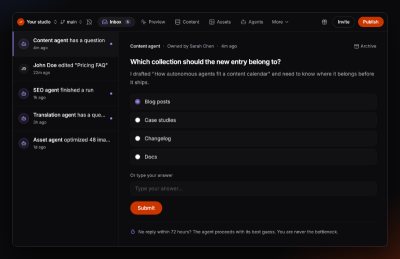
Autonomous websites function by deploying a fleet of specialized agents, each tasked with a specific vertical of site health. These agents do not simply follow a script; they use Large Language Models (LLMs) and computer vision to understand context. For example, an accessibility agent does not just check for the presence of alt-text; it analyzes the image and the surrounding copy to ensure the description is meaningful and compliant with WCAG 2.2 standards.
Data from early adopters of autonomous platforms indicates a significant reduction in "maintenance drag." In a pilot study involving enterprise-level SaaS sites, autonomous agents were able to reduce technical SEO errors by 85% and improve page load speeds by an average of 1.2 seconds through continuous image and script optimization. These improvements occurred in the background, requiring zero manual hours from the internal engineering teams.
The Psychology of Autonomy: The Human-in-the-Loop Barrier
Despite the technical advantages, the transition to full autonomy has met with unexpected resistance. Burgy and his team at Fimo discovered that when presented with a platform capable of total self-management, stakeholders often hesitated. The core of this resistance is not a lack of trust in the AI’s capability, but rather the complex nature of website ownership.
A corporate website rarely has a single owner. It is a shared space where designers own the aesthetic, marketers own the messaging, and developers own the performance. Because each stakeholder has a different "line of control," a universal setting for autonomy is impossible. Burgy’s research identified three distinct categories of tasks that define how humans interact with autonomous agents:
1. Rule-Bound Maintenance (The "No-Brainers")
This category includes repetitive, low-stakes tasks that are governed by clear rules rather than subjective taste. Examples include optimizing image compression, fixing broken links, updating meta tags for SEO, and ensuring CSS tokens remain consistent across new pages. Industry sentiment suggests that professionals are overwhelmingly relieved to delegate these "chores" to agents, as they represent the "80% of work" that provides little professional fulfillment.
2. Taste-Based Strategy (The "Untouchables")
At the opposite end of the spectrum are tasks involving brand identity, emotional resonance, and high-level strategy. An agent can verify that a page is functional, but it cannot determine if the "vibe" of a new landing page aligns with a company’s evolving brand personality. This remains the exclusive domain of human judgment.
3. The Variable Middle (The Conflict Zone)
The most significant challenge lies in tasks that sit between rules and taste. A prime example is the implementation of a "dark mode" default. To a developer, this is a technical toggle with a clear rationale (e.g., user system preference). To a brand designer, it is a significant statement on the site’s visual identity. The decision to automate such a change depends entirely on who is drawing the line.
Official Responses and Industry Reactions
The emergence of these autonomous systems has prompted reactions from across the tech sector. CTOs generally view the technology as a means to reallocate expensive engineering talent toward innovation rather than "keeping the lights on."
"The goal of autonomy was never to remove the human from the website," says Pierre Burgy in a recent industry address. "It was to remove the decay. We want to reach a state where the launch-day version of a site is actually its worst version, and it only gets better from there."
Conversely, some creative directors express caution. Sarah Jenkins, a veteran UI/UX consultant, notes, "There is a risk of ‘homogenization’ if agents are given too much latitude over layout. We need granular controls that allow us to say, ‘Optimize the performance, but do not touch the typography or the spacing without a human sign-off.’"
Broader Implications and the Future of Digital Presence
The shift toward autonomous websites has profound implications for the global digital economy. Currently, it is estimated that businesses spend billions of dollars annually on "site maintenance" and "content updates." If agents can handle the majority of these tasks, the cost of maintaining a high-performance web presence will drop significantly, lowering the barrier to entry for smaller enterprises.
Furthermore, the impact on Search Engine Optimization (SEO) cannot be overstated. As search engines increasingly prioritize user experience signals—such as Core Web Vitals and content freshness—sites that optimize themselves daily will naturally outpace those that rely on quarterly human audits.
However, the "frozen site" remains the real risk. In a competitive market, a static site is a liability. It represents a company that is no longer moving, failing to adapt to the real-time feedback of its users. The move toward autonomy is not merely a technical upgrade; it is a shift in mindset. It requires teams to move from being "builders" who finish a project to "governors" who oversee an evolving digital organism.
As trust in AI agents grows, the "line of control" is expected to move. What requires human approval today may be delegated tomorrow as agents prove their reliability. The future of the web is not one of human replacement, but of human-agent collaboration, where the tedious maintenance of the past is replaced by the continuous optimization of the future. The most successful digital brands of the next decade will likely be those that learn how to draw their line precisely, letting agents handle the decay while humans focus on the vision.

