
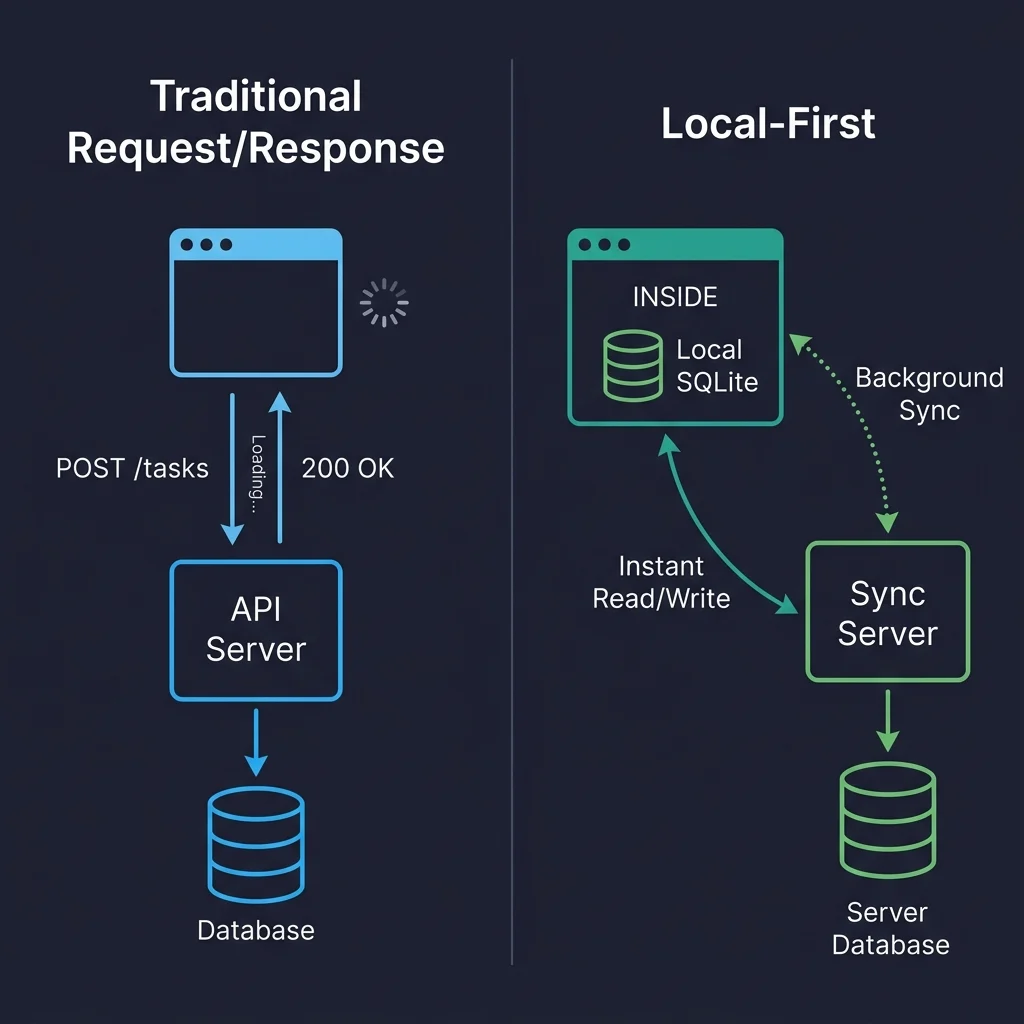
The landscape of web application architecture has undergone a fundamental transformation as of mid-2026, moving away from the centralized "cloud-only" models that dominated the previous decade. For years, the industry standard relied on a "thin client" model, where the browser served as a mere view layer, requesting permission for every data interaction from a server thousands of miles away. However, the inherent fragility of this model—exposed by fluctuating network conditions and the increasing demand for real-time collaboration—has catalyzed the rise of local-first architecture. This paradigm shift prioritizes the client as a primary node in a distributed system, possessing its own database and the authority to perform instant reads and writes without immediate server confirmation.
The Paradigm Shift: From Request-Response to Data Replication
The core tenet of local-first development is a departure from the traditional request-response cycle. In a standard REST or GraphQL architecture, a user action, such as moving a task on a kanban board, triggers an API request. The user is then presented with a loading spinner, awaiting a 200-OK response from the server before the UI reflects the change. In a local-first model, the application writes directly to a local database—typically a version of SQLite running via WebAssembly (WASM)—and the UI updates in less than two milliseconds. Synchronization with the server occurs asynchronously in the background.
This architectural shift is often compared to the transition from Subversion (SVN) to Git in the realm of version control. While SVN required a central server for almost every operation, Git provides every developer with a full replica of the repository. Local-first web development applies this "Git-like" philosophy to application data, ensuring that the user’s device holds the primary copy of their information, while the server acts as a synchronization peer, backup provider, and access control gatekeeper.
A Chronology of Local-First Maturity
The journey toward the current 2026 standard began in earnest in 2019 with the publication of the seminal research paper "Local-first software: You own your data, in spite of the cloud" by the Ink & Switch research lab. At that time, the paper outlined seven ideals: fast performance, multi-device support, offline capability, collaboration, longevity, privacy, and user ownership. However, the technical infrastructure to realize these ideals was largely absent.
By 2022, the emergence of high-performance WebAssembly allowed developers to port complex C-based libraries like SQLite to the browser. The subsequent introduction of the Origin Private File System (OPFS) provided a high-speed, sandboxed file system that allowed these local databases to persist data with performance levels comparable to native desktop applications.
In 2024 and 2025, the "sync engine" market matured. Companies like PowerSync, ElectricSQL, and Triplit began providing the necessary plumbing to connect local SQLite databases with server-side Postgres instances. This solved the "hard problem" of synchronization, allowing developers to focus on application logic rather than the complexities of conflict resolution and partial data replication.
Technical Foundations: The Role of WASM and OPFS
The technical feasibility of local-first apps in 2026 rests on three pillars: SQLite WASM, OPFS, and Conflict-Free Replicated Data Types (CRDTs).
SQLite, compiled to WebAssembly, provides a full relational database within the browser environment. This allows developers to use standard SQL queries, transactions, and indexes on the client side. Supporting this is the OPFS, which offers a synchronous API for Web Workers. According to performance benchmarks from mid-2025, SQLite on OPFS can handle complex joins and multi-row inserts at speeds 10 to 20 times faster than the aging IndexedDB API.
For collaborative environments, such as shared document editors or design tools, CRDTs have become the industry standard. Libraries like Yjs and Automerge allow multiple users to edit the same data structure simultaneously without a central coordinator. These data types are mathematically designed to merge concurrent changes deterministically, ensuring that all users eventually see the same state without the need for manual merge conflict resolution.
Addressing the Conflict Resolution Challenge
Conflict resolution remains the most discussed aspect of local-first engineering. Most modern applications utilize a "Last-Write-Wins" (LWW) strategy at the field level. For instance, if User A updates a task’s title while User B updates its due date, the system merges both changes. A conflict only arises if both users attempt to modify the same field simultaneously, in which case the system uses high-precision timestamps and client IDs as tiebreakers.
However, industry experts distinguish between structural conflicts and semantic conflicts. A structural conflict (two people editing the same text) is handled by the sync engine. A semantic conflict (two people booking the same meeting room for the same time) requires application-level logic. In 2026, the prevailing pattern for resolving semantic conflicts involves the server "flagging" violations rather than rejecting writes. This prevents the "ghost record" problem, where a user’s local state diverges permanently from the server state. Instead, the server accepts the conflicting data but syncs a "violation notification" back to the client, prompting the user to resolve the scheduling overlap manually.
Market Data and Performance Metrics
Data from production-grade local-first applications in 2026 highlights the significant performance gains of this architecture. On average, a local-first application reduces the perceived latency of user interactions by over 95%.
- Read Latency: Local SQLite queries typically return in <5ms, compared to 100ms–500ms for traditional API calls.
- Write Latency: Local writes are near-instantaneous (<2ms), eliminating the need for complex "optimistic update" logic in the frontend.
- Sync Performance: Initial synchronization of a workspace containing 5,000 records takes approximately 1.2 seconds on a standard broadband connection. Incremental updates thereafter consume negligible bandwidth, often less than 1KB per transaction.
Despite these gains, developers must account for the "WASM Tax." Loading the SQLite WASM binary adds approximately 400KB (gzipped) to the initial bundle size. Furthermore, mobile browsers with aggressive memory management may struggle with local databases exceeding 100MB, necessitating aggressive data pruning and partial sync strategies.

Broader Industry Implications and Expert Reactions
The shift toward local-first architecture has significant implications for data privacy and security. Because data is stored and processed locally, end-to-end encryption (E2EE) becomes significantly easier to implement. "The privacy benefits are not just a feature; they are a fundamental byproduct of the architecture," says Dr. Elena Rossi, a distributed systems consultant. "When the server only sees encrypted blobs of data it cannot read, the risk of large-scale data breaches is mitigated at the source."
However, the transition has not been without criticism. Software architects warn of the "complexity budget." Implementing a sync engine and managing client-side schema migrations requires a more sophisticated engineering team than building a standard CRUD app. "The best architecture is the one your team can debug at 2 AM," noted one CTO during the 2025 Web Summit. "For a simple internal tool, local-first is often an expensive over-engineering trap. For a global collaborative platform, it is a necessity."
The Intersection of Local-First and Artificial Intelligence
As we look toward the latter half of 2026, the intersection of local-first architecture and edge-based AI is becoming a major trend. With the advent of WebGPU and optimized local models, applications can now perform AI-driven data analysis, search, and content generation directly on the user’s device.
By keeping the application data in a local SQLite database, these local AI models can access the entire user context with zero latency and maximum privacy. This "Local AI + Local Data" stack is increasingly seen as the next frontier for productivity software, allowing for deeply personalized experiences without the data-sovereignty concerns associated with centralized AI providers.
Conclusion: A New Standard for User Experience
The maturation of local-first web development in 2026 marks the end of the "spinner era." While the architectural complexity is higher than traditional models, the resulting user experience—characterized by instantaneous response times, robust offline capabilities, and enhanced privacy—is setting a new baseline for what users expect from professional software.
As tooling continues to standardize and the "novelty risk" of these technologies decreases, the industry is likely to see a continued migration of data-intensive applications toward the local-first paradigm. For developers and stakeholders, the message is clear: the future of the web is no longer just in the cloud; it is on the device.

