
The global corporate landscape is currently navigating a significant friction point as a widening gap emerges between executive enthusiasm for artificial intelligence and the actual utility experienced by the end-user. While senior leadership across Fortune 500 companies continues to pivot toward "AI-first" strategies, recent market data and user experience audits suggest that the anticipated "craving" for new AI features has failed to materialize among the general workforce. Instead of streamlining operations, many AI implementations are being met with resistance, low retention rates, and a growing sentiment that these tools complicate rather than simplify daily professional life.
The Illusion of the AI Value Proposition
A fundamental misunderstanding currently persists within the upper echelons of technology management: the belief that "AI-powered" is, in itself, a value proposition. Market analysis indicates that while venture capital and boardrooms are enamored with the generative capabilities of large language models (LLMs), customers and employees remain focused on reliability, predictability, and integration.
In many instances, AI features are being introduced as "bolt-on" solutions—separate interfaces or tools that require users to step out of their established workflows. This fragmentation creates a cognitive load that often outweighs the perceived benefits of the automation. When a tool requires a user to "hop" between disconnected systems to verify an AI-generated output, the efficiency gain is neutralized. Furthermore, AI has a documented tendency to amplify existing organizational shortcomings. If a company suffers from poor data quality, fragmented internal communication, or technical debt, the introduction of AI often acts as a magnifying glass for these issues rather than a solution. Instead of fixing broken processes, AI frequently hands the resulting "mess" to the end-user, who is then tasked with reconciling conflicting priorities and correcting inaccuracies.
A Chronology of the AI Integration Cycle (2022–2024)
The current state of AI fatigue can be traced through a distinct timeline of rapid adoption and subsequent realization:
Late 2022: The Catalyst Phase
The public release of ChatGPT and subsequent generative models sparked a "gold rush" mentality. Organizations feared being left behind, leading to a period of "fear of missing out" (FOMO) where AI integration was prioritized over user research.
Mid-2023: The Integration Surge
Major software vendors began embedding AI assistants into core productivity suites. Companies initiated pilot programs, assuming that the novelty of generative text and image creation would translate directly into productivity gains.
Early 2024: The Realization Gap
Studies began to show a disconnect. While executive surveys suggested high confidence in AI ROI, employee sentiment began to dip. Reports from institutions like the IBM Institute for Business Value and the Nielsen Norman Group highlighted that "powered by AI" was failing to excite customers who found the features inconsistent or unreliable.

Late 2024: The Shift to Utility
The current phase is defined by a demand for "AI-second" approaches—where the technology is a silent, background supporter of human tasks rather than the primary interface. There is a growing movement toward "Design Patterns for AI" that prioritize UX over the raw power of the model.
Supporting Data: The Hidden Costs of AI Productivity
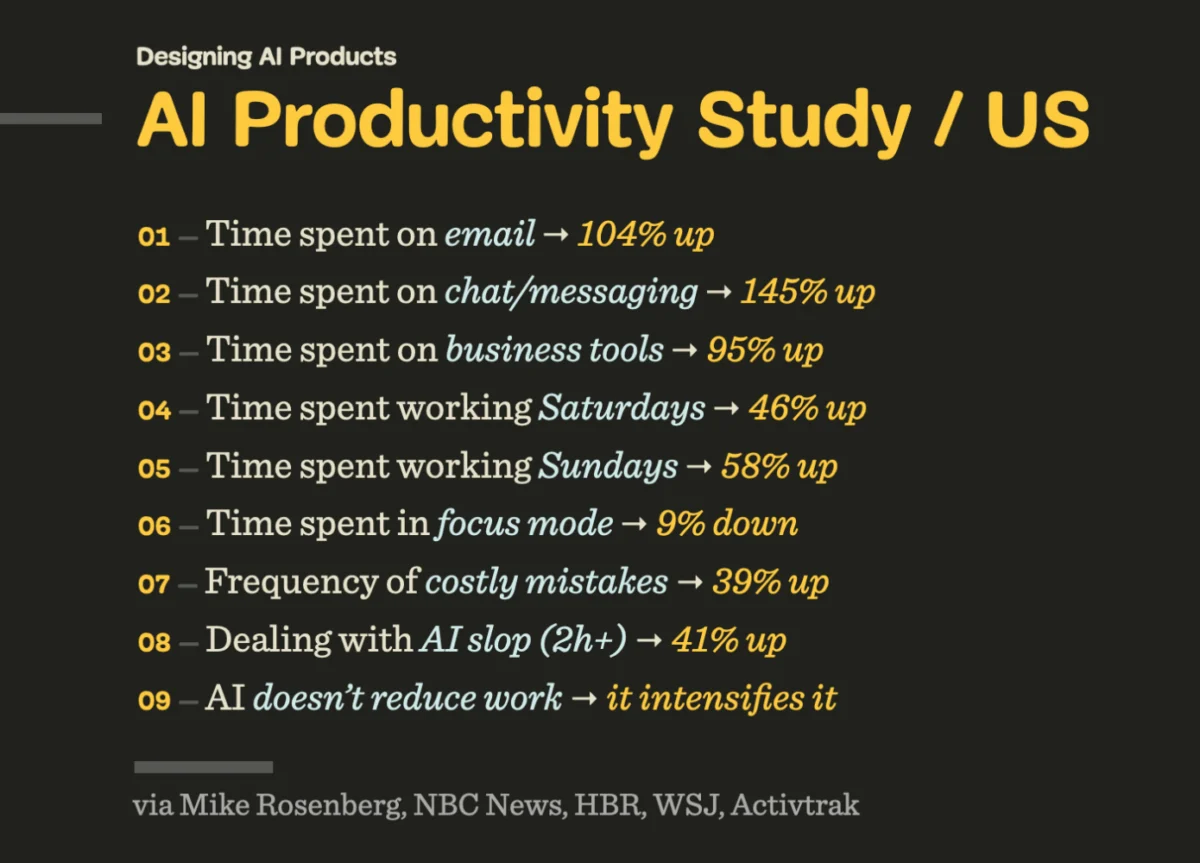
Contrary to the narrative of effortless efficiency, recent productivity studies in the United States have revealed an "intensification" of work. Data compiled from sources including NBC News, Harvard Business Review, and Activtrak suggest that the introduction of AI has led to an increase in secondary tasks.
Specific findings include:
- Time Spent on Communication: Time spent managing emails has increased by an estimated 104%, while chat and messaging volumes have surged by 145%.
- The "Hallucination Tax": The cost of finding and fixing AI-generated errors (hallucinations) has become a significant burden. Mistake-checking and dealing with "AI slop" have increased workload intensity by approximately 41%.
- The Weekend Shift: There has been a recorded 46% increase in work conducted on Saturdays and a 58% increase on Sundays, suggesting that AI is not reducing the workweek but rather extending the time required to manage digital outputs.
- Reliability Metrics: Users report a 39% increase in costly mistakes when relying on AI-generated summaries without rigorous human oversight.
These statistics suggest a "Productivity Paradox" where the speed of initial content generation is offset by the time required for verification and the increased volume of digital noise.

The Psychological Impact and Workforce Resistance
The resistance to AI is not merely a matter of technical friction; it is deeply rooted in psychological and professional anxiety. For many employees, AI represents an "uninvited guest" that arrives at a pace dictated by others. The prevailing narrative that AI will replace human labor has fostered a culture of caution rather than curiosity.
Beyond the fear of job displacement, there is a loss of "vibe-coded" reward. Many professionals derive satisfaction from the process of creation—the thinking, the decision-making, and the refinement of a project. When AI automates the creative or intellectual core of a task, it can strip away the sense of achievement, leaving the worker as a mere "editor" of a machine’s output. This shift is particularly evident in fields like software development and public relations, which are highly exposed to automation but rely heavily on human "taste" and intuition.
Industry leaders have noted that people do not compare AI to other humans; they compare features to other features. If a traditional, non-AI tool works with 100% predictability and an AI tool works with 85% predictability, the user will almost always favor the former. In the professional world, "almost right" is often equivalent to "entirely wrong," especially in legal, medical, or financial contexts.
Official Reactions and Expert Perspectives
The shift in sentiment has prompted reactions from UX designers, ethicists, and corporate strategists. Vitaly Friedman, a prominent figure in the UX design community, has advocated for a more "humble" approach to AI. He suggests that the most successful AI features are those that are "subtle, calm, and ambient," taking a supportive role in the background to handle mundane tasks while leaving the rewarding work to humans.

In a widely discussed statement, Bo Young Lee, a leadership executive, summarized the human-centric desire: "I don’t want AI to teach my children. I don’t want to have an AI therapist. I want AI to do all the physical and mental labor that taxes me so I can read books written by humans and go to art galleries to engage with art made by humans."
This sentiment reflects a broader demand for AI to serve as a tool for "augmentation" rather than "replacement." The goal is not to spend more time with AI, but to use AI to gain more time for human-centric activities.
Broader Implications and the Future of AI Integration
The implications of this adoption gap are significant for the future of software development and corporate strategy. If companies continue to push AI features that users do not want or need, they risk high delivery costs, reputational damage, and a workforce that is both burnt out and disengaged.
To bridge this gap, the industry must pivot toward three core principles:

- Deep Integration over Bolt-ons: AI must be woven into existing mental models and workflows so that it does not feel like an additional task to manage.
- Predictability as a Priority: Reliability must take precedence over novelty. A tool that is "smart" but unpredictable is a liability in a professional environment.
- Human-Centric Design: AI should adapt to how people think and make decisions, rather than forcing people to adapt to the idiosyncratic "prompts" required by a machine.
The "AI-second" philosophy suggests that the most valuable technology is often the most invisible. When AI successfully automates the "boring stuff"—data entry, schedule coordination, or technical troubleshooting—its value is immediately clear. When it attempts to replace human intuition, storytelling, or emotional connection, it meets an inevitable wall of resistance.
Ultimately, the market is beginning to realize that people do not want "more AI" in their lives; they want more time, more focus, and more human connection. The companies that thrive in the next decade will likely be those that use AI to facilitate those human desires, rather than those that attempt to replace them with a "magical box." The future of AI is not in the spotlight, but in the background, quietly making the human experience more efficient and less taxed by mundane labor. The challenge for today’s AI leaders is to stop asking what AI can do, and start asking what humans actually want to be freed from.

