
The shift from traditional software to agentic artificial intelligence represents the most significant paradigm shift in human-computer interaction since the introduction of the graphical user interface. For three decades, designers have relied on a narrow set of visual metaphors to manage user expectations during system latency. The spinning wheel, the progress bar, and the pulsing icon were designed for a technical reality where delays were caused by bandwidth limitations or file sizes. However, as AI agents move from simple chatbots to autonomous entities capable of reasoning, planning, and executing multi-step workflows, these legacy patterns are proving insufficient. Modern interface design must now solve for "thinking time" rather than just "loading time," transforming the black box of AI processing into a transparent, trust-building experience through specific architectural and visual patterns.
The Evolution of User Feedback: From Command Lines to Agentic Reasoning
The history of system feedback is a chronology of increasing complexity. In the early days of computing, command-line interfaces provided immediate, albeit cryptic, feedback. The 1980s saw the rise of the progress bar, a breakthrough that provided users with a mental model of how much work remained. By the 2000s, the "spinner" became the ubiquitous solution for asynchronous web requests. Each of these patterns addressed a static environment where the system was performing a predictable task.
In 2023 and 2024, the emergence of Large Language Models (LLMs) introduced a new variable: stochastic reasoning. When an agentic AI pauses, it is often navigating a "Decision Node"—a moment where it must weigh probabilities, access external APIs, or revise its own internal plan. Industry data suggests that user anxiety increases significantly when an AI pause exceeds ten seconds without granular feedback. According to recent UX research in the field of Explainable AI (XAI), users are up to 40% more likely to abandon a task if they cannot discern whether an agent is "thinking" or has simply crashed. This necessitated the development of the Decision Node Audit, a process where designers map internal system logic to pinpoint exactly when the system should reveal its status to the user.

The Microcopy Revolution: Moving Beyond Generic Status Updates
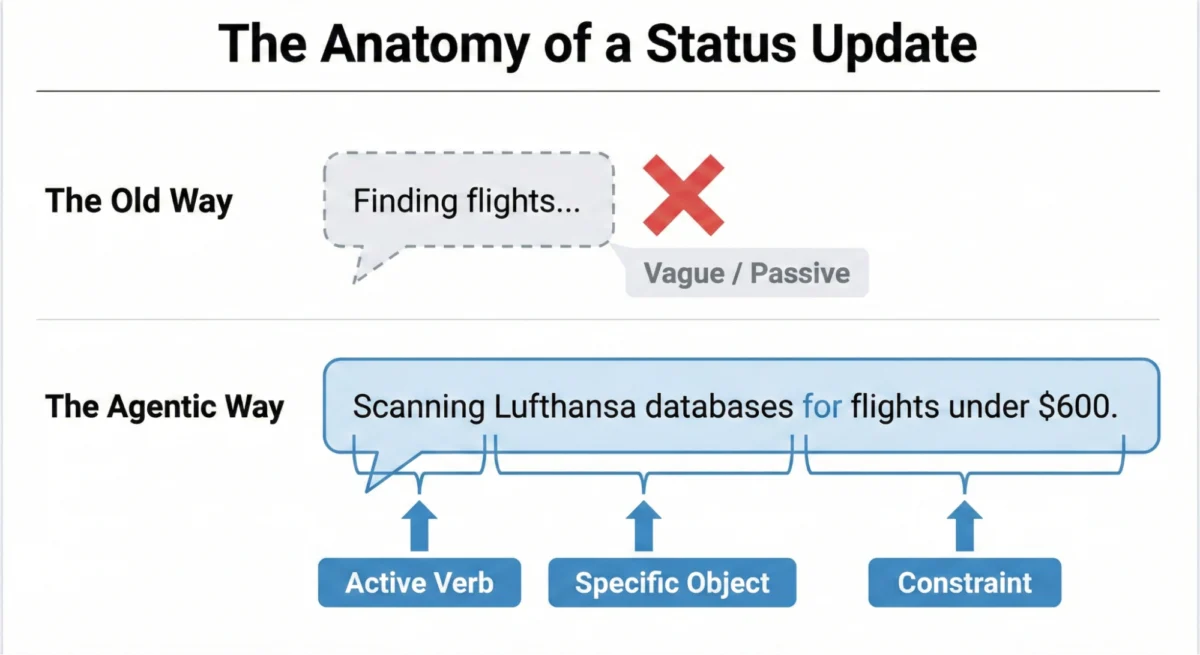
The primary failure of current AI interfaces is the reliance on vague microcopy. Terms like "Working," "Thinking," or "Processing" belong to an era of static software. To build professional-grade trust, designers are now adopting a three-part "Agentic Update Formula": a strong Action Word, a Specific Item, and a defined Limit or Rule.
For example, a travel-planning agent that displays "Searching for flights" provides minimal reassurance. Conversely, an update that reads "Analyzing 150 flight options from London to Tokyo within your $1,200 budget" provides three layers of transparency. It confirms the AI understood the task, reveals the scale of the work being performed, and reaffirms the constraints. This approach grounds the technical process in the user’s actual requirements. By shifting the tone based on an Impact/Risk Matrix, systems can maintain a conversational tone for low-stakes tasks, such as scheduling a meeting, while switching to precise, mechanical language for high-stakes actions like financial auditing or medical data synthesis.

Core Interface Patterns for AI Transparency
To house these status updates, a new library of interface patterns has emerged, categorized by the level of user attention required and the risk associated with the task.
The Living Breadcrumb
Designed for low-stakes background tasks, the Living Breadcrumb is a subtle, non-disruptive indicator. It is ideal for agents drafting emails or organizing file directories in the background. Rather than a pop-up, it utilizes a pulsing text string within the application’s chrome that transitions between states, such as "Reading email threads" to "Drafting response." This pattern provides "passive assurance," allowing the user to continue their primary work while remaining aware that the agent is active.

Dynamic Checklists
For high-stakes workflows with unpredictable durations, the Dynamic Checklist has become the gold standard. Unlike a progress bar, which implies a linear and known timeline, a checklist breaks down the agent’s plan into discrete steps. If a specific step, such as "Verifying account routing numbers," takes longer than expected, the user can see exactly where the bottleneck lies. This prevents the "stalled bar" phenomenon where a progress indicator stays at 99% indefinitely, causing user frustration.
The Thinking Toggle and Raw Logic Logs
Expert users, particularly in software development and data science, often require deeper transparency. The "Thinking Toggle" is a progressive disclosure pattern—usually a chevron or a "View Logs" button—that allows users to expand a friendly summary into a raw terminal view. This view displays the sanitized logic logs of the AI, such as "Querying Vector Database" or "Self-Correction: Revised SQL syntax." While the majority of users may never open this view, its mere presence acts as a "trust signal," indicating that the system has nothing to hide.

Designing for Partial Success and System Disentanglement
One of the most complex challenges in agentic AI is the "grey zone" of partial success. In traditional software, a task either succeeds or fails. In AI, an agent might successfully book a flight and a hotel but fail to secure a specific restaurant reservation.
Designing for this reality requires a move away from binary error messages. A "Request Failed" banner is often a misrepresentation of the work performed. Instead, interfaces must now display granular outcomes: "Travel Plan 90% Complete. Flight and Hotel Booked; Restaurant Reservation Failed." This allows the user to intervene only where necessary, preserving the value of the work the AI did complete.

Furthermore, designers must "disentangle" the AI from its tools. If an agent fails to retrieve data because an external API—such as Google Calendar or a banking portal—is down, the error message must clearly state that the tool failed, not the AI. This distinction is critical for long-term adoption; if a user blames the AI for an external service’s outage, their trust in the agent’s core capabilities is unfairly eroded.
The Audit Trail: Post-Task Verification and the "Memory" Problem
Real-time transparency is only half of the equation. If a user is away from their screen while an agent works, they return to a finished result with no context of how it was achieved. This has led to the requirement of a persistent "Audit Trail." Similar to a digital receipt, the Audit Trail allows users to replay the decision logic after the fact.

This pattern addresses a growing concern regarding "AI Memory." A notable example involves recent criticisms of ChatGPT’s memory features. In early 2025, developers like Simon Willison highlighted instances where ChatGPT used information from past conversations—such as a user’s location—to influence new outputs without explicitly stating it was doing so. This "hidden dossier" approach can lead to user unease, as seen when an AI generates an image with local landmarks the user never requested. A robust Audit Trail prevents this by listing exactly which "memories" or data points were used to generate a specific outcome, turning personalization from a potential privacy concern into a transparent feature.
Professional Implications and the "Accelerator" Mindset
For enterprise users, transparency is not just a UX preference; it is a prerequisite for professional liability. Research involving insurance underwriters and financial analysts suggests that these professionals judge AI systems based on "Expectation Alignment." If an underwriter expects a quote of $500 and the AI returns $550, the user immediately enters a state of skepticism.

If the interface does not provide a persistent explanation for that $50 discrepancy—such as a specific high-risk surcharge found in the fine print—the professional will likely ignore the AI output and recalculate the quote manually. This "manual rework" is the death of AI adoption. The Audit Trail and Dynamic Checklist serve as the mechanisms that prevent this rework by providing the "why" behind the "what" at the exact moment of disagreement.
Future Outlook: Moving from Magic to Partnership
The tech industry is moving away from the "AI as Magic" marketing phase. Magic relies on hidden mechanics and misdirection, whereas professional tools rely on predictability and reliability. By implementing these interface patterns, organizations can transition their AI products from mysterious black boxes to reliable colleagues.

The broader impact of this shift is a move toward "Active Collaboration." When an AI is transparent about its process, limits, and history, the user is no longer a passive recipient of an output. They become a supervisor capable of guiding the system. This level of openness changes the fundamental nature of the interaction, ensuring that trust is built through honesty rather than aesthetic polish. As agentic AI continues to integrate into critical infrastructure, the ability to audit, understand, and trust these systems will be the primary differentiator between successful products and those that fail to gain traction in a skeptical market.

