
The rapid integration of agentic Artificial Intelligence (AI) into enterprise workflows has introduced a critical friction point between autonomous system efficiency and human psychological trust. As AI shifts from passive chatbots to active "agents" capable of executing complex, multi-step tasks—such as processing insurance claims, auditing legal contracts, and managing supply chains—the industry is facing a crisis of transparency. Designers and engineers are currently caught between two suboptimal extremes: the "Black Box" approach, which hides system logic to maintain a clean interface, and the "Data Dump," which overwhelms users with raw logs and API calls. To bridge this gap, a new methodology known as the Decision Node Audit is emerging as a standard for creating trust through calibrated transparency, ensuring that autonomous systems remain accountable to their human overseers.
The Crisis of the Black Box in Autonomous Systems
The fundamental challenge of agentic AI lies in the "latency of logic." When a user assigns a complex task to an agent, the system often enters a period of high-intensity processing that can last anywhere from thirty seconds to several minutes. During this interval, the user is frequently left with a static progress bar or a generic "processing" message. This lack of visibility triggers significant cognitive load and anxiety, leading users to question whether the system is hallucinating, skipping critical compliance steps, or failing entirely.
Research into human-computer interaction suggests that trust is not a binary state but a mechanical result of predictable communication. When an agent disappears into a black box, the user loses the context necessary to validate the eventual output. Conversely, providing a raw stream of every background operation—the data dump—leads to notification blindness. In this state, users ignore all information until a failure occurs, at which point they lack the historical context required to diagnose and fix the error. Industry experts argue that the ideal user experience lies in "transparency moments"—specific, high-value updates that reveal the agent’s internal decision-making process at critical junctures.
The Evolution of AI Interface Design: A Brief Chronology
The trajectory of AI design has moved through three distinct phases over the past decade. In the initial phase, AI was largely invisible, operating as recommendation engines within social media feeds or streaming services. The second phase, popularized by the release of Large Language Models (LLMs) in late 2022, introduced the conversational interface, where transparency was achieved through real-time text generation.
The current third phase involves agentic AI, where the system does not just speak but acts. This shift has necessitated a move away from simple chat bubbles toward complex dashboards that include "Intent Previews" and "Autonomy Dials." The chronology of this shift highlights a growing demand for "Labor Illusion" in design—a psychological phenomenon where users perceive more value in a service when they can see the work being performed. By 2024, the focus shifted from what the AI says to how the AI decides, leading to the development of the Decision Node Audit.
Methodology: The Decision Node Audit and Probability Mapping
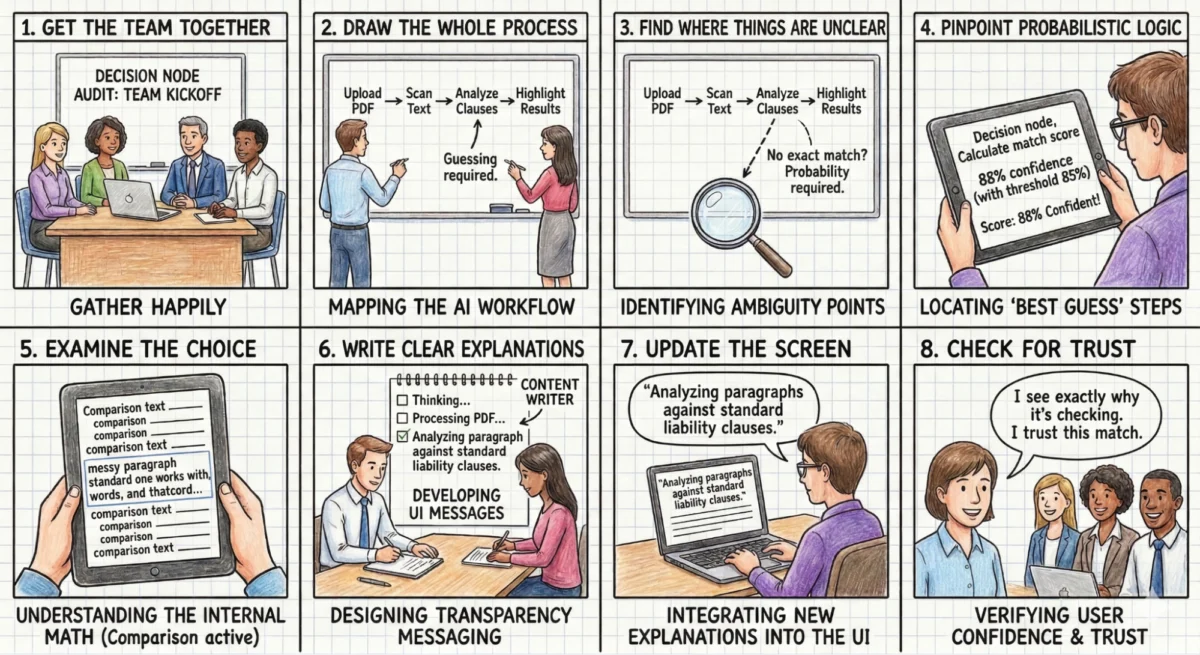
The Decision Node Audit is a structured process that requires cross-functional collaboration between software engineers, product managers, and UX designers. The goal is to map the backend logic of an AI agent to the user interface, identifying "Ambiguity Points" where the system makes choices based on probability rather than hard-coded rules.
In traditional software, if-then logic is deterministic; however, agentic AI operates in a probabilistic framework. For instance, an AI reviewing a legal contract may be 65% certain that a liability clause meets company standards. This 35% margin of uncertainty represents a "Decision Node." The audit process involves three primary phases:

- System Logic Mapping: The team documents every step the AI takes from input to output.
- Ambiguity Identification: Engineers pinpoint where the system uses confidence scores or comparative analysis to make a judgment call.
- Transparency Translation: These technical nodes are converted into human-readable status updates, such as "Analyzing liability risk levels" instead of a generic "Working" status.
Case Study: Meridian Insurance and the Impact of Visible Logic
A recent implementation of these principles can be seen in the case of Meridian (a pseudonym for a major insurance provider). The company deployed an agentic AI to handle initial vehicle accident claims. Originally, the system followed a black-box model: the user uploaded photos and police reports, and the screen displayed "Calculating Claim Status" for sixty seconds. User frustration was high, with many reporting a lack of confidence in the AI’s ability to parse complex mitigating circumstances in police reports.
Following a Decision Node Audit, the team identified three probability-based steps within the workflow: assessing damage severity, reviewing police report narratives, and verifying policy coverage. The interface was updated to reflect these stages in real-time. Although the processing time remained identical, user satisfaction scores increased significantly. By seeing the AI "Reviewing police report for mitigating factors," users felt the system was performing the thorough due diligence they expected from a human adjuster.
The Impact/Risk Matrix: Prioritizing Information Flow
To avoid the pitfall of the data dump, designers utilize an Impact/Risk Matrix to prune the information shown to the user. Not every decision node warrants a notification. The matrix categorizes AI actions based on two axes: Stake Level and Reversibility.
High-Stakes and Irreversible Actions
These are the most critical nodes, such as permanently deleting a database or executing a high-value financial trade. These moments require an "Intent Preview" pattern, where the AI pauses and requests explicit human confirmation before proceeding. This friction is intentional, serving as a safety interlock.

High-Stakes and Reversible Actions
Actions such as moving a sales lead to a different pipeline or drafting a client email are high-impact but can be undone. These are handled via "Action Audits" and "Undo" patterns. The AI proceeds autonomously but provides a clear log of its actions and an immediate opportunity for reversal.
Low-Stakes Actions
Decisions such as renaming internal files or archiving routine notifications are often kept invisible or relegated to a passive log. Displaying these would contribute to alert fatigue without providing meaningful value to the user.
Qualitative Validation: The "Wait, Why?" Protocol
Beyond technical audits, the industry is adopting the "Wait, Why?" protocol for qualitative validation. During user testing, participants are asked to watch an agent complete a task and verbalize their thoughts. Any moment the user asks "Wait, why did it do that?" or "Is it stuck?" is marked as a timestamped failure of transparency.
In a healthcare scheduling assistant study, a four-second silence caused users to worry about calendar synchronization. By splitting that four-second window into two transparency moments—"Checking your availability" followed by "Syncing with provider schedule"—the reported anxiety levels dropped by nearly 40%. This confirms that transparency is not merely about providing information but about aligning the system’s communication with the user’s mental model.

Broader Implications for Corporate Governance and AI Regulation
The move toward transparent agentic design carries significant implications for regulatory compliance. With the advent of the EU AI Act and increasing scrutiny from the FTC, companies are under pressure to explain how their AI systems reach specific conclusions. A documented Decision Node Audit provides a "paper trail" of how transparency was prioritized, which can serve as a defense in cases of algorithmic bias or error.
Furthermore, this approach changes the internal culture of product development. It forces a departure from siloed workflows where engineers build the "brain" and designers build the "skin." Instead, it requires an integrated approach where the technical capabilities of the backend directly inform the linguistic and visual elements of the frontend.
The Future of Trust in the Age of Autonomy
As AI agents become more sophisticated, the window for human intervention will likely shrink. However, the requirement for human oversight remains a constant in high-risk industries. The frameworks outlined—the Decision Node Audit, the Impact/Risk Matrix, and the "Wait, Why?" protocol—represent a shift toward a more mature, responsible era of AI implementation.
Trust in AI is not an emotional byproduct but a design choice. By exposing the machinery of the agent at the right moments, organizations can transform a period of user anxiety into a moment of perceived value. As the industry moves forward, the most successful AI tools will not be those that work the fastest in total silence, but those that communicate their labor with the most clarity. The goal is to move from "Black Box" systems to "Open Experiences," where the user and the agent act as partners in a transparent, verifiable workflow.

