
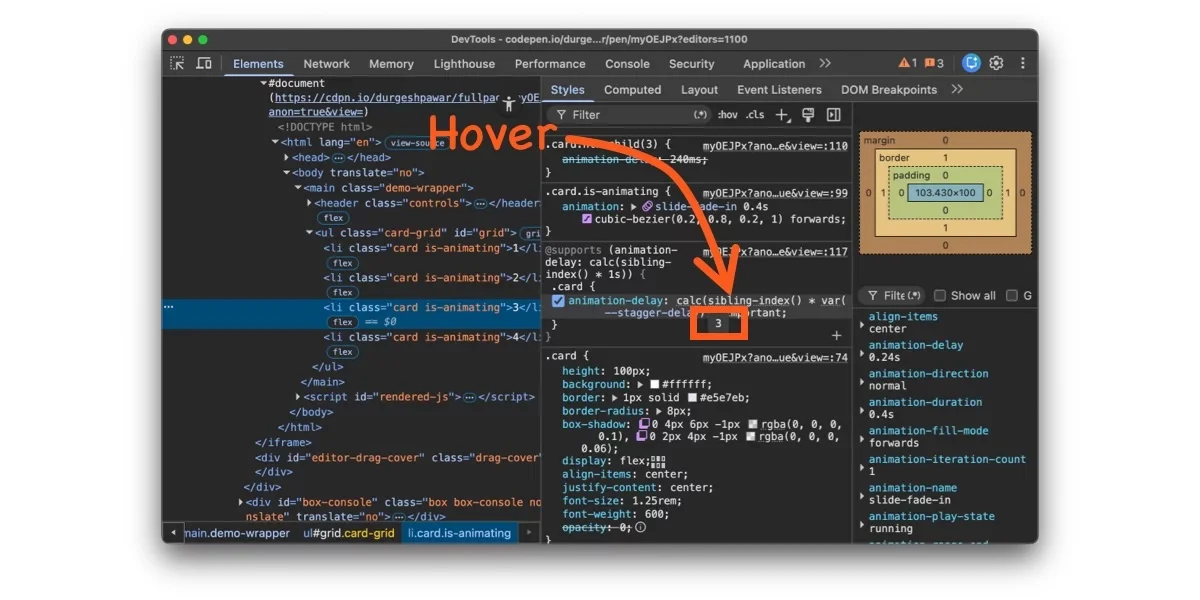
The introduction of the sibling-index() and sibling-count() functions marks a significant milestone in the evolution of Cascading Style Sheets (CSS), effectively bridging a long-standing gap between the Document Object Model (DOM) and style declarations. These new functions, part of the CSS Values and Units Module Level 5, allow developers to access an element’s position and the total number of its siblings directly within CSS. This capability eliminates the need for complex :nth-child() selector chains, preprocessor loops, or JavaScript-based style injections that have historically been required to create staggered animations and proportional layouts.
The Technical Shift: From Hardcoded Selectors to Dynamic Calculation
For decades, web developers seeking to implement staggered visual effects—such as a grid of cards fading in sequentially—faced a choice between two suboptimal strategies. The first involved writing multiple CSS rules using the :nth-child() pseudo-class. For a list of ten items, a developer would typically write ten individual rules, each manually assigning a unique animation delay. This approach was inherently fragile; if the number of items exceeded the number of defined rules, the effect would fail for subsequent elements.
The second common strategy involved utilizing JavaScript to iterate through DOM elements and inject inline CSS custom properties (e.g., element.style.setProperty('--index', i)). While dynamic, this method often led to a "separation of concerns" violation, where layout logic was scattered across scripts, making the codebase harder to maintain and prone to breaking during component refactoring.
The core issue was that while the browser’s rendering engine inherently knew the position of every element within the DOM tree, CSS lacked a native mechanism to query that data. The approval of sibling-index() and sibling-count() via CSS Working Group (CSSWG) issue #4559 addresses this by exposing internal tree-counting data as usable integers within CSS declarations.
Chronology of Development and Specification
The journey toward native tree-counting functions began in the early 2020s as developers pushed for more expressive layout tools. The proposal was formally integrated into the CSS Values and Units Module Level 5, specifically within Section 9, titled "Tree-Counting Functions."
- Initial Proposal: Discussion centered on the inefficiency of existing "O(N)" strategies where developers used complex selectors to count elements.
- Approval: Following substantial debate regarding performance and syntax, the CSSWG approved the functions, opting for a simple, argument-free syntax for the initial release.
- Browser Implementation: Chrome and Edge 138 reached stable release in June 2025, providing the first major platform support. Safari followed shortly after with version 26.2.
- Current Status: As of mid-2025, implementation work is actively tracked in Firefox under Bugzilla issue #1953973, with Mozilla signaling a positive standards position.
Unlike the counter() function, which returns a string and is restricted to the content property of pseudo-elements, sibling-index() and sibling-count() resolve to actual <integer> values. This technical distinction is critical, as it allows the functions to be used within calc(), min(), max(), and modern trigonometric functions like sin() and cos().
Practical Applications and Use Cases
The primary advantage of these functions is the ability to create "mathematical layouts" that adapt to the number of elements present without manual intervention.
1. Staggered Animation Cascades
With a single line of code—animation-delay: calc(sibling-index() * 100ms);—developers can ensure that every item in a list, whether there are five or five thousand, animates in sequence. By incorporating sibling-count(), developers can also create reverse-staggered effects where the last item fires first: animation-delay: calc((sibling-count() - sibling-index()) * 80ms);.
2. Automatic Proportional Widths
In UI components like tab bars or navigation menus, sibling-count() allows for perfect distribution of space. Setting width: calc(100% / sibling-count()); ensures that tabs automatically resize as items are added or removed from the DOM, eliminating the need for media queries or ResizeObservers for basic proportional adjustments.
3. Dynamic Hue and Color Distribution
Designers can distribute colors evenly across the HSL color wheel by tying the hue to the sibling index. By calculating (360deg / sibling-count()) * sibling-index(), a set of elements will always form a complete and balanced color palette regardless of the count.
4. Advanced Radial Layouts
The combination of tree-counting and native CSS trigonometric functions enables the creation of complex radial menus. By using the sibling index to determine the angle of each item, CSS can calculate the top and left coordinates of elements arranged in a circle, a task that previously required coordinate geometry calculations in JavaScript.
Technical Constraints and Edge Cases
While sibling-index() and sibling-count() offer significant power, the specification includes several "gotchas" related to DOM structure and security.
Shadow DOM Scoping: The functions operate on the actual DOM tree rather than the flattened visual tree. In the context of Web Components, sibling-index() only recognizes siblings within the same shadow root. Elements projected into a component via a <slot> are not counted as siblings of internal shadow DOM elements. Furthermore, for security reasons, CSS reaching into a component via ::part() will see a value of 0 to prevent external stylesheets from probing a component’s private internal structure.
Pseudo-Element Behavior: ::before and ::after are not considered siblings in the DOM tree. However, if these functions are used within a pseudo-element’s declaration, they resolve based on the index of the "originating element." This allows developers to style decorations based on the parent element’s position.
The Impact of display: none: A critical distinction for developers is that these functions read the DOM tree, not the layout tree. An element with display: none is removed from the visual layout but remains in the DOM. Consequently, it still occupies an index. For layouts that require sequential counting—such as a filtered list where hidden items should not leave "gaps" in the animation timing—developers must physically remove nodes from the DOM or utilize JavaScript to manage indexes.

Performance Analysis and Scalability
From a performance perspective, native tree-counting functions are generally more efficient than JavaScript alternatives because they are evaluated during the CSS cascade phase, before layout and paint. However, the computational cost is not zero.
When an element is inserted at the beginning of a container, the browser must recalculate the sibling index for every subsequent sibling. In standard UI scenarios involving dozens or even a few hundred elements, this cost is negligible. However, for extreme use cases—such as data-heavy infinite scrolls or virtualization windows containing thousands of nodes—the constant recalculation of styles for every sibling could lead to main-thread jank. Industry experts suggest that while these functions are robust, JavaScript-managed indexes remain the preferred solution for highly volatile, high-density data environments.
Industry Reaction and Accessibility Implications
The response from the web development community has been overwhelmingly positive, with many citing the functions as a major step toward "CSS-first" development. However, accessibility experts have issued a cautionary note: these functions are purely visual.
If a developer uses sibling-index() to visually reorder elements—for instance, by manipulating the order property in a Flexbox or Grid layout—the visual order will no longer match the DOM source order. Since screen readers and keyboard navigation follow the DOM order, this can create a disjointed experience for users with disabilities. To maintain compliance with Web Content Accessibility Guidelines (WCAG), developers must ensure that any tree-counting logic used for layout does not break the logical flow of information. Furthermore, ARIA attributes such as aria-posinset and aria-setsize must still be managed via JavaScript, as they currently have no native way to sync with CSS-calculated values.
The Road Ahead: Future Specification Extensions
The CSSWG is already looking toward expanding these capabilities. A proposed extension, tracked in issue #9572, would introduce an of <selector> argument, similar to the syntax used in :nth-child(n of .selector). This would allow for sibling-index(of .active), enabling developers to count only a specific subset of siblings. This would solve the "hidden element" problem, allowing for sequential counting even when some siblings are filtered out visually.
Additionally, proposals for children-count() and descendant-count() are currently under discussion. While sibling-count() provides a horizontal view of the DOM tree, these future functions would provide a vertical view, allowing parent elements to style themselves based on the number of children they contain.
In summary, sibling-index() and sibling-count() represent a fundamental shift in how CSS interacts with the DOM. By providing a native, performant way to access tree data, they reduce the industry’s reliance on "hacky" workarounds and pave the way for more dynamic, math-driven layouts that are easier to write and maintain. As Firefox moves toward implementation, these functions are set to become a baseline requirement for modern web architecture.

