
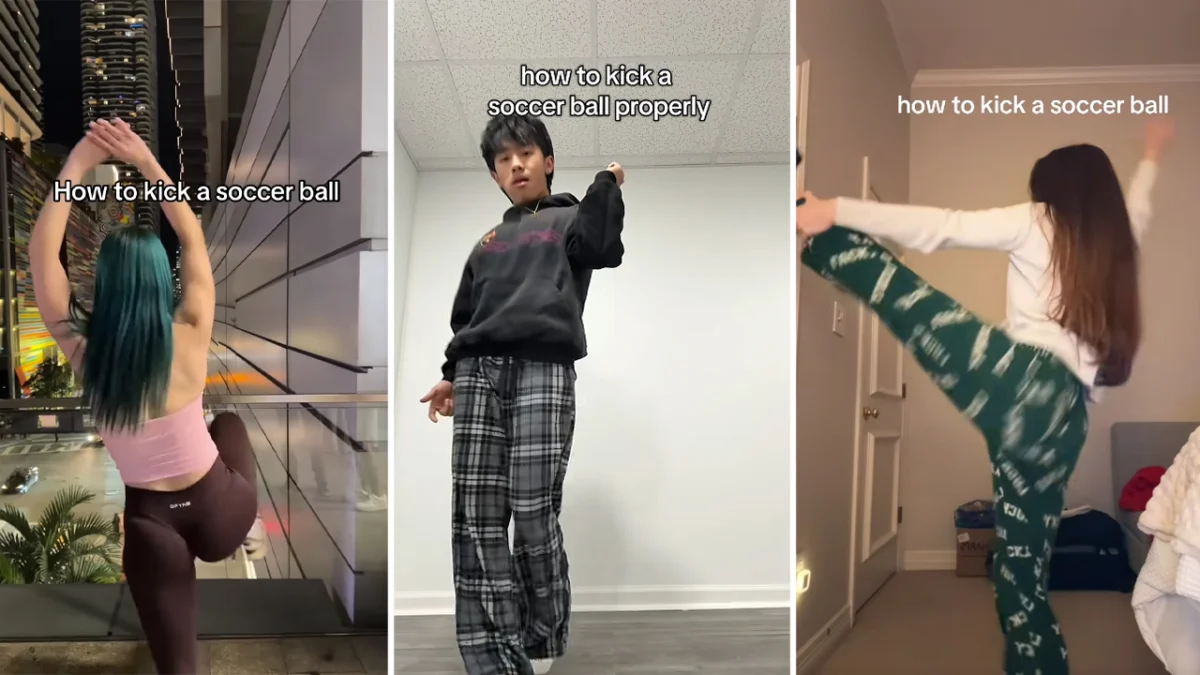
The Kick A Ball Trend, also recognized across digital platforms as the How To Kick A Soccer Ball or How To Properly Kick A Soccer Ball Trend, represents a significant shift in the landscape of viral bait-and-switch media and performative pranks. Emerging in the final quarter of 2025 and maintaining cultural relevance through mid-2026, the trend utilizes a deceptive instructional premise to engage viewers. Participants typically begin their videos by positioning themselves as if they are about to provide a technical demonstration of association football—commonly referred to as soccer in North America—only to subvert expectations by intentionally missing the ball and transitioning into a choreographed dance or twerking routine.
This phenomenon is categorized by digital media analysts as a "thirst trap" trend, where the athletic context serves as a creative vehicle for self-expression and performative display. While the trend primarily flourished on TikTok and Instagram Reels, its reach eventually transcended linguistic and geographic barriers, manifesting in various international iterations. By blending sports culture with the established tropes of short-form video comedy, the Kick A Ball Trend exemplifies the mid-2020s obsession with "zesty" content—a colloquial term for flamboyant or high-energy performance—and the persistent popularity of the bait-and-switch format.
The Genesis and Early Trajectory of the Trend
The origins of the Kick A Ball Trend can be traced back to November 2024, with the first documented instance appearing on the social media platform TikTok. On November 24th, 2025, Nepali American creator only3ms uploaded a video that established the structural blueprint for the trend. Under the caption "how to kick a soccer ball properly," the creator presented the video as a genuine tutorial. However, instead of delivering a strike, the creator performed a stylized strut toward the camera. This initial post garnered approximately 138,400 views and 20,900 likes within a nine-month window, signaling the potential for the format to resonate with a broader audience.
Following this initial spark, the trend underwent a rapid evolution. Within days, other creators began to refine the "switch" aspect of the bait-and-switch. On November 29th, 2025, TikTok user kayy_millzz introduced a more provocative element to the prank, which would eventually become a staple of the trend. In her version, she adopted the instructional premise but pivoted to a twerking routine with one leg raised, a visual motif that many subsequent participants would emulate. Her contribution proved highly successful, securing over 53,200 likes and further solidifying the trend’s identity as a blend of humor and physical performance.
Exponential Growth and Platform Saturation
As the calendar turned to December 2025, the Kick A Ball Trend transitioned from a niche hobbyist activity to a mainstream social media sensation. The simplicity of the setup—requiring only a ball, a camera, and a basic understanding of the "bait" structure—allowed for high levels of user participation. On December 1st, 2025, creator jamesdnpng shared a version filmed in a domestic setting, emphasizing the "zesty" nature of the movement. This specific iteration exploded in popularity, amassing over 2.9 million likes and nearly 15,000 comments, marking one of the highest engagement peaks for the trend during its early lifecycle.
The surge in popularity was supported by the TikTok and Instagram algorithms, which increasingly prioritized high-retention content. The bait-and-switch format is inherently designed for high retention; viewers often watch the first few seconds expecting a tutorial, and once the "twist" occurs, they are likely to watch until the end or re-watch to see the transition. This mechanical advantage helped the trend spread internationally. By mid-December, creators in Asia began adopting the format. On December 15th, 2025, Korean Instagram user joyyourtype posted a version of the trend, demonstrating the cross-cultural appeal of the visual humor involved.
Analytical Breakdown of Engagement Metrics
Data collected from the peak of the trend suggests that the Kick A Ball Trend possessed a remarkably high "virality coefficient." For instance, a video posted by user izzil888 on December 19th, 2025, received over 489,500 likes. More notably, the video was shared over 100,000 times, indicating a high level of peer-to-peer transmission. This ratio suggests that the trend was not merely being passively consumed but was being used as a communicative tool between users.
The trend’s longevity is also reflected in its continued performance throughout the first half of 2026. In April 2026, creator chofff330 participated in the trend, receiving over 348,300 likes, proving that the format had not yet reached a point of audience fatigue. By May and August of 2026, creators like squishyymama and your1weaknesss continued to find success with the format, often adding personal narratives, such as claiming to be "former players" to enhance the irony of the missed kick.
Subversion and the "Meta" Stage of the Trend
As with many viral memes, the Kick A Ball Trend eventually entered a "meta" stage where creators began to subvert the subversion. On December 7th, 2025, an Instagram user known as madtekkerz posted a version that acted as a counter-prank. While the setup mirrored the "thirst trap" versions, the creator followed through with a high-skill soccer strike into a goal, effectively pranking viewers who were expecting a dance routine.
This subversion served several purposes within the digital ecosystem:
- Audience Correction: It appealed to viewers who were weary of the dance-centric versions and preferred genuine athletic content.
- Skill Validation: It allowed creators with actual soccer talent to reclaim the hashtag while still benefiting from the trend’s high search volume.
- Humorous Contrast: The humor shifted from the "missed kick" to the "unexpected success," keeping the format fresh for long-term viewers.
Cultural and Psychological Implications
The success of the Kick A Ball Trend can be attributed to several psychological and cultural factors prevalent in mid-2020s internet culture. At its core, the trend exploits "pattern interruption." Human brains are wired to predict the outcome of a sequence; when a person stands over a ball in an athletic stance, the brain anticipates a kick. The sudden shift to a dance move creates a dopamine-rewarding surprise, which is a fundamental component of humor and viral engagement.
Furthermore, the trend highlights the blurring lines between different genres of content. In this case, the "educational" or "tutorial" genre is co-opted by the "performance" and "thirst trap" genres. This reflects a broader movement on social media where creators use mundane or professional contexts to showcase personality or physical attributes. The "zesty" label applied to many of these videos also points to a shifting standard of masculinity and performance on platforms like TikTok, where flamboyant and expressive movements are celebrated and rewarded with high engagement.
Platform Dynamics and the Role of Audio
The role of audio in the Kick A Ball Trend cannot be overstated. Most iterations utilized specific sound clips, such as "Leave Em Alone" by Quality Control or various "original sounds" that became synonymous with the movement. On TikTok, audio acts as a connective tissue; clicking on a specific sound allows users to see thousands of variations of the same trend. The synergy between the visual bait-and-switch and the rhythmic timing of the audio tracks allowed creators to synchronize their "miss" with a specific beat drop, enhancing the comedic and aesthetic impact.
Instagram Reels also played a vital role in the trend’s internationalization. While TikTok is often the birthplace of such memes, Instagram’s global infrastructure allowed the Kick A Ball Trend to reach demographics that may not be active on TikTok, particularly in regions where Instagram remains the dominant short-form video platform.
Impact on Sports Media and Digital Trends
The Kick A Ball Trend has left a measurable mark on how sports content is consumed by younger demographics. It suggests that for Gen Z and Gen Alpha audiences, sports are often viewed through the lens of lifestyle and entertainment rather than just competition or skill. The fact that a "fake" soccer tutorial could generate significantly more engagement than many "real" tutorials highlights the priority of entertainment value over utility in the current attention economy.
In conclusion, the Kick A Ball Trend is more than a simple internet prank; it is a case study in digital subversion and the power of the bait-and-switch. From its humble beginnings in late 2025 to its status as a global phenomenon in 2026, the trend demonstrated how a simple creative pivot could capture the attention of millions. As social media continues to evolve, the lessons learned from this trend—regarding retention, pattern interruption, and cross-platform pollination—will likely influence the next generation of viral content. Whether viewed as a harmless joke or a calculated pursuit of digital influence, the "How To Kick A Soccer Ball" phenomenon remains a definitive moment in the history of mid-2020s internet culture.

