
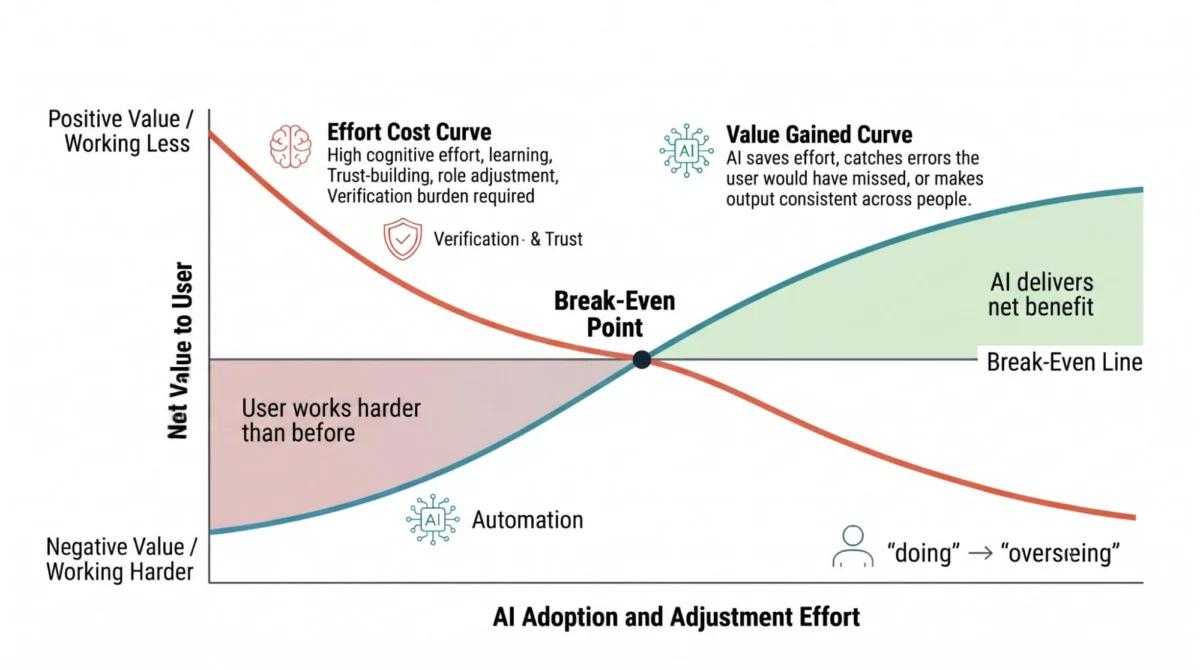
In the current landscape of enterprise software development, the rush to integrate generative artificial intelligence has led to a significant paradox: features designed to save time often increase the cognitive burden on the end-user. As organizations pivot from experimental AI implementations to long-term operational strategies, a new evaluative framework known as the "Break-even Line" audit is gaining traction among product teams. This practical audit helps developers determine whether an AI feature truly earns its place within a workflow or if it merely shifts the nature of labor from creation to exhaustive verification.
The Efficiency Paradox in Enterprise AI
The central challenge facing modern product teams is the hidden cost of AI adoption. While an AI model may execute a task—such as drafting a document or analyzing a dataset—in a fraction of the time a human would require, the subsequent "shadow work" of auditing that output can negate any gains. A primary example of this phenomenon was recently observed within a large health insurance provider. The organization’s product team attempted to deploy an AI system to draft full written determinations for benefits appeals specialists.
On a technical level, the technology functioned perfectly, producing coherent and contextually relevant drafts. However, internal tracking soon revealed a troubling trend: specialists were either abandoning the tool or taking significantly longer to process cases than those who worked manually. A subsequent evaluation revealed that the mental effort required to read an AI-generated determination carefully enough to legally sign off on it was equal to, or greater than, the effort required to write one from scratch. Furthermore, the specialists were forced to remain hyper-vigilant for "hallucinations" or logical errors that a human professional would never commit, adding a layer of stress to a task they had already mastered.
The resolution for the insurer came not from improving the AI’s writing capabilities, but from rescoping the feature. By pivoting to a "search and surface" model—where the AI identified relevant policy provisions and prior decisions but left the final writing to the human expert—the search time dropped, and the specialists’ core competencies remained central to the workflow. This shift highlights the fundamental principle of the Break-even Line: the value of an AI feature is determined by the specific part of the task it handles, not just the power of the underlying technology.
The Anatomy of the Break-even Line
Every change to a user interface imposes an immediate cognitive cost. Users must update their mental models of the tool, locate new controls, and calibrate their level of trust in the machine’s output. According to seminal research by Nelson Cowan in 2001, the human working memory is limited to approximately four items at any given time. When an AI feature forces a user to juggle the original task, the tool’s new mechanics, and the verification of the output, it risks exceeding this capacity.
In enterprise settings, AI does more than redesign a menu; it alters the user’s professional identity. When a synthesis task is handed to an AI, the user is demoted from a "creator" to a "checker." Research conducted by Sophia Ackerhans in 2025 found that this shift can be particularly damaging in high-stakes fields like medicine. Physicians who were asked to sign off on AI-assisted decisions reported a perceived threat to their professional standing. Interestingly, the study found that providing detailed explanations of the AI’s reasoning increased trust but simultaneously heightened the threat to the professional’s identity, as the machine appeared to be encroaching on the physician’s specialized judgment.
For an AI feature to be successful, its "return" must exceed the "cost" of adjustment. Returns generally manifest in three forms:
- Time Saved: The task is completed faster, including the time spent on verification.
- Starting Point Provided: The AI overcomes the "blank page" problem for non-experts.
- Errors Caught: The AI identifies issues that a human would likely miss.
A Chronology of AI Integration Failures and Successes
The evolution of AI in the workplace has followed a distinct timeline, moving from simple automation to complex generative tasks.
- Phase 1: Deterministic Automation (2010–2020): Rules-based systems handled repetitive data entry. Verification was simple because the logic was transparent.
- Phase 2: The Generative Leap (2021–2023): LLMs began drafting emails, summaries, and code. Adoption was high, but "AI fatigue" set in as users realized the high rate of subtle errors.
- Phase 3: The Audit Era (2024–Present): Product teams began utilizing frameworks like the Break-even Line to prune features that added more work than they saved.
A comparative analysis of common AI features illustrates this divide. AI-powered meeting summaries, now ubiquitous in platforms like Zoom and Microsoft Teams, generally clear the break-even line. For the average participant, the benefit of having a searchable record far outweighs the occasional misattribution of a speaker. However, for a senior legal analyst, an AI-generated contract summary might fall below the line, as the risk of a missed clause is too high to permit anything less than a full manual reading of the original document.
The Four-Question Audit Framework
To prevent the deployment of "value-negative" features, product teams are encouraged to run a four-question audit during the proposal phase.
1. Does This Reduce Total Effort?
Teams must calculate the "total cost of ownership" for a task. This includes the thinking, clicking, and checking required. If an AI pre-fills a form, but the user must verify every field against a source document, the effort has merely been relocated, not reduced. This is particularly true for senior staff who have developed "muscle memory" for certain tasks; for them, the AI often acts as an obstacle rather than an accelerant.
2. Does This Beat the Current Method?
AI excels in scenarios involving ambiguity, massive scale, or the need for consistency across large teams. However, if a user already has a streamlined spreadsheet or a practiced workflow that reaches a reliable answer in minutes, the AI intervention is likely redundant. A "design condition" arising from this question is the removal of AI from any step where the manual method is already optimized.
3. Can the User Catch the Errors?
This is perhaps the most critical question for risk management. Error visibility varies significantly. For instance, if an AI trip planner suggests a flight that departs before a connection arrives, the error is visible on the screen. If it suggests a restaurant that has been closed for two years, the error is invisible until the user arrives at the location.

Decades of human factors research by Raja Parasuraman and Dietrich Manzey (2010) show that humans are prone to "automation bias," where they stop scrutinizing machine output once a baseline of trust is established. To combat this, features with high-consequence, low-visibility error surfaces must ship with "provenance"—clear indicators of where the data originated and when it was last verified.
4. Is Long-term Skill Atrophy a Risk?
A 2023 experiment involving 27 radiologists revealed the dangers of long-term AI reliance. When presented with mammograms and AI suggestions, even experienced radiologists (averaging 15 years in the field) saw their diagnostic accuracy drop from 82.3% to 45.5% when the AI provided an incorrect suggestion. The study suggests that constant deference to AI judgment can degrade the very human expertise required to catch the AI’s mistakes.
Implementing the Decision Matrix
The findings of these questions should be synthesized into a decision matrix (Table 1) that dictates the design brief.
| Audit Question | AI Earns Its Place When… | AI Costs the User When… | Design Condition |
|---|---|---|---|
| Total Effort | Synthesis of large data is required. | Verification equals original work time. | Name the served segment; provide exits. |
| Current Method | AI wins on scale or consistency. | Manual path is already fast and reliable. | Remove AI from optimized steps. |
| Error Detection | Errors are obvious; stakes are low. | Errors are subtle; stakes are high. | Mandatory provenance and prompts. |
| Skill Retention | User keeps making judgment calls. | AI absorbs judgment with no feedback. | Build in periodic human-only reviews. |
Strategic Implications for Product Roadmaps
The results of a Break-even Line audit often lead to a "rescoping" rather than a total cancellation of a project. For instance, in the case of meeting summaries, the audit reveals that while the summary is useful, the high consequence of misattributing an action item requires a "linked source timestamp" for every attributed decision. This becomes a non-negotiable project requirement.
Furthermore, these audits allow for better user segmentation. A feature that fails for a senior analyst may be a vital "scaffold" for a junior employee who lacks the pattern-matching experience to start a task from scratch. By identifying these segments, product managers can deploy AI features as onboarding tools rather than universal workflow changes.
As competitive pressure forces companies to announce AI capabilities, the "pro-innovation bias"—the assumption that all new technology is inherently beneficial—can lead to strategic missteps. By spending an hour on a structured audit, product teams can provide a factual, objective basis for their design choices, ensuring that AI serves as a genuine force multiplier rather than a cognitive tax on the workforce. The ultimate goal is to protect the fixed supply of human attention, ensuring it is spent on high-value judgment rather than the tedious verification of machine-generated drafts.

