
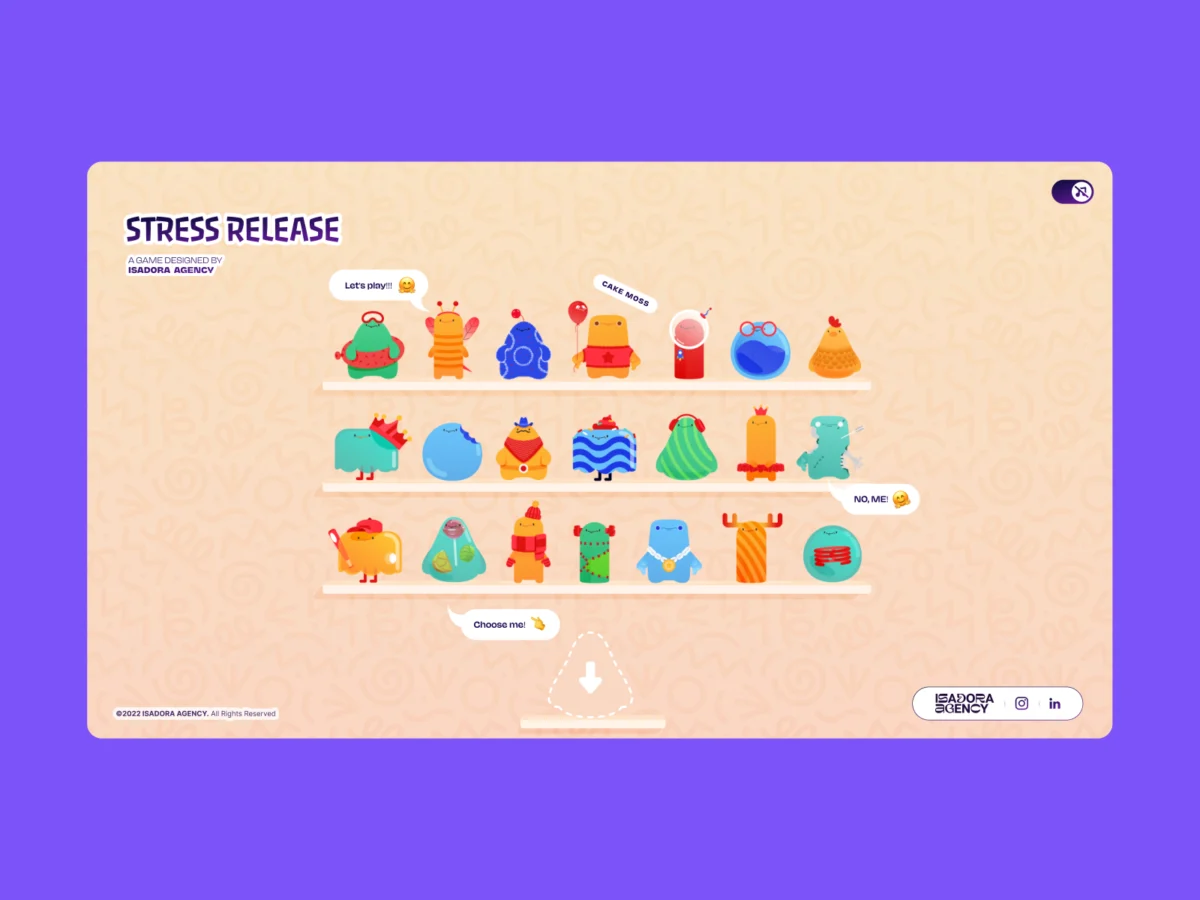
The digital landscape is currently witnessing a paradigm shift in how users interact with web interfaces, moving from static navigation toward highly tactile, immersive environments. When Alexey Kopytin and the development team at Isadora Agency were commissioned to create "Stress Release"—a digital stress-relief squeeze toy game—they faced a fundamental architectural crossroads. While the industry standard for creating "bouncy" or "squishy" interfaces typically involves heavy-duty physics engines like Matter.js or Cannon.js, the team ultimately rejected these tools in favor of a bespoke system utilizing Lottie animations, DOM events, and distance-based mathematics. This decision was rooted in a desire for "intentional motion" over "plausible motion," ensuring that the developer’s architecture served the animator’s vision with absolute precision.
The Architectural Rationale: Intentional vs. Plausible Motion
In modern front-end development, the instinct to reach for a physics engine when building interactive games is driven by the desire for realism. Physics engines calculate the movement of objects based on variables like gravity, friction, and restitution, producing motion that feels "plausible" to the human eye. However, for a project like Stress Release, where the goal was to allow users to "smash, stretch, and distort" animated characters, the unpredictability of a simulation posed a threat to the art direction.
The design team at Isadora Agency had crafted intricate, frame-by-frame sequences that defined the personality of each character. A physics engine, while realistic, would have overwritten these hand-crafted keyframes with algorithmic approximations. If a character is designed to have a "mega squeeze" reaction that builds up over exactly 181 frames, a physics engine might trigger a bounce that cuts that sequence short or distorts the vector paths in a way that feels "glitchy" rather than "squishy." By choosing programmatic state control via Lottie’s native API, the developers ensured a deterministic outcome: every click triggers the exact visual narrative the designers intended.
Technical Implementation: The Geometry of Interaction
To bridge the gap between static code and tactile feedback, the team implemented a system of radial input mapping. This approach bypassed the need for complex collision detection layers often found in WebGL environments. Instead, the team relied on the Pythagorean theorem to calculate the distance between a user’s click and the center of the character.
The process begins by converting page-relative coordinates into the character’s local coordinate space. By determining the center point of the character (x_center, y_center) and comparing it to the click position (X, Y), the system generates a vector. The straight-line distance is then calculated using Math.hypot(a, b). This single numerical value becomes the primary driver for the game’s logic, determining the score, the intensity of the visual feedback, and the exact placement of "explosion" animations.

This "concentric zone" system functions much like a dartboard. A click within 10 pixels of the center yields a "bullseye" (100 points), while distances further out scale the rewards downward. Critically, because the explosion Lottie files are repositioned to the exact (a, b) vector of the click, the user receives immediate, spatially accurate visual confirmation of their action. This creates a psychological sense of "physicality" without the overhead of a 3D rendering engine.
Chronology of Development: From Physics to Programmatic Control
The development of Stress Release followed a structured four-phase timeline that highlights the iterative nature of high-end UX engineering:
- Phase I: Conceptualization and Character Design: The creative team developed 21 unique characters, each with distinct personalities and "stress-relief" profiles. Animators produced initial .json files using Adobe After Effects and the Bodymovin plugin.
- Phase II: The Physics Engine Prototype: Initial builds utilized Matter.js to handle character collisions. However, the team found that the "emergent behavior" of the physics engine often resulted in characters clipping through the floor or reacting with a stiffness that contradicted the "soft" aesthetic of the characters.
- Phase III: Pivot to Lottie State Management: The team scrapped the physics engine and rebuilt the interaction layer using the Lottie-web library. They defined specific "frame segments" for each character (idle, light squeeze, heavy squeeze, and end-state), allowing the code to jump to precise frames based on game logic.
- Phase IV: Optimization and Cross-Platform Scaling: The final phase involved fine-tuning performance for mobile devices. This included implementing a "quality toggle" that reduced interpolation calculations on the character "shelf" (where 21 animations play simultaneously) while maintaining high fidelity on the main play screen.
Data-Driven Performance Optimization
One of the primary challenges of using Lottie animations in a web environment is the potential for high CPU and memory usage, particularly when multiple vector-heavy JSON files are active. Lottie files, while significantly smaller than traditional video formats or GIFs—often by as much as 600%—still require the browser to perform complex calculations to render SVG paths in real-time.

To maintain a fluid 60 frames per second (FPS) across all devices, Isadora Agency implemented several aggressive optimization strategies:
- Segmented Loading: Only the animations required for the current screen are loaded into the DOM.
- Quality Scaling: The
lottie.setQuality()method was used to drop the rendering resolution to 50% on the character selection shelf. This reduced the mathematical overhead of calculating Bezier curves for 21 characters at once. - Speed Modulation: By setting
shelf.setSpeed(0.6), the team reduced the number of frame calculations per second on non-essential animations, preserving battery life and processing power for mobile users. - Responsive Scaling with CSS Variables: Instead of recalculating bounding boxes via JavaScript on every resize event, the team used CSS custom properties (variables) to handle layout changes. This allowed the Lottie SVGs to scale naturally within their containers, maintaining their internal animation state without interruption.
Official Response and Design Philosophy
"When you are tasked with building an interface that feels destructive or tactile, the instinct is to simulate reality," stated Alexey Kopytin in his technical review of the project. "But in the world of high-end art direction, reality is often less satisfying than a well-timed animation. By mapping Lottie’s native timeline capabilities to the DOM, we delivered an experience where the architecture serves the art, not the other way around."
This sentiment reflects a broader trend in the industry where "juiciness"—a term used in game design to describe excessive, satisfying feedback for user actions—is being prioritized over strictly realistic simulations. The "Stress Release" project serves as a case study for how developers can achieve "game-feel" using standard web technologies (HTML, CSS, and JS) rather than specialized gaming frameworks.

Broader Impact and Industry Implications
The success of a non-physics-based approach to tactile UX has significant implications for the future of web design, particularly in the realms of e-commerce, digital wellness, and gamified marketing.
Firstly, it lowers the barrier to entry for creating high-fidelity interactive experiences. Developers who may not be proficient in WebGL or complex physics math can achieve sophisticated results using familiar DOM manipulation and basic geometry. Secondly, the use of Lottie ensures that these experiences are accessible and SEO-friendly. Since Lottie renders as SVG, the elements remain part of the DOM, allowing for better screen-reader compatibility and faster indexing compared to canvas-based solutions.
Furthermore, the "Stress Release" model aligns with the growing "Digital Wellness" movement. As users spend more time in digital environments, the demand for "satisfying" and "calming" UI interactions—often referred to as "Oddly Satisfying" content—has skyrocketed. By providing a tool that allows users to physically "vent" their frustrations on digital characters, Isadora Agency has tapped into a psychological need for tactile engagement in an increasingly virtual world.

Conclusion
The development of Stress Release demonstrates that the most powerful tool in a developer’s kit is not always the most complex one. By choosing to honor "intentional motion" and leveraging the programmatic control of Lottie animations, the team at Isadora Agency created a highly responsive, tactile experience that remains performant across a wide array of devices. This approach proves that with a solid understanding of coordinate math and a deep respect for art direction, front-end engineers can build immersive digital worlds that feel every bit as "squishy" and "real" as those governed by the laws of physics.

