
The European Union has finalized the operational framework for its landmark Artificial Intelligence Act, setting a definitive deadline of August 2, 2026, for mandatory AI labelling and transparency disclosures. This regulation represents the world’s first comprehensive legal framework for AI, moving beyond voluntary industry guidelines to enforceable statutory requirements. While initial industry reactions were marked by concerns over "sweeping measures" and "punitive fines," a closer examination of the finalized guidelines reveals a focused approach aimed at content provenance and user awareness. The rules are designed to ensure that when a citizen of the European Union interacts with an AI system or consumes AI-generated content, that fact is made "clear and distinguishable." Crucially, the reach of the AI Act is extraterritorial; it applies to any organization worldwide that places AI systems on the EU market or whose AI-generated output is used within the Union’s borders, mirroring the jurisdictional reach of the General Data Protection Regulation (GDPR).
The Chronology of AI Governance in Europe
The path to the August 2026 enforcement date has been a multi-year legislative journey. The European Commission first proposed the AI Act in April 2021, aiming to balance innovation with the protection of fundamental rights. Following years of intense negotiations, particularly regarding the rise of generative AI and Large Language Models (LLMs), a political agreement was reached in December 2023. The European Parliament formally adopted the Act in March 2024, followed by the European Council’s approval in May 2024.
The regulation entered into force on August 1, 2024, but its provisions are being phased in to allow industry adaptation. Prohibitions on "unacceptable risk" AI systems—such as social scoring and certain biometric surveillance—take effect in early 2025. The transparency and labelling requirements, which impact the widest range of commercial products and digital interfaces, become legally binding in the summer of 2026. This timeline provides developers and deployers a two-year window to audit their systems, update their user interfaces, and implement technical watermarking solutions.
Transparency Obligations under Article 50
At the heart of the new transparency regime is Article 50 of the AI Act, which categorizes specific scenarios where disclosure is non-negotiable. The European Commission’s guidance clarifies that labelling is not a blanket requirement for all uses of AI, but rather a targeted measure for instances where there is a risk of deception or confusion.
First, providers must ensure that AI systems intended to interact with natural persons—such as customer service chatbots or virtual assistants—are designed and developed so that users are informed they are interacting with an AI. This disclosure must happen at the start of the interaction, unless it is "obvious from the circumstances and the context of use."

Second, deployers of AI systems that generate or manipulate "deepfake" content—images, audio, or video that appreciably resemble existing persons, objects, places, or events and would falsely appear to a person to be authentic—must disclose that the content has been artificially generated or manipulated. This is particularly critical in the context of political discourse and media integrity.
Third, the rules cover AI-generated text published with the intent to inform the public on matters of public interest. This includes content related to health, safety, the environment, finances, and politics. If an AI system generates such text, the fact that it is machine-authored must be disclosed, unless the content has undergone a substantive human editorial review.
Distinguishing Between AI-Generated and AI-Assisted Content
A significant point of confusion for digital product teams has been the threshold at which "AI-assisted" work becomes "AI-generated" content. The European Commission’s Code of Practice provides a nuanced distinction. Assistive edits, such as standard spellcheck, grammar correction, basic formatting, or color grading in photography, do not trigger the disclosure requirement. These are viewed as tools that enhance human creativity rather than replace it.

However, the line is crossed when the AI performs "substantive generation." This includes creating summaries of long documents, generating composite imagery from text prompts, or performing substantive rewrites of human drafts. The Commission specifies that a cursory "human skim" prior to publication does not constitute an editorial review. For a piece of content to be exempt from AI labelling, a named person or entity must take editorial responsibility, implying a level of manual intervention that fundamentally shapes the final output.
In the realm of B2B (business-to-business) environments, the rules are slightly more relaxed. Disclosures may not be required for AI systems used in internal workflows where users are already aware of the technology’s presence, provided these systems do not produce content intended for public consumption.
Technical Standards: Beyond the Sparkle Icon
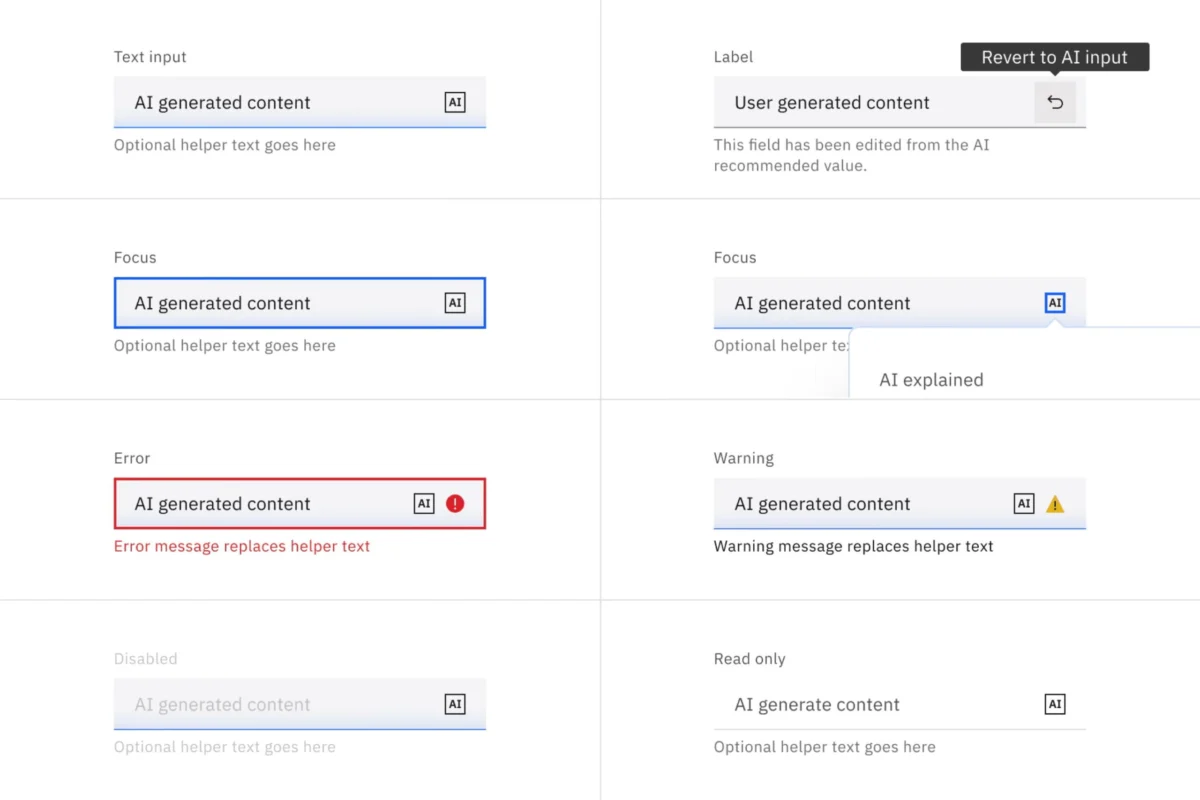
One of the most practical challenges for UX (User Experience) designers is the visual representation of AI. For several years, the "sparkle" icon (✨) has become the industry shorthand for AI-powered features. However, the EU’s new guidelines suggest that this icon alone is insufficient for legal compliance. The Commission argues that the sparkle is too ambiguous; it is often used to denote "new" or "enhanced" features rather than specifically identifying AI-generated content.

To standardize the user experience, the European Commission has released an official EU AI icon set. This includes specific marks for "AI-generated," "AI-modified," and "AI-interact." These icons are designed to be paired with plain-language labels, such as "Generated by AI" or "Synthetically altered." The guidance emphasizes that the disclosure must be "clear and distinguishable," meaning it cannot be buried in a footer, hidden behind a "learn more" link, or displayed only momentarily.
Furthermore, the Act encourages the use of technical metadata and digital watermarking. Organizations are increasingly looking toward the C2PA (Coalition for Content Provenance and Authenticity) standards, which allow for "nutrition labels" for digital content to be embedded in the file itself. This ensures that the AI disclosure persists even when a file is downloaded, shared on social media, or repurposed.
Global Context and the "Brussels Effect"
The EU AI Act does not exist in a vacuum. It is part of a global trend toward AI governance that observers call the "Brussels Effect," where EU regulations effectively become the global standard due to the size of the European market. Other jurisdictions are following suit with similar, though not identical, transparency mandates.

In the United States, the Bipartisan AI Act and several executive orders have pushed for "provenance and watermarking" of AI content. State-level laws, such as those in California and Florida, already require disclosures for AI used in political advertising and "synthetic human performers." In China, the Cyberspace Administration of China (CAC) has implemented strict rules requiring "prominent labels" on any synthetically generated content, particularly deepfakes. Meanwhile, the G7’s "Hiroshima AI Process" has established a voluntary code of conduct that aligns closely with the EU’s transparency goals.
Enforcement and the Cost of Non-Compliance
The stakes for failing to comply with the AI Act’s transparency rules are high. The regulation establishes a tiered system of fines. Violations of the transparency obligations can result in administrative fines of up to €15 million or 3% of a company’s total worldwide annual turnover for the preceding financial year, whichever is higher. For the world’s largest technology companies, these fines could reach into the billions of euros.
Enforcement will be handled by a combination of national competent authorities within EU member states and a newly established "European AI Office" within the Commission. This centralized office will oversee the implementation of rules regarding general-purpose AI models and coordinate cross-border enforcement actions.

Industry Reactions and Implementation Challenges
Industry reactions to the finalized guidelines have been mixed. While many tech giants have expressed support for the goal of building digital trust, there are concerns regarding the technical feasibility of permanent watermarking. Trade associations representing software developers have pointed out that "persistent" labels can often be stripped away by simple screenshotting or re-encoding, leading to a "cat-and-mouse game" between regulators and bad actors.
Civil society groups, on the other hand, have praised the rules as a necessary step against the "tsunami of AI slop" and misinformation. They argue that clear labelling is the only way to preserve the integrity of the digital public square.
For businesses, the immediate priority is an "AI Audit." Companies are advised to map every instance where AI interacts with customers or generates content. This involves reviewing third-party licenses—as the AI Act holds the "deployer" responsible even if they are using a licensed tool—and updating design systems to include the official EU icons and plain-language disclosures.

Analysis of Long-term Implications
The implementation of the EU AI Act marks the end of the "permissionless" era of generative AI. By 2026, the digital landscape will likely look significantly different. AI disclosures will become as ubiquitous as "cookie banners" were following the implementation of GDPR. While this may lead to some "disclosure fatigue" among users, the long-term goal is to foster a more resilient information ecosystem.
The shift toward transparency is expected to drive innovation in "provenance technology." We are likely to see a surge in tools that verify human authorship, providing a premium for content that can prove it was created without AI intervention. For designers and marketers, the challenge will be to integrate these disclosures into the user experience in a way that provides clarity without creating friction.
Ultimately, the EU AI Act’s labelling requirements represent a bet on human agency. By mandating that AI be obvious when it needs to be, the regulation seeks to empower users to make informed decisions about the information they consume and the systems they trust. As the August 2026 deadline approaches, the global tech industry must pivot from rapid deployment to responsible disclosure, ensuring that the sparkle of AI does not obscure the reality of its origin.

