
Google Ads is implementing a significant alteration to its bidding system, scheduled to go into effect on August 17. The platform asserts that these changes are designed to foster a more predictable performance for advertisers utilizing target-based bidding strategies. However, initial analyses suggest that the adjustments could potentially lead to unforeseen fluctuations in campaign outcomes. This evolution in Google’s algorithmic approach marks a critical juncture for advertisers, necessitating a thorough understanding of the forthcoming modifications and proactive preparation to mitigate risks and capitalize on opportunities.
The core of the change lies in how Google Ads will manage target-based bidding strategies, specifically focusing on Cost Per Acquisition (CPA) and Target Return on Ad Spend (tROAS). Previously, while these strategies aimed for specific performance metrics, actual results could often deviate significantly. The updated system will now place a higher priority on achieving the advertiser’s set goal, even if current performance surpasses it. For instance, if an advertiser has set a tROAS of 300%, the new system will actively work to bring performance closer to this 300% benchmark, even if the campaign is currently delivering a 500% return. This represents a fundamental shift from a more flexible optimization approach to one that prioritizes hitting defined targets with greater precision. While target bid strategies were conceptually designed to operate in this manner, Google’s explicit statement emphasizes that "hitting the goal is the priority," signaling a more aggressive and direct optimization mechanism.
Google has indicated that this change will primarily affect budget-limited campaigns. However, prudent advertisers are advised to review all their campaigns, regardless of budget constraints, to fully understand the potential implications. The platform’s assertion that only budget-limited campaigns will be impacted might be an oversimplification, and a comprehensive review is the most secure approach.
Understanding the Impact on Advertisers
The impending changes necessitate a strategic recalibration by advertisers. The immediate imperative is for businesses to clearly define their performance preferences and objectives. This involves a critical assessment of what constitutes acceptable performance and how it aligns with broader business goals.
Advertisers are being prompted to consider the following key decisions:
- What is the acceptable deviation from the target?
- How should campaigns that are currently overperforming be managed?
- What is the acceptable trade-off between achieving a specific target and overall campaign volume or revenue?
To aid in this transition, Google has introduced a bid target adjustment tool. This tool provides advertisers with a clear visualization of their current targets alongside recent campaign performance data. This transparency is crucial for informed decision-making.
Analyzing the Bid Target Adjustment Tool
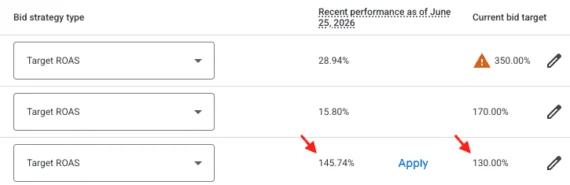
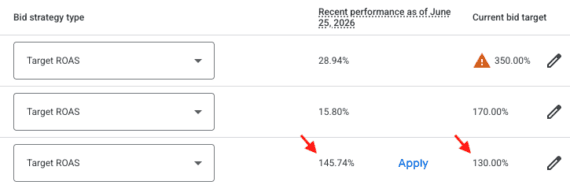
The provided example of the bid target adjustment tool illustrates a scenario where a campaign’s target ROAS was set at 130.00%, but its actual recent performance reached 145.74%. According to Google’s new paradigm, without any intervention, this campaign would be optimized downward to meet the 130.00% target. This means that the excess performance, while seemingly positive, will be curtailed by the system to adhere to the defined goal.
The tool typically presents data in a tabular format, highlighting campaigns and their respective performance against targets. A common visual representation might include columns for:
- Campaign Name
- Target Metric (e.g., tROAS, tCPA)
- Current Target Value
- Recent Performance Value
- Status Indicator (e.g., warning, success)
For instance, a campaign with a 350.00% tROAS target might show a recent performance of only 28.94%, flagging a potential issue of underperformance. Another campaign might have a 170.00% tROAS target with a recent performance of 15.80%, also indicating a significant gap. The third example, with a 130.00% target and 145.74% performance, is where the new system’s impact becomes most apparent, as it suggests an adjustment downward. Red arrows often point to "Apply" links, indicating recommended actions or areas for attention.
Strategic Options for Advertisers
Google Ads outlines four primary options for advertisers to navigate these changes:
1. Keep the Target as Is
This is the most passive approach. Advertisers who are content with their campaigns gradually adjusting downwards to meet the existing target, even if current performance is higher, require no immediate action. This strategy is suitable for those who prioritize stability and predictability over maximizing current overperformance, or for whom the existing target represents a long-term, sustainable benchmark.
2. Maintain Recent Performance
For advertisers whose campaigns are consistently exceeding their set targets, the recommendation is to increase the target to align with actual performance. However, this adjustment should be approached with caution. Google suggests a gradual increase, particularly if performance is exceeding the target by more than 20%. For example, if a campaign is achieving a 200% ROAS against a 130% target, the new target should not exceed 156% (a 20% increase on the current performance). This gradual approach allows the algorithm to adapt and learn, minimizing the risk of drastic performance swings. After a period of observation, typically two weeks, further incremental increases can be implemented. This iterative process is key to experimenting with the new system and understanding its responsiveness.
A critical consideration here is the overall account performance. If individual campaigns are significantly outperforming their targets, and these targets are not adjusted, the new system could inadvertently reduce their efficiency to meet the lower goals. This could negatively impact the aggregate ROAS of the entire account. Therefore, maintaining overall account health and performance should be a paramount consideration when adjusting individual campaign targets.
3. Adjust the Custom Target
This option involves setting a new, custom target that reflects realistic and desired performance levels. If a 300% target is demonstrably too low and 400% is an achievable and desirable outcome, then directly adjusting the target to 400% is the appropriate course of action. This is not about gradual increments but about establishing a new, more ambitious benchmark that the system will then work to achieve. This strategy is best suited for advertisers who have a clear understanding of their market dynamics and the potential for their campaigns.
4. Switch to a Maximize Strategy
For advertisers whose primary objective is to generate the highest possible volume of conversions or revenue within a fixed budget, switching to a "Maximize Conversions" or "Maximize Conversion Value" strategy might be the most effective solution. These strategies are designed to utilize the entire budget to achieve the most conversions or the highest total conversion value, respectively. While this approach may lead to a decline in efficiency (e.g., a higher CPA or lower ROAS compared to target-based strategies), it prioritizes volume and revenue generation. This is particularly relevant for businesses focused on market share acquisition or driving immediate sales volume.
Background and Chronology of the Change
The shift in Google Ads’ bidding strategy is part of a continuous evolution in its automated advertising solutions. Over the past decade, Google has increasingly relied on machine learning and artificial intelligence to optimize campaign performance. This move towards prioritizing specific targets reflects a maturing of these algorithms and a desire to provide advertisers with more direct control over performance outcomes.
The announcement of the change was made in the lead-up to the August 17 implementation date, allowing advertisers a window to prepare. This timeframe is typical for significant Google Ads updates, providing a period for industry analysis, communication, and strategic adjustments. The underlying technology powering these changes has likely been in development and testing for an extended period, undergoing rigorous internal evaluations to ensure its efficacy and stability.
Supporting Data and Industry Context
While specific data on the scale of impact is not yet publicly available, the potential implications can be inferred from general industry trends. The digital advertising landscape is increasingly competitive, with advertisers constantly seeking ways to improve return on investment. Automation in bidding is a cornerstone of modern ad management, and changes to these core functionalities can have a profound effect on campaign spend and performance.
The push for greater predictability in ad performance is a response to advertiser demands for more reliable forecasting and budgeting. Historically, the "black box" nature of some automated bidding strategies has been a point of concern for many. By emphasizing goal achievement, Google aims to offer greater transparency and control, albeit with the caveat of potential performance swings.
Broader Implications and Expert Reactions
The implications of this change extend beyond individual campaign settings. For agencies managing multiple client accounts, this necessitates a systematic review and potential restructuring of their bidding strategies across their entire portfolio. The emphasis on goal adherence could lead to a more disciplined approach to campaign setup and monitoring, potentially weeding out underperforming strategies.
Industry experts have noted that this move underscores Google’s commitment to its AI-driven optimization. "Advertisers have been asking for more control and predictability," stated [Hypothetical Expert Name], [Hypothetical Title] at [Hypothetical Organization]. "Google’s response here is to provide that by making the system more focused on hitting the defined targets. The key will be for advertisers to set realistic targets and understand the trade-offs, particularly if their campaigns are currently performing exceptionally well."
However, concerns about "unpredictable swings" are valid. If a campaign is performing significantly above its target, and the system aggressively pulls it back, advertisers might experience a sudden drop in revenue or conversions. This could be particularly disruptive during peak sales periods or for campaigns that have been carefully optimized over time to achieve high returns.
Another aspect to consider is the potential for increased competition for certain conversion metrics. If many advertisers are aggressively optimizing towards similar targets, it could drive up bid prices and make it harder for individual advertisers to achieve their goals without increased spend.
Preparing for the Transition
The most crucial advice for advertisers is to act proactively. The August 17 deadline should be treated as a firm date for implementing necessary changes. A comprehensive audit of all Google Ads campaigns, with a particular focus on those using tCPA and tROAS bidding, is essential.
Advertisers should:
- Utilize the Bid Target Adjustment Tool: Familiarize themselves with its functionality and use it to assess current campaign performance against targets.
- Re-evaluate Performance Goals: Ensure that current targets are realistic and aligned with business objectives. If historical data suggests higher performance is sustainable, consider adjusting targets upwards.
- Monitor Closely Post-Change: Once the new system is live, continuous monitoring of campaign performance is paramount. Be prepared to make further adjustments based on observed outcomes.
- Consider a Phased Approach: For significant changes, consider implementing them on a few key campaigns first to gauge the impact before rolling them out across the entire account.
- Document Changes: Keep detailed records of all adjustments made to targets and strategies, along with the rationale behind them. This will be invaluable for future analysis and troubleshooting.
The upcoming changes to Google Ads’ bidding system represent a significant evolution in how advertisers can leverage automated strategies. By understanding the mechanics of the shift, carefully evaluating performance preferences, and implementing a well-thought-out strategy, advertisers can navigate this transition effectively and continue to drive successful outcomes on the platform. The emphasis on goal prioritization signals a new era of algorithmic control, where precise target achievement takes precedence, demanding a more strategic and data-driven approach from all users.

