
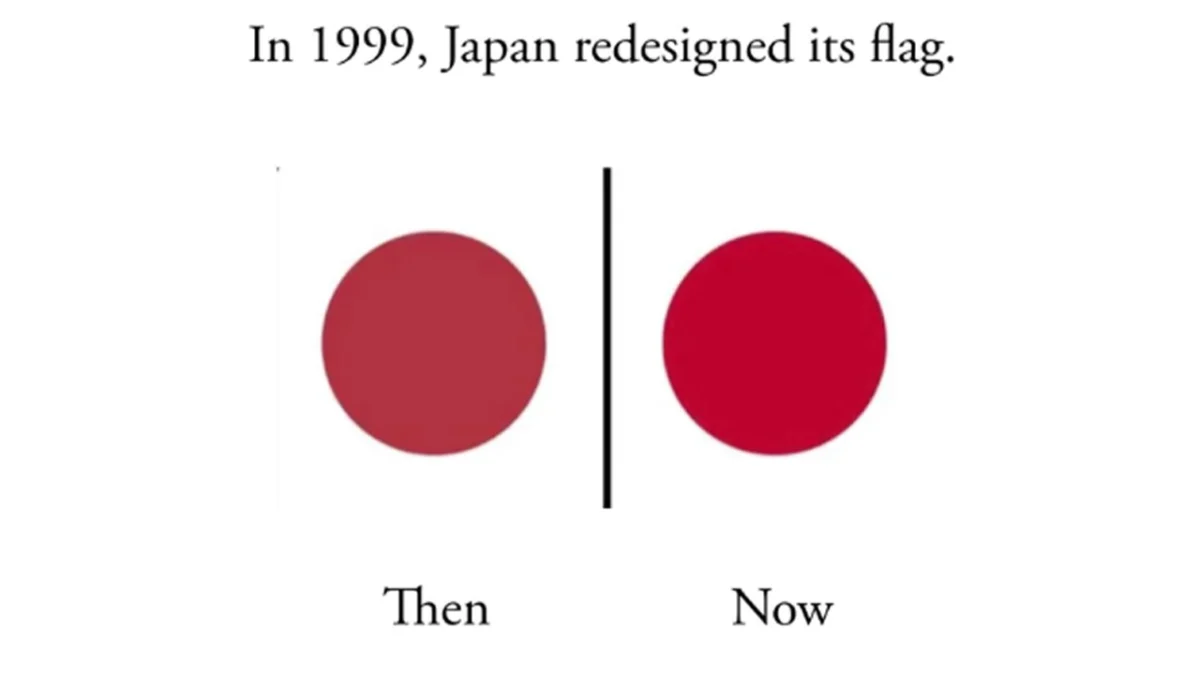
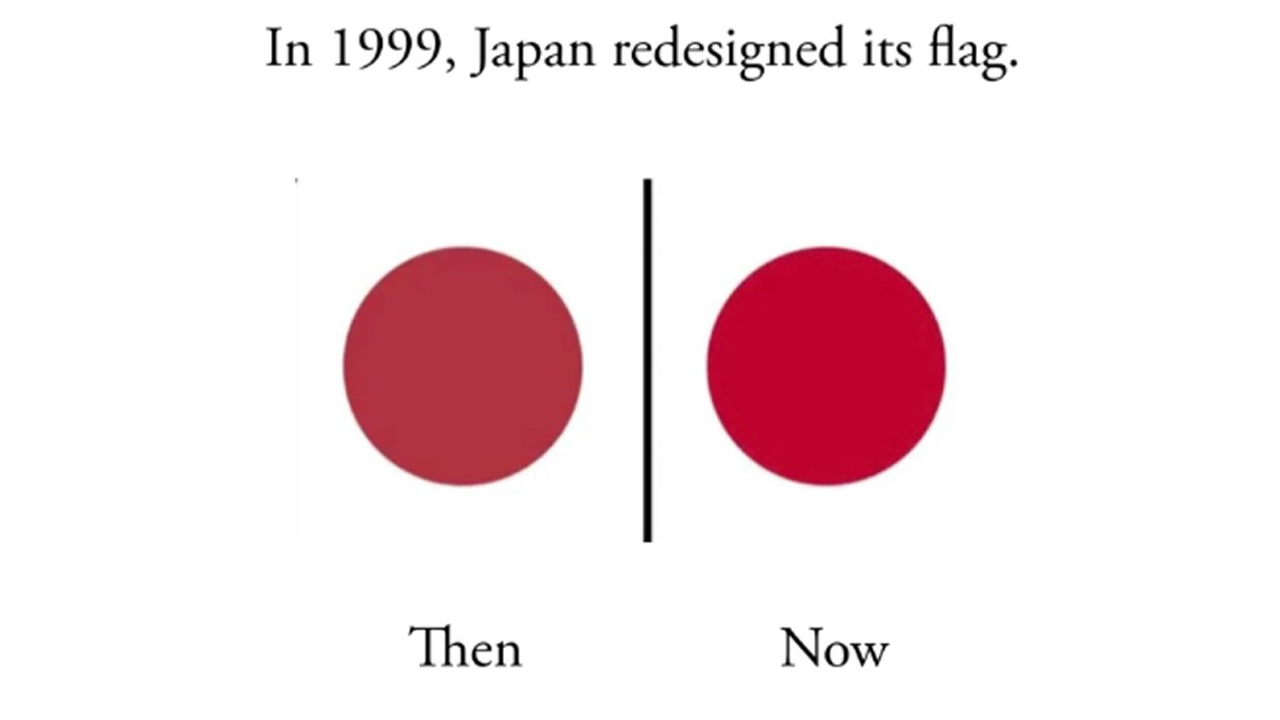
The 1999 Japan Flag Redesign meme, a digital phenomenon that emerged in the late 2010s, serves as a prominent cultural critique of minimal aesthetic changes in branding, personal development, and corporate identity. Centered on the historical standardization of the Japanese national flag—the Nisshōki, commonly known as the Hinomaru—the meme juxtaposes the pre-1999 version of the flag with the post-1999 iteration. To the untrained eye, the two images appear identical, though they contain subtle technical differences in color saturation and geometric proportions. This visual subtlety has transformed a piece of Japanese legislative history into a universal shorthand for mocking situations where significant claims of "change" or "improvement" are met with nearly imperceptible results.
Historical Context and the Law Regarding the National Flag and National Anthem
To understand the origins of the meme, one must first examine the historical and legislative reality of the 1999 redesign. For over a century, the Hinomaru served as the de facto national flag of Japan without formal statutory backing. It was first officially regulated during the Meiji era via Proclamation No. 57 in 1870. This initial design established a white background with a red sun disc, utilizing a 7:10 ratio. Notably, the sun disc was positioned slightly toward the hoist (the side attached to the flagpole) by one-hundredth of the flag’s width.
For decades, this design remained the standard, even as Japan navigated the complexities of the post-World War II era. However, the lack of formal legislation regarding the flag and the national anthem, "Kimi ga Yo," led to significant domestic friction, particularly within the Japanese education system. The controversy reached a breaking point in early 1999 following the suicide of Toshihiro Ishikawa, a high school principal in Hiroshima, who found himself caught between government mandates to fly the flag and the staunch opposition of teacher unions.
In response to this national crisis, the administration of Prime Minister Keizō Obuchi introduced the Law Regarding the National Flag and National Anthem. Passed on August 9, 1999, and enacted on August 13, the law finally codified the Hinomaru as the official national flag. While the primary purpose of the law was legal formalization, it included technical "redesigns" to simplify production and standardize appearance. The ratio was adjusted from 7:10 to 2:3, the sun disc was moved to the exact center of the field, and the shade of red was updated from a deeper, more muted tone to a brighter, more vibrant hue.
Vexillological Analysis: The Nature of the Change
From a vexillological perspective—the scholarly study of flags—the 1999 changes were significant in terms of standardization but minor in terms of visual impact. The pre-1999 flag’s sun disc was three-fifths of the flag’s height, a proportion that remained unchanged in the 1999 law. The shift from a 7:10 ratio to a 2:3 ratio is a difference of only 3.3% in total width relative to height.
Furthermore, the centering of the disc, while a departure from the 1870 "hoist-heavy" tradition, was already common practice in unofficial and merchant versions of the flag. The most noticeable change for digital audiences is the color saturation. The modern flag utilizes a red that is more "pure" in digital RGB or CMYK spaces, whereas older iterations often leaned toward a crimson or deep scarlet. It is this specific nuance—the "change that isn’t really a change"—that provided the fertile ground for internet humor.
Chronology of the Meme’s Digital Evolution
The transition of this historical fact into a viral meme began on February 6, 2018. An Imgur user under the pseudonym Steezyskreezy uploaded a comparison of the two flags with the caption: "When I tell my girl I’ll change for her." This initial post established the template for the meme: an acknowledgment of a "redesign" that serves as a metaphor for hollow promises or negligible effort. Although it took several years to achieve mainstream saturation, the format proved remarkably durable.
By 2019, the meme migrated to Reddit, where it began to be used in "relatable" humor contexts. In October 2019, users on the subreddit r/2meirl4meirl adapted the flag comparison to discuss mental health, specifically the feeling of making "changes" to one’s lifestyle that fail to alleviate deep-seated dissatisfaction. This signaled the meme’s evolution from a relationship joke to a broader commentary on the human condition.
The meme reached its peak popularity between 2020 and 2022. In March 2020, during the early stages of the global pandemic, a version featuring the "No Need to Thank Me" reaction image gained over 41,000 upvotes on r/memes. This iteration mocked the hypothetical "flag designer" who likely received credit for a task that required almost no creative labor. Later that year, the "It Ain’t Much, But It’s Honest Work" format further cemented the meme’s status as a critique of minimal productivity.
Case Studies in Modern Usage
The versatility of the 1999 Japan Flag Redesign meme is evidenced by its application across various industries, most notably in sports and technology.
1. Formula 1 Livery Critiques:
In February 2022, the Haas F1 Team revealed its car livery for the upcoming season. Fans noted that the design was nearly identical to the previous year’s controversial "Russian flag" inspired aesthetic. Redditors immediately deployed the Japan flag template to highlight the lack of creative evolution in the team’s branding. This use case demonstrated the meme’s utility in sports journalism and fan commentary, providing a visual shorthand for "stagnation."
2. Corporate Rebranding and YouTube:
One of the most prominent recent uses of the meme occurred in October 2024. When Google announced a "refresh" of the YouTube identity, citing a new color palette with "magenta-infused gradients" and a "softer shade of red," the tech community responded with skepticism. A post on r/memes using the 1999 Japan Flag template to mock YouTube’s announcement garnered thousands of upvotes before being moderated. The meme effectively captured the public’s exhaustion with corporate "rebranding" efforts that appear to be superficial exercises in marketing jargon rather than substantive improvements to user experience.
3. The "Greg Heffley" Comparison:
Digital culture analysts often compare the Japan flag meme to the "Greg Heffley Yearbook Photo" format. In that meme, two identical photos of a character from the Diary of a Wimpy Kid series are placed side-by-side to represent a "before and after" scenario. While the Heffley meme is rooted in fiction, the Japan flag meme carries the weight of historical fact, which some users argue makes the satire "sharper" and more "intellectual."
Analysis of Societal Implications
The enduring popularity of the 1999 Japan Flag Redesign meme reflects a broader societal cynicism toward the concept of "innovation." In an era where software updates often remove features while claiming to improve "UI/UX," and where "new and improved" products often feature only a change in packaging, the meme acts as a tool for collective eye-rolling.
Psychologically, the meme resonates because it triggers the "Spot the Difference" cognitive reflex. When viewers are presented with two nearly identical images and told they represent a "redesign," the brain experiences a brief moment of dissonance. Resolving that dissonance through humor allows the audience to bond over a shared perception of absurdity.
Furthermore, the meme highlights a shift in how history is consumed by younger generations. For many Gen Z and Millennial internet users, the legislative history of the Obuchi administration is not learned through textbooks, but through image macros. While this may strip the event of its somber political origins—such as the tragic circumstances surrounding the 1999 law’s passage—it keeps the historical fact in the public consciousness, albeit in a highly abstracted form.
Legacy and Template Longevity
As of 2024, the "In 1999, Japan Redesigned Its Flag" template remains a "top-tier" reaction image. Its longevity is attributed to its simplicity. Unlike memes that require knowledge of specific video games, movies, or niche celebrities, the Japan flag meme requires only the ability to see color and shape. It is a "clean" meme, devoid of inherent profanity or offensive content, making it suitable for a wide range of digital environments, from edgy Discord servers to professional LinkedIn commentary.
The meme stands as a testament to the unpredictable nature of the digital archive. A technical adjustment intended to provide legal clarity and production standards for a sovereign nation’s symbol has, decades later, become the internet’s favorite way to say: "You didn’t actually do anything." Whether used to mock a friend’s "new" haircut or a multi-billion dollar company’s "new" logo, the 1999 Japan flag redesign remains the gold standard for the art of the minimal change.

