
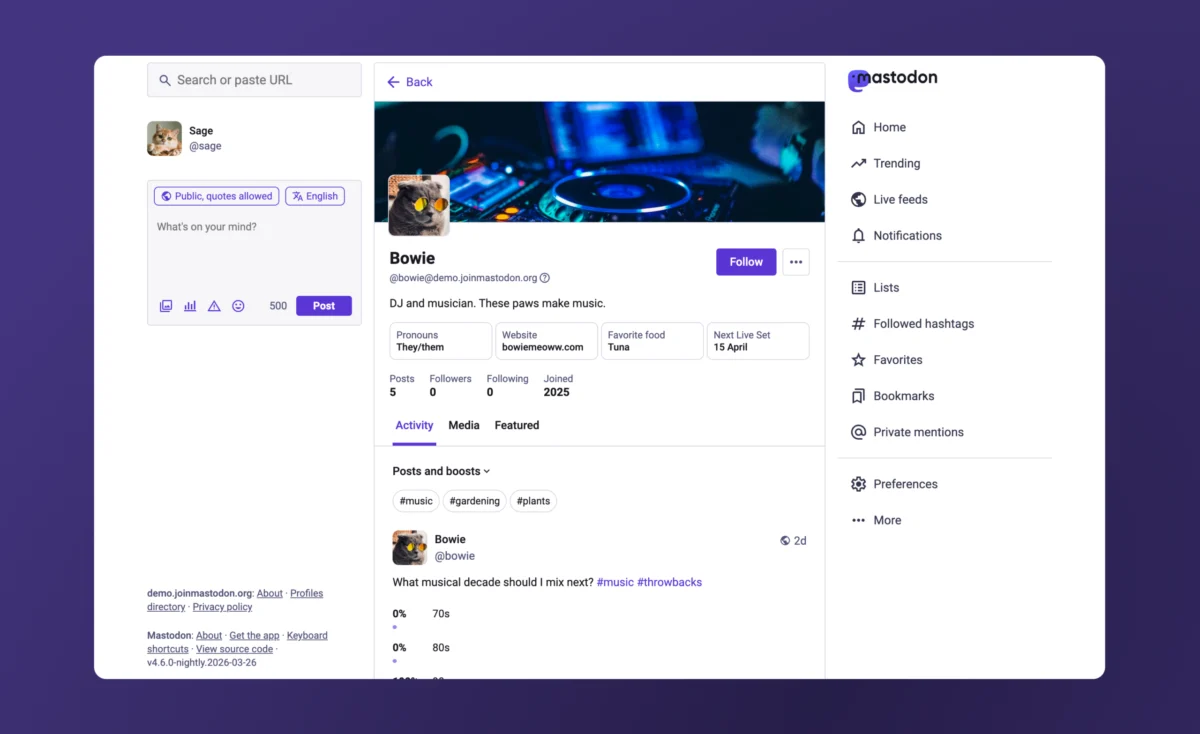
Mastodon, the decentralized social networking service, is implementing significant changes aimed at enhancing its appeal and ease of use, particularly for mainstream audiences seeking robust alternatives to platforms like X (formerly Twitter) and Meta’s Threads. This strategic overhaul focuses on redesigning a core element of its user experience: the profile page. Announced on Thursday, March 2026, by the ActivityPub-based software developer, the revamped profiles are designed to be more intuitive and engaging, catering to both individual users and organizations. This initiative is a crucial step in Mastodon’s ongoing efforts to streamline its platform and overcome the complexities that have historically hindered broader adoption.
The Genesis of a Decentralized Alternative: From Niche to Necessity
Mastodon’s journey into the mainstream consciousness accelerated dramatically following Elon Musk’s acquisition of Twitter in late 2022. As Twitter underwent significant changes, including its rebranding to X and a series of controversial policy shifts, a substantial segment of its user base began actively searching for alternative social media platforms. Mastodon, with its foundational commitment to decentralization and open-source principles, emerged as a prominent contender. Built upon the ActivityPub protocol, which allows for federation between independent servers, Mastodon promised users an escape from the centralized control, algorithmic manipulation, and corporate whims often associated with platforms like X. Its appeal lies in this federated nature: no single company dictates the rules, controls the algorithm, or holds dominion over user data. Users have the unprecedented freedom to choose a server that aligns with their values and moderation preferences, and even to migrate their accounts if their chosen server no longer meets their expectations. This user-centric governance model stands in stark contrast to the top-down control seen in most commercial social networks.
Navigating the Labyrinth: Mastodon’s Early Challenges with User Adoption
Despite its ideological advantages and the influx of users during the "Twitter drama," Mastodon has grappled with significant challenges in sustaining its growth and attracting a truly mainstream audience. The very decentralized architecture that forms its unique selling proposition also introduces a layer of complexity that can be daunting for newcomers accustomed to the simplicity of traditional social networks. The onboarding process, for instance, requires users to select a specific server (or "instance") to join, a concept unfamiliar to many. This choice often dictates the user’s initial community and content exposure, which can be confusing. Furthermore, the presence of multiple timelines—such as the "local" timeline (posts from users on the same server) and the "federated" timeline (posts from users across all connected servers)—adds another layer of navigational complexity. The process of finding and following users across different instances, often requiring the full @[email protected] handle, has also been noted as cumbersome compared to the straightforward @username model on X or Threads.
These initial hurdles have impacted Mastodon’s user growth trajectory. While the platform surged to over a million monthly active users (MAUs) at the peak of the Twitter exodus in late 2022, this number subsequently receded, hovering around 800,000 MAUs as of early 2026. This dip underscored the critical need for Mastodon to bridge the gap between its powerful underlying technology and a user experience that could compete with the streamlined interfaces of its centralized counterparts.

A Proactive Approach to User Experience: Previous Milestones
Recognizing these "pain points," Mastodon’s development team has embarked on a sustained effort over recent months to enhance usability and attract a broader user base. These efforts demonstrate a clear strategic pivot towards user-centric design without compromising the platform’s core decentralized ethos. In February 2026, for example, Mastodon significantly simplified its onboarding process, making it easier for new users to get started and understand the platform’s unique structure. This included clearer guidance on server selection and an improved initial experience. The platform also introduced features that users had come to expect from other social networks, such as "Quote Posts" (Mastodon’s equivalent of a quote retweet), which allows users to add their own commentary to another user’s post while linking back to the original. Additionally, "Collections"—akin to "starter packs"—were rolled out to help new users discover content and communities relevant to their interests, further easing the initial exploration phase. These incremental updates laid the groundwork for the more comprehensive overhaul now being introduced.
The Core of the Transformation: A Redesigned User Profile
The latest and most significant update in this ongoing usability drive is the comprehensive redesign of user profiles, a crucial element for both individual expression and organizational presence. The revamped profiles introduce a series of visual and functional changes, all geared towards clarity, flexibility, and a more intuitive user experience.
Streamlined Content Presentation: The "Activity" Tab
One of the most notable changes is the consolidation of post views. Previously, profiles often presented two distinct views for a user’s posts: "posts" and "posts and replies," mirroring a common layout found on X. The new design simplifies this by introducing a single, unified "Activity" tab. This tab now features a dynamic dropdown menu that empowers users to configure various combinations of posts. Users can easily toggle replies and "boosts" (Mastodon’s version of a repost) on or off, allowing them to curate precisely what content is displayed on their profile feed. This flexibility is particularly valuable for creators or organizations who may wish to showcase their original content without cluttering the feed with conversational replies or shared posts, offering a cleaner presentation of their primary output.
Enhanced Discoverability and Organization: Hashtags at the Forefront

To further improve content discoverability and organization, hashtags associated with a user’s posts now prominently appear at the top of the "Activity" tab. This strategic placement allows visitors to quickly filter the displayed posts by clicking on any relevant tag. For individuals, this means a more organized personal archive, while for organizations, it provides a powerful tool for categorizing and highlighting specific campaigns, topics, or announcements directly from their profile page. This feature moves beyond mere tagging, transforming hashtags into active navigational elements.
Refining Pinned Content: A More Elegant Solution
The previous "pinned posts carousel," a feature that aimed to balance the display of multiple pinned posts with quick access to recent activity, often fell short of user expectations and was widely criticized for being clunky and visually distracting. Mastodon has addressed this by eliminating the carousel entirely. In the new design, if a user has multiple pinned posts, one will be featured prominently, while the rest can be easily accessed by clicking a new, less intrusive "View all pinned posts" button. This change provides a cleaner profile aesthetic while still allowing users to highlight important content without overwhelming the page.
Demystifying Decentralization: Explaining Mastodon Handles
A significant barrier for new users has been understanding Mastodon’s unique handle structure. Unlike the singular @username on centralized platforms, Mastodon handles incorporate two @ symbols—one for the account name and another for the server’s name (e.g., @[email protected]). This format, while essential to the federated model, has been a source of confusion. The redesigned profile now includes a new informational pop-up that clearly explains this handle structure to newcomers, making the decentralized nature of the platform more accessible and less intimidating. This small but crucial detail addresses a fundamental point of friction for mainstream adoption.
Increased Control Over Profile Presentation
The update also grants users greater control over how their profiles appear to others. Users can now choose to hide the "Media" or "Featured" tabs if they are not relevant to their content strategy. Furthermore, the option to hide replies from the "Media" tab is particularly useful for artists, photographers, or brands who want to showcase their visual work without interruptions from conversational threads. Custom fields on the profile, where users typically add links, pronouns, and other biographical information, are now displayed side by side. This change optimizes vertical screen space, making profiles appear less cluttered and more information-rich at a glance. Critically, these custom fields can now be modified directly on iOS and Android applications, a significant improvement from the previous limitation where such edits were only possible via the web interface.

Decluttering the Interface: Subtle Yet Impactful Tweaks
Beyond these major overhauls, several subtle design tweaks contribute to a less cluttered and more professional profile appearance. The "following you" badge, which could sometimes add visual noise, has been removed. Similarly, the optional "personal note" that users could add to their profiles has been moved to an overflow menu, maintaining a clean primary profile view while still allowing for personalized messages.
Unified Profile Management: A Seamless Editing Experience
One of the most user-friendly enhancements is the consolidation of all profile editing options into a single, intuitive location within the account settings. This unified editing interface allows users to manage featured hashtags (with helpful suggestions provided by Mastodon), links, and other profile information from one central hub. This streamlines the customization process, making it easier for users to maintain an up-to-date and representative profile.
Enhanced Credibility and Security: Accessible Link Verification
Mastodon’s unique approach to link verification, which allows users to establish credibility without relying on a centralized authority or requiring payment (unlike X’s subscription-based verification), has also been improved. This feature, previously buried deep within settings, is now more prominently accessible, encouraging wider adoption of this trust-building mechanism. Additionally, users now have more control over their visual identity, with improved options to crop and add alt text to both their profile images and cover photos, enhancing accessibility and creative expression.
Rollout and Broader Implications: A Strategic Vision for the Fediverse

These comprehensive profile enhancements will initially be rolled out to the mastodon.social server and other instances that opt to run the "nightly build." The wider fediverse will receive these updates with the general release of the Mastodon 4.6 software update, anticipated in the coming weeks.
This series of updates, culminating in the profile redesign, signifies a pivotal moment for Mastodon. By systematically addressing the complexities that have deterred mainstream users, the platform is strategically positioning itself to attract a broader demographic, including professional organizations, creators, and individuals seeking a more stable and user-controlled social media environment. The move towards a more intuitive and visually appealing interface directly challenges the perception that decentralized social media must inherently be difficult to use.
In the competitive landscape dominated by centralized giants, Mastodon’s commitment to continuous improvement in user experience is critical. While X and Threads command massive user bases, Mastodon offers a fundamentally different value proposition: autonomy, privacy, and community-driven governance. By making its platform more accessible, Mastodon aims not only to retain its current users but also to convert a new wave of disillusioned social media users into long-term adherents. The success of these initiatives will not only determine Mastodon’s future growth but also serve as a significant indicator for the viability and potential of the broader fediverse as a credible, user-friendly alternative to the status quo of centralized social networking. The journey from a niche, technically oriented platform to a truly mainstream contender relies heavily on these strategic design and usability enhancements.

