
The implementation of these transparency obligations represents a significant evolution in global digital policy. Much like the General Data Protection Regulation (GDPR) and the European Accessibility Act (EAA), these rules possess extraterritorial reach. Any company worldwide, regardless of its headquarters, must comply with these labelling standards if its AI-generated content is accessible to and used by individuals within the European Union. This "Brussels Effect" ensures that the EU’s standards are likely to become the de facto global baseline for AI transparency, forcing international tech giants and boutique developers alike to overhaul their user interface (UI) and user experience (UX) design patterns.
The Scope of Transparency: What Requires Disclosure
Under Article 50 of the EU AI Act, the requirements for disclosure are specific and risk-based. The legislation does not demand a blanket label for every instance of AI involvement but focuses on scenarios where the lack of transparency could lead to deception or harm. The primary categories requiring explicit labelling include:
- Direct Interaction Systems: Any AI system designed to interact directly with natural persons, such as customer service chatbots or virtual assistants, must be disclosed as an AI entity unless the context makes it blindingly obvious to a reasonable person.
- Synthetic Content (Generative AI): Systems that generate or manipulate image, audio, or video content—often referred to as deepfakes—must ensure their outputs are marked in a machine-readable format and are detectable as artificially created.
- Textual Information for Public Interest: AI systems that generate text intended to inform the public on matters of public interest (such as health, safety, or political discourse) must carry a disclosure.
- Emotion Recognition and Biometric Categorization: Though more niche, systems that use AI to categorize people or detect emotions must inform the individuals being processed.
Crucially, the legal burden falls on both "providers"—those who develop or supply the AI system—and "deployers"—the entities that utilize the AI system in a professional or commercial capacity. A company cannot circumvent Article 50 simply by licensing a third-party tool; the responsibility for transparency remains with the entity presenting the content to the end-user.

Chronology of Implementation
The journey toward the August 2026 deadline has been marked by several key legislative milestones. Understanding this timeline is essential for businesses to gauge the urgency of their compliance efforts.
- April 2021: The European Commission proposed the first regulatory framework for AI, following a 2020 White Paper on Artificial Intelligence.
- December 2023: The European Parliament and Council reached a political agreement on the AI Act after intense trilogue negotiations.
- August 1, 2024: The EU AI Act officially entered into force across the European Union.
- February 2, 2025: Provisions regarding "Prohibited AI Practices" (such as social scoring and certain types of predictive policing) take effect.
- August 2, 2025: Governance rules and obligations for General-Purpose AI (GPAI) models become applicable.
- August 2, 2026: The comprehensive transparency obligations under Article 50, including AI labelling for high-risk systems and generative content, become legally enforceable.
- August 2, 2027: Obligations for AI systems embedded into regulated products (such as medical devices or vehicles) take effect.
The "Human-in-the-Loop" Exception and Editorial Responsibility
One of the most critical nuances of the EU guidelines is the distinction between "AI-generated" and "AI-assisted" content. The disclosure obligation is generally waived if the content has undergone a "substantive" editorial review by a human. If a named person or entity takes editorial responsibility for the final output, the content is viewed as a human-led product assisted by technology, rather than a purely synthetic creation.

However, the European Commission has clarified that a superficial "skim" before publishing does not constitute substantive review. To qualify for the exception, the human intervention must involve active decision-making, verification of facts, and stylistic refinement. Minor assistive edits—such as the use of AI for spellchecking, grammar correction, formatting, or basic colour grading in photography—do not trigger the disclosure requirement. Conversely, generating an entire summary of a report, creating a composite image from scratch, or performing substantive rewrites via an LLM (Large Language Model) are classified as AI generation and must be disclosed.
In the realm of translation, the rules remain somewhat flexible. While AI-generated translations are generally viewed as assistive, the Commission suggests that in contexts involving high stakes—such as legal or medical documentation—the use of AI should be noted unless a professional human translator has verified and signed off on the work.

Beyond the Sparkle: New Standards in UI/UX Design
For several years, the "sparkle" icon (✨) has served as the unofficial industry shorthand for AI-powered features. From Google’s Gemini to Adobe’s Firefly, the sparkle has been used to denote everything from "magic" photo editing to text generation. However, EU regulators and UX researchers, such as those at the Nielsen Norman Group, have expressed concern that this icon is too ambiguous to satisfy legal transparency requirements.
The sparkle icon often signals a "premium feature" or a "new tool" rather than specifically informing the user that "this content is not real." To address this, the European Commission has published a specific "EU AI Icon Set." These icons provide a more standardized visual language, offering three distinct variants:

- An icon for basic AI interaction.
- An icon for fully AI-generated content.
- An icon for content that has been partially modified by AI.
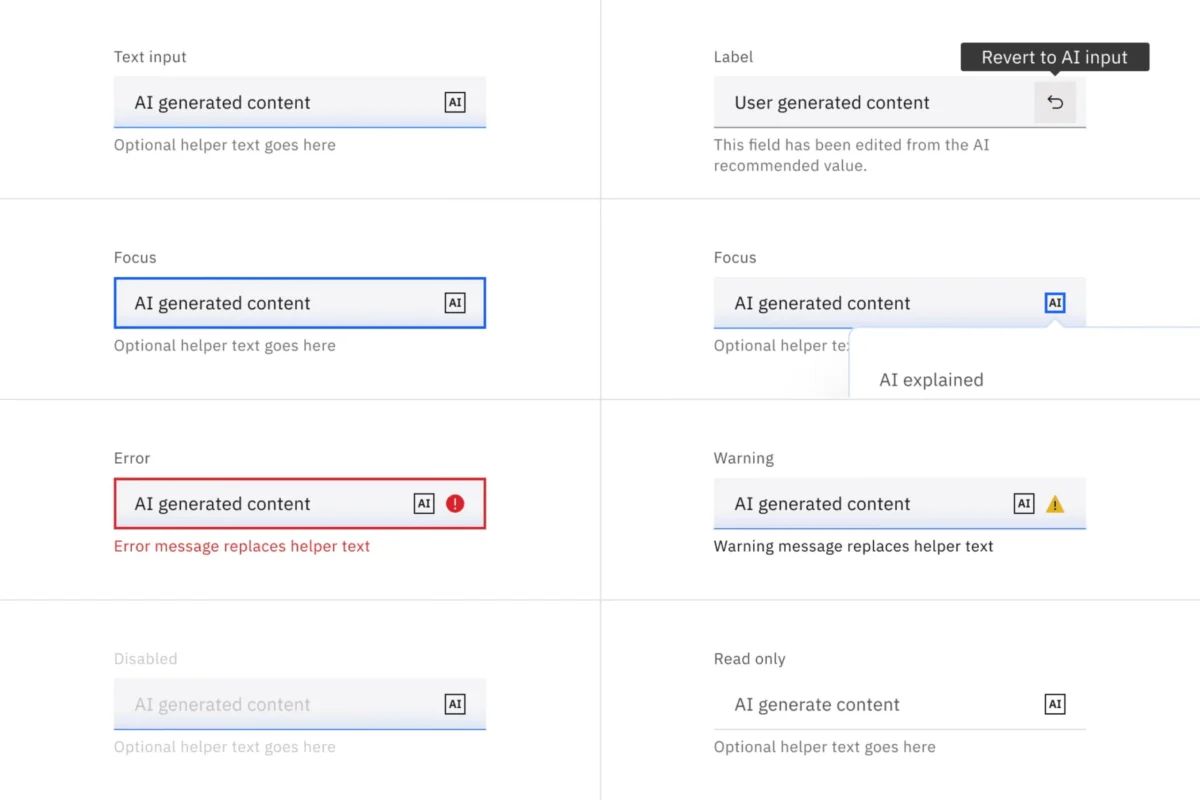
Design systems are already beginning to adapt. IBM’s Carbon Design System, for example, has pioneered the use of "AI Labels" that go beyond mere icons. These labels often include "explainability panels" that allow users to click on the AI tag to see which parts of the data were generated by AI and what the confidence levels of those outputs are. The EU guidelines emphasize that a label must be "clear and distinguishable," meaning it must be legible, accessible to assistive technologies like screen readers, and persistent even when the content is downloaded or shared on other platforms.
Economic Implications and the Cost of Non-Compliance
The financial stakes for failing to meet these transparency standards are considerable. The EU AI Act follows a tiered penalty structure based on the severity of the infringement and the size of the company:

- Non-compliance with Prohibited Practices: Fines of up to €35 million or 7% of total worldwide annual turnover, whichever is higher.
- Non-compliance with Transparency and Other Obligations: Fines of up to €15 million or 3% of total worldwide annual turnover.
- Supply of Incorrect or Misleading Information: Fines of up to €7.5 million or 1.5% of total worldwide annual turnover.
For Small and Medium Enterprises (SMEs) and startups, the fines are capped at more proportionate levels, but the reputational damage and the cost of retrofitting existing products to meet 2026 standards could be prohibitive. Industry analysts suggest that companies should begin auditing their AI pipelines now to identify where automated generation occurs without human oversight.
A Global Regulatory Pattern
While the EU is the first major jurisdiction to implement a comprehensive AI Act, it is not acting in isolation. A global pattern of AI regulation is emerging, suggesting that transparency is becoming a universal requirement:

- China: The Cyberspace Administration of China (CAC) has already implemented rules requiring "conspicuous labels" on synthetically generated content, particularly images and videos.
- South Korea: Proposed amendments to the Content Industry Promotion Act would require watermarks on AI-generated content to prevent the spread of disinformation.
- United States: While federal legislation has been slow, states like California and Tennessee have passed laws targeting "synthetic performers" and the use of AI in political advertising.
These parallel developments suggest that the "wild west" era of generative AI is concluding. For global enterprises, maintaining different versions of a product for different regions is inefficient, leading many to adopt the EU’s strict transparency standards as their global default.
Broader Impact on Digital Trust and "AI Slop"
The long-term objective of the EU AI Act is to preserve the integrity of the information ecosystem. The rise of "AI slop"—low-quality, mass-produced synthetic content designed to farm clicks or manipulate algorithms—has threatened to overwhelm search engines and social media feeds. By requiring clear labels, the EU aims to empower users to make informed choices about the media they consume.

Furthermore, in the context of democratic processes, the mandatory disclosure of deepfakes and AI-generated political messaging is seen as a vital safeguard. As AI models become increasingly capable of mimicking human speech and appearance with 100% fidelity, the legal requirement to "say so" becomes the final line of defense for digital trust.
In conclusion, the August 2, 2026, deadline for AI labelling is not merely a technical hurdle but a cultural shift in how we interact with digital media. By moving away from ambiguous symbols like the sparkle and toward clear, plain-language disclosures, the EU is setting a precedent for a more honest digital future. For designers, developers, and legal teams, the next two years will be a critical period of transition as they align their products with the new reality of a regulated artificial intelligence landscape.

