
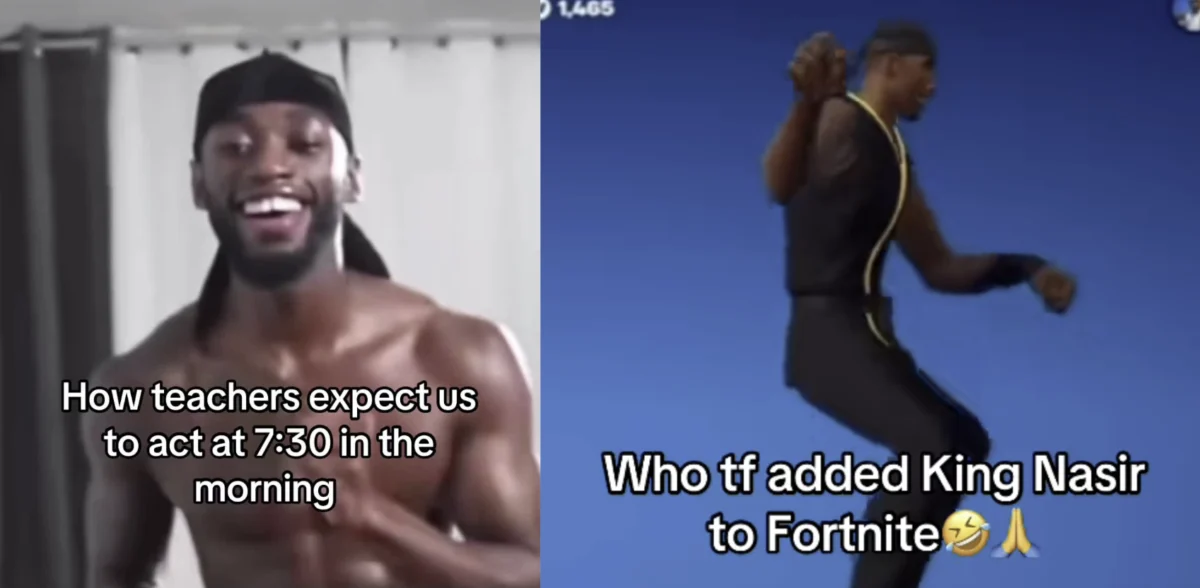
The King Nasir Dance refers to a complex social media phenomenon characterized by ironic dance trends, reaction videos, and the widespread distribution of recontextualized imagery featuring Nigerian-American adult content creator King Nasir. Since emerging as a prominent figure in the "GIFTok" subculture in late 2024, the Miami-based performer has become the centerpiece of a multi-year meme cycle that leverages his distinct physicality and suggestive choreography for comedic effect. This digital movement operates through the careful cropping and editing of explicit source material, transforming adult entertainment into mainstream "emotes" and reaction templates that have garnered hundreds of millions of views across platforms like TikTok and Instagram.
The rise of the King Nasir meme highlights a broader shift in digital culture where transgressive or mature content is stripped of its original intent and repurposed as "clean" humor. By isolating specific movements and pairing them with high-energy Jersey Club remixes or somber indie-pop tracks, creators have established a new vernacular of "ironic dancing." This trend has not only sustained Nasir’s digital relevance through 2025 and 2026 but has also sparked significant discourse regarding platform moderation, the ethics of recontextualization, and the mechanics of viral longevity in an increasingly fragmented social media landscape.
The Biological and Professional Background of the Subject
To understand the cultural impact of the King Nasir Dance, it is necessary to examine the origins of the individual at its center. King Nasir, a Nigerian-American residing in Miami, Florida, initially gained notoriety within the adult entertainment industry. However, his transition into the realm of internet memes was largely unintentional and driven by third-party creators. Unlike many influencers who cultivate a specific persona for mainstream audiences, Nasir’s "King Nasir" brand was absorbed into the meme ecosystem due to the high energy and idiosyncratic nature of his performances.
The "King Nasir" persona is defined by a blend of confidence and exaggerated physical expression. These traits made his content particularly susceptible to the "GIFTok" trend of 2024, where users seek out short, looping clips of high-intensity actions to use as digital reactions. In Nasir’s case, his movements—often characterized by rhythmic shifts and expressive facial cues—were viewed by TikTok’s younger demographic as "emotes," a term borrowed from video game culture (most notably Fortnite) to describe stylized victory dances or gestures.
Chronology of the Trend: From GIFTok to Global Resurgence
The evolution of the King Nasir Dance can be divided into three distinct phases, each marked by a different style of content and a unique set of viral "sounds."
Phase 1: The 2024 Emergence and the Jersey Club Era
The trend first gained significant traction in August and September 2024. During this period, the meme was largely focused on the "re-enactment" of Nasir’s movements. On September 9, 2024, TikTok user @pkprivv2 published one of the earliest high-engagement examples of the trend. The video, which featured the creator mimicking various clips of Nasir to a Jersey Club remix of "Last Man Standing," served as a blueprint for future participants. By asking the rhetorical question, "Where do you learn all your moves from?" the creator established an ironic distance between the source material and the dance itself.
This initial phase was characterized by a high degree of participation from male TikTok users who sought to replicate Nasir’s "moves" as a form of "gatekept" knowledge or a secret skill set. Shortly after, on September 22, 2024, user @udaysunny2.0 further popularized the trend by labeling Nasir as "the Goat" (Greatest of All Time), a title that would stick with the performer as he transitioned from a person to a meme archetype.
Phase 2: The 2025 Recontextualization and Relatability
After a period of relative dormancy in early 2025, the trend resurfaced in June of that year with a shift toward relatability-based humor. On June 22, 2025, user @fw_marzel posted a compilation of Nasir’s videos with a caption describing the anxiety of sending a "risky message" to a romantic interest. In this context, Nasir’s dancing was framed as a "random emote" performed to mask social nervousness. This video, which amassed nearly two million views, signaled a shift in how the meme was used: it was no longer just about the dance itself, but about using the dance to represent a specific emotional state.
Phase 3: The 2026 Renaissance and the "Prom Queen" Era
The most significant spike in the meme’s history occurred in March 2026. This resurgence was driven by an unlikely pairing of Nasir’s energetic movements with the melancholic song "Prom Queen" by Beach Bunny. On March 16, 2026, user @zeewickk posted a video recreating the dances to this audio, which quickly surpassed 7.4 million views. Simultaneously, user @cysniz uploaded a similar video that blended actual clips of Nasir with the creator’s own performance, reaching over 10.4 million views in a single week.
The juxtaposition of Nasir’s "dances" with the lyrics "I wish I was like you" created a layer of absurdist irony that resonated deeply with the platform’s algorithm. This era also saw the rise of the "Fake Dancers vs. Real Dancer" format, popularized by @zainj_dm on March 19, 2026. In these videos, popular TikTok dancers are compared unfavorably to King Nasir, further cementing his status as a "peak" performer within the meme’s internal logic.
Analysis of the Mechanics of Virality
The success of the King Nasir Dance trend can be attributed to several key factors that align with the current state of social media algorithms and youth culture.
1. The Power of Recontextualization
The primary engine of the meme is the "cleansing" of mature content. By cropping videos to exclude explicit imagery and focusing solely on the torso or face, creators bypass TikTok’s strict community guidelines regarding adult content. This allows the meme to reach a younger audience that may be entirely unaware of the original context of the clips. The humor arises from this hidden knowledge—a "wink and a nod" to those who know the source, while appearing as harmlessly absurd to those who do not.
2. Sonic Juxtaposition
The choice of music plays a critical role in the meme’s longevity. The shift from high-tempo Jersey Club remixes to the slower, emotional tempo of "Prom Queen" allowed the meme to evolve from a "hype" trend to a "vibe" trend. This flexibility ensures that the visual component—Nasir’s dancing—remains fresh by being applied to different auditory moods.
3. Emote Culture and Gaming Literacy
The framing of Nasir’s movements as "emotes" is a direct reflection of the influence of gaming on modern humor. For Gen Z and Gen Alpha, a "dance" is often viewed as a modular piece of content that can be "equipped" or performed in various social situations. Nasir’s repetitive, rhythmic motions fit perfectly into this "emote" framework, making them easy to replicate and categorize.
Supporting Data and Engagement Metrics
The scale of the King Nasir trend is evidenced by the staggering engagement metrics recorded during its peak periods. Analysis of TikTok data from 2024 through early 2026 shows:
- Total Views: Videos tagged with #kingnasir and related terms have exceeded an estimated 500 million aggregate views.
- Peak Velocity: During the March 2026 resurgence, the top three videos in the trend gained a combined 21 million views within a seven-day window.
- User Participation: Tens of thousands of unique videos have been created using the "Last Man Standing" and "Prom Queen" audios specifically to reference Nasir, indicating a high "join rate" for the trend.
- Geographic Spread: While originating in the Nigerian-American and Miami digital spheres, the trend has seen significant participation from users in Western Europe, Southeast Asia, and Latin America, as seen in the "EL KING" videos by creators like @monterrubio67.
Platform Safety and Ethical Implications
The King Nasir Dance trend occupies a complex ethical and legal gray area. On one hand, the trend has provided Nasir with a level of mainstream visibility and "legend" status that is rarely afforded to performers in his industry. On the other hand, the use of recontextualized adult content raises questions about platform safety.
TikTok’s moderation systems are designed to detect explicit imagery, but they are less effective at identifying "coded" content. The King Nasir meme demonstrates how a community can collectively agree to treat specific imagery as a meme, thereby "normalizing" a figure from the adult industry within a space frequented by minors. While the meme itself is often "clean," the "search interest" it generates inevitably leads users toward Nasir’s original, uncensored work.
Furthermore, the trend highlights the lack of control performers have over their own image once it enters the meme ecosystem. While some adult stars, such as Johnny Sins, have leaned into their meme status to build mainstream brands, others find their likenesses used in ways that are entirely outside their control or intent.
Broader Impact on Digital Culture
The legacy of the King Nasir Dance lies in its role as a precursor to a new type of "transgressive mainstreaming." It follows in the footsteps of previous memes involving figures like Ricardo Milos or Lana Rhoades, where the irony of their profession is the primary driver of the humor. However, the Nasir trend is unique in its focus on "skill" and "choreography," however ironic that focus may be.
By framing Nasir as a "Real Dancer" in opposition to "Fake Dancers," the meme community has created a satirical hierarchy of talent. This subversion of traditional influencer culture—where a "random" figure from the fringes of the internet is elevated above established celebrities—remains a core tenet of modern digital humor.
As the trend continues to see periodic revivals, it serves as a case study in the "zombie meme" phenomenon: content that never truly dies, but instead enters a state of dormancy only to be resurrected by a new audio track or a slight shift in formatting. Whether through the lens of "risky message" emotes or "Prom Queen" recreations, King Nasir’s presence on social media has become a permanent fixture of the 2020s digital landscape, illustrating the unpredictable and often irreverent nature of viral fame.

