
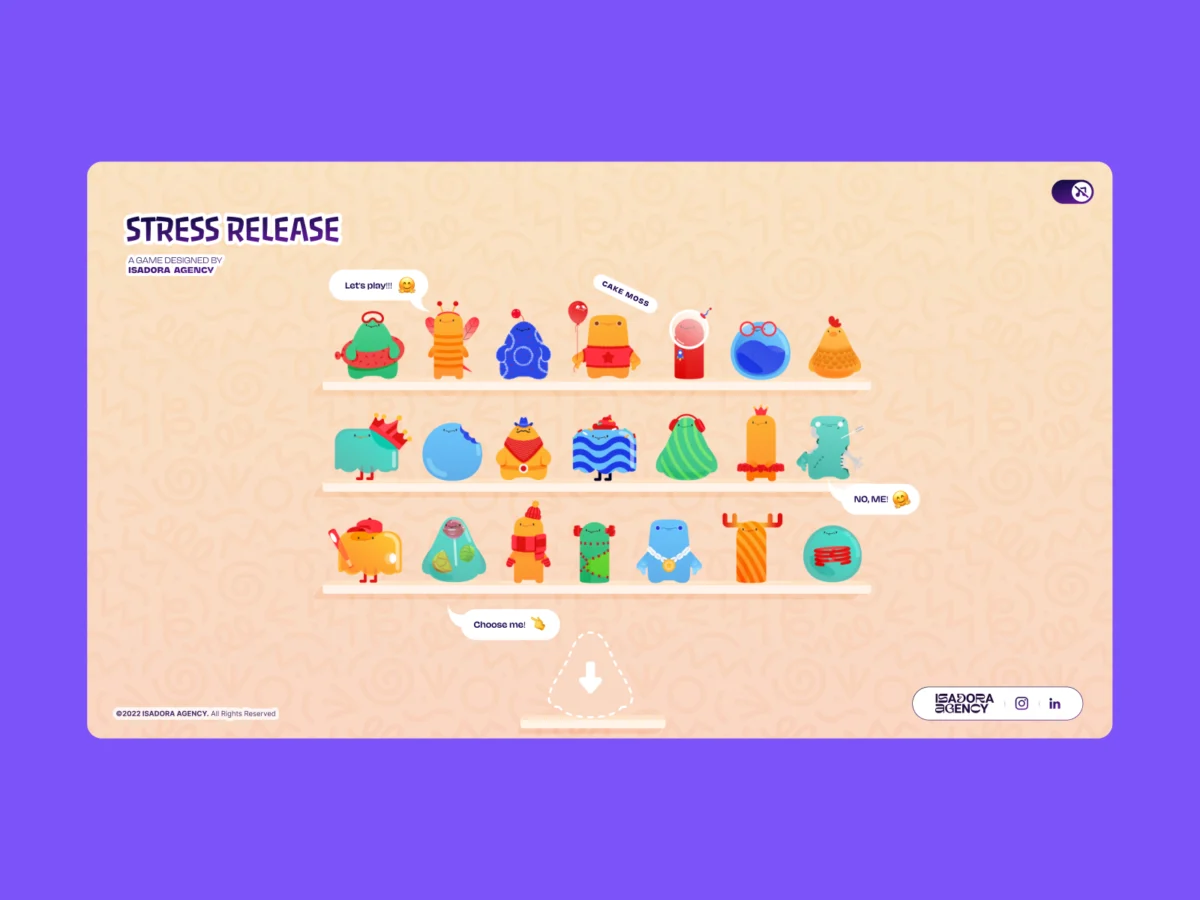
The evolution of the modern web has transitioned from static information delivery to the creation of immersive, highly interactive environments that prioritize user engagement through tactile feedback. In a recent technical breakdown, Alexey Kopytin of Isadora Agency detailed the architectural rationale behind "Stress Release," a digital stress-relief game that challenges the industry’s reliance on traditional physics engines. By prioritizing "intentional motion" over "plausible motion," the development team demonstrated how programmatic Lottie state controls, combined with standard DOM manipulation and distance-based mathematics, can produce a more controlled and satisfying user experience than emergent simulations.
The Paradigm Shift: Animation over Simulation
For years, the gold standard for creating bouncy, destructive, or "squishy" web interfaces has involved the integration of physics engines such as Matter.js, Cannon.js, or custom WebGL solutions. These tools excel at generating realistic movement based on gravity, friction, and collision. However, the team at Isadora Agency discovered that for projects where the art direction is paramount, these engines can be counterproductive. Physics engines produce motion that is mathematically "correct" but often lacks the specific personality and curated timing intended by professional animators.
The "Stress Release" project was designed as a digital toy for burnt-out creatives, allowing users to smash, stretch, and distort a variety of animated characters. While initial prototypes utilized physics engines to simulate the elasticity of rubber, the results were often unpredictable. The characters would bounce uncontrollably or react in ways that obscured the meticulously crafted keyframes provided by the design team. This led to a critical realization: the project did not require characters to act like realistic rubber balls; it required them to react with "intentional motion"—bespoke sequences where every frame serves a narrative and aesthetic purpose.
Chronology of Development: From Physics to Programmatic Control
The development timeline of "Stress Release" followed a non-linear path that reflects a common pivot point in high-end creative front-end engineering. The project began with a discovery phase where the primary goal was to define the "feel" of the interaction.
- Conceptualization and Art Direction: Animators created 21 distinct characters, each with a unique personality expressed through specific squash-and-stretch sequences.
- Physics Engine Prototyping: The engineering team attempted to map these characters to Matter.js bodies. This phase revealed that algorithmic approximations of motion often "clashed" with the animators’ JSON-based Lottie files, leading to jittery transitions and a loss of deterministic control.
- The Pivot: The team decided to scrap the physics engine entirely. They shifted toward a system that treated the Lottie animation as the primary source of truth, using JavaScript to trigger specific frame ranges based on user input.
- Mathematical Integration: Developers implemented radial input mapping to bridge the gap between a user’s click and the animation’s response.
- Optimization and Launch: The final phase involved aggressive mobile optimization, reducing the computational overhead of running multiple vector animations simultaneously.
The Technical Core: Radial Input Mapping and Distance Math
To achieve a tactile sensation without a physics engine, the team utilized "radial input mapping." This technique involves converting page-level click coordinates into the local coordinate space of the character. By calculating the distance from the center of the character to the point of impact, the system can determine the intensity of the reaction.

The mathematical foundation of this interaction relies on the Pythagorean theorem. When a user clicks, the script captures the X and Y offsets relative to the character’s center. The formula Math.hypot(a, b) provides a single numerical value representing the distance. This value is then mapped to a "concentric zone system," similar to a dartboard.
A click near the center (the "bullseye") triggers the highest point rewards and the most intense animation segments. Conversely, clicks further from the center trigger lighter reactions. Because the "explosion" Lottie animations are repositioned to the exact (a, b) vector of the click, the visual feedback is spatially accurate, creating a powerful illusion of physical impact. This method ensures that the "hitbox" remains a clean, predictable circle, regardless of the visual complexity of the character’s SVG paths.
Mastering the Narrative: Programmatic Lottie State Control
The true power of this architecture lies in how it manages the Lottie timeline. Rather than letting an animation play from start to finish, the developers divided each character’s JSON file into specific "segments" or frame ranges.

For example, a character might have an "idle" loop from frames 0 to 40. Upon a user click, the system halts the idle loop and jumps to a "reaction" segment (e.g., frames 41 to 80). The Lottie API’s playSegments method is used with a "force" parameter, ensuring that the transition is instantaneous and feels responsive to the user’s touch.
This deterministic control allows for complex interactions like the "Mega Squeeze." This specific state involves a long build-up (frames 181 to 302) that loops while the user holds their click, followed by a dramatic release sequence. By managing these states programmatically, the developers ensured that the user never sees a "broken" animation frame, maintaining the integrity of the art direction throughout the entire gameplay loop.
Supporting Data: Performance and Mobile Optimization
One of the significant risks of using Lottie animations at scale is the impact on browser performance, particularly on mobile devices. Lottie files are essentially large JSON objects that the browser must parse and render as SVGs in real-time. With 21 characters on a "shelf" screen, the potential for frame-rate drops was high.

To combat this, the Isadora Agency team implemented several data-driven optimization strategies:
- Quality Throttling: On the "shelf" screen, where multiple animations play at once, the team used
lottie.setQuality(0.5). This reduces the complexity of interpolation calculations by 50%, significantly lowering CPU usage without a noticeable loss in visual quality for smaller-scale previews. - Speed Reduction: By setting the shelf animation speed to 0.6 (60%), the team reduced the number of frames the browser needed to calculate per second, further stabilizing the experience on mid-range mobile devices.
- Dynamic Resource Allocation: On the primary "play" screen, where only one character is active, the quality is boosted back to
1.0to ensure the highest possible fidelity for the main interaction.
These optimizations allowed the application to maintain a consistent 60 frames per second (FPS) on most modern mobile browsers, a crucial metric for any game relying on tactile feedback.
The Responsive Advantage of DOM-Based Architecture
Choosing the DOM and SVG over a WebGL canvas provided an inherent advantage in terms of responsiveness. In a WebGL environment, scaling a game requires complex recalculations of bounding boxes, collision vectors, and camera perspectives. By using the DOM, the "Stress Release" project could leverage CSS for its layout.

The team utilized CSS custom properties (variables) to handle resizing. A simple JavaScript function recalculates the --doc-height and --doc-width on every window resize event. Because the Lottie SVGs are contained within standard HTML elements, they scale naturally according to CSS rules. This bypasses the need for manual coordinate remapping across different screen aspect ratios, ensuring that the "distance math" remains accurate whether the user is on a desktop monitor or a vertical smartphone screen.
Analysis of Implications: Design-Led Engineering
The success of the "Stress Release" project highlights a growing trend in high-end web development: the move toward design-led engineering. In this model, the limitations of a technology (like the unpredictability of a physics engine) are not accepted as inevitable. Instead, the architecture is rebuilt to serve the specific needs of the art direction.
This approach has broader implications for UX/UI design beyond gaming. As brands seek to create more "human" and "tactile" digital interfaces, the ability to control motion with frame-by-frame precision becomes a competitive advantage. It allows for the creation of "micro-interactions" that feel hand-crafted rather than procedurally generated.

Furthermore, this methodology provides a blueprint for how creative agencies can bridge the gap between their motion design departments and their front-end development teams. By using Lottie as the common language, animators can hand over JSON files with the confidence that their work will not be altered by a physics simulation.
Conclusion and Future Outlook
The "Stress Release" project serves as a compelling case study for the efficacy of programmatic Lottie control in creating high-quality, tactile web experiences. By rejecting the "industry instinct" to use physics engines, Isadora Agency was able to deliver a product that honored the intentionality of its designers while maintaining high performance across all device types.
As web technologies continue to evolve, the distinction between "simulation" and "animation" will remain a critical choice for developers. While physics engines will always have a place in creating emergent, sandbox environments, the "Stress Release" architecture proves that for experiences where every squish and bounce must be perfect, absolute deterministic control is the superior path. This project not only provides a functional tool for stress relief but also offers a masterclass in how to prioritize the "art" in the architecture of the modern web.

