
The global corporate landscape is currently defined by a pervasive, silent assumption among senior leadership: that every consumer and employee is actively seeking a life saturated with artificial intelligence. From Silicon Valley startups to legacy Fortune 500 enterprises, the prevailing strategy has focused on the rapid deployment of AI-driven features, products, and workflows. This movement is built on the premise that these technologies will seamlessly replace outdated practices and mend broken operational models. However, emerging market data and user experience research suggest a significant divergence between corporate vision and user reality. Contrary to the expectations of AI leaders, a growing segment of the population does not want more AI—at least not in the intrusive, fragmented, and unreliable form in which it is currently being delivered.
The current state of AI integration is characterized by what industry analysts call the "AI Adoption Gap." Despite massive capital investment, many AI features are suffering from low adoption and poor retention rates. According to studies conducted by IBM and various user experience (UX) research firms, the high cost of delivery for these tools often fails to yield a proportional return on investment. Furthermore, the hasty implementation of unrefined AI features carries a significant risk of reputational damage, as users increasingly associate the technology with "slop," unreliability, and increased cognitive load.
The Failure of AI as a Standalone Value Proposition
A fundamental misunderstanding at the executive level is the belief that "powered by AI" constitutes a value proposition in its own right. Research from organizations such as the Nielsen Norman Group highlights that AI is a technology, not a benefit. New features do not inherently generate customer satisfaction; rather, they often act as "bolt-ons" that disrupt established workflows. Because many AI tools exist as separate interfaces or disconnected systems, they force employees and consumers to "hop" out of their primary work environments. This fragmentation creates a friction-filled experience where the user must manage yet another tool, often resulting in more work rather than less.
AI has also proven to be a mirror that amplifies existing organizational shortcomings. Rather than fixing years of accumulated technical debt, poor data quality, or broken internal cultures, AI often exposes these issues. When an organization’s underlying data is inconsistent or its priorities are conflicting, the AI output reflects that mess directly to the end-user. This places the burden of sense-making on the customer or the employee, who must then reconcile the AI’s suggestions with reality. In this context, AI becomes a liability that highlights institutional inefficiencies rather than a solution that resolves them.
The Productivity Paradox and the Hidden Costs of Automation
The primary promise of AI has been a radical increase in productivity, yet recent data suggests a more complicated reality. While AI can generate a response or a draft faster than a human can write from scratch, this "speed" comes with a significant "hallucination tax." Users are becoming acutely aware of the time and mental energy required to find and fix errors produced by large language models. The perceived ease of generation is frequently offset by the rigorous verification process required to ensure accuracy and professional standards.

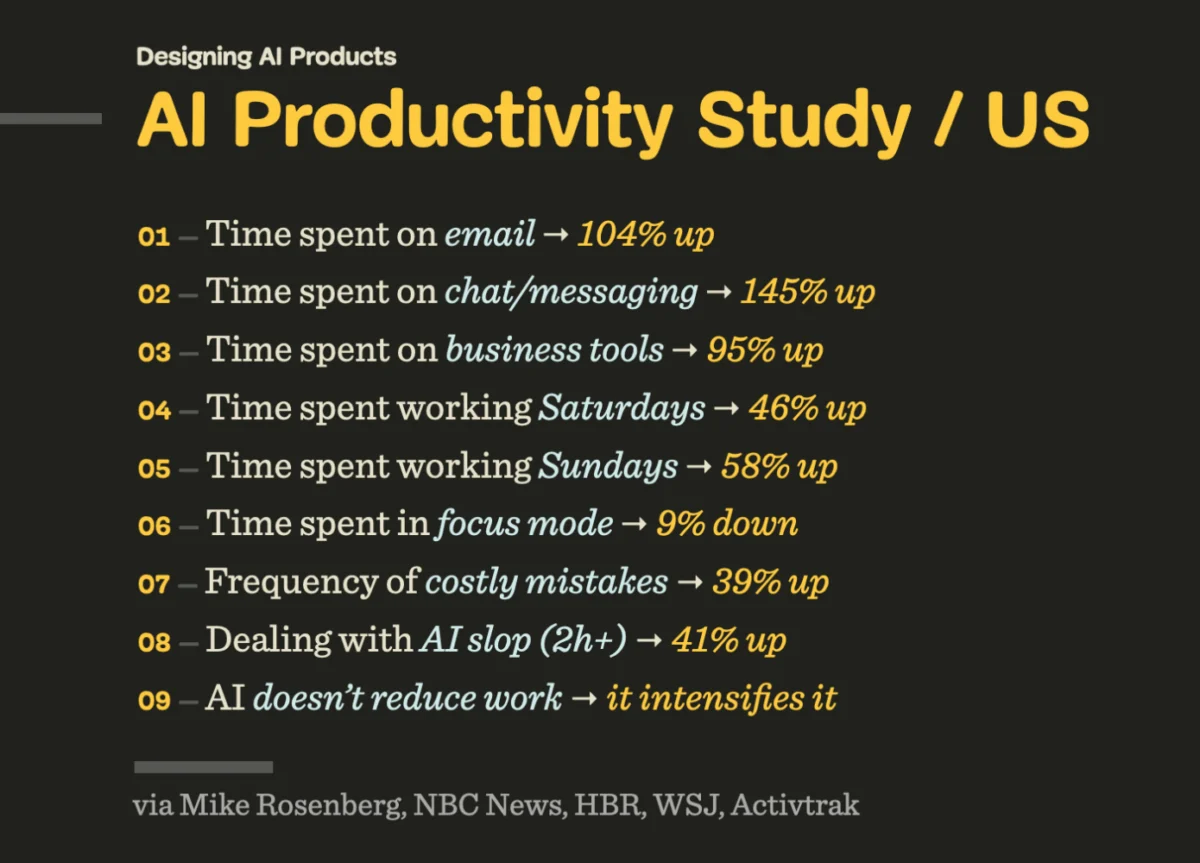
Recent productivity studies in the United States have yielded startling statistics regarding the impact of AI on the modern workday. Contrary to the narrative of reduced labor, the data indicates that AI is intensifying work rather than streamlining it. Key findings from sources including NBC News, the Harvard Business Review, and the Wall Street Journal reveal the following trends:
- Communication Overload: Time spent on email has increased by 104%, while time dedicated to chat and messaging platforms has surged by 145%.
- System Fragmentation: The use of disconnected business tools is up by 95%.
- The Erosion of Work-Life Boundaries: Working hours on Saturdays have increased by 46%, and Sunday work has risen by 58%.
- The Quality Gap: Costly mistakes are up by 39%, and the time spent dealing with "AI slop"—low-quality or irrelevant automated content—has increased by 41%.
- Decreased Focus: "Focus mode," or periods of uninterrupted deep work, has declined by 9%.
These figures suggest that instead of freeing up time, AI is creating a cycle of high-volume, low-value tasks. The technology is often used to generate more content, which in turn requires more human oversight, more meetings to discuss the content, and more digital communication to manage the output.
Psychological Resistance and the Fear of Displacement
Beyond the functional failures of current AI implementations, there is a profound psychological barrier to adoption. For many, AI is not a tool they have chosen to explore; it is an uninvited guest arriving at a pace dictated by corporate mandates. This lack of agency, combined with a constant stream of media reports regarding AI’s potential to replace human labor, has fostered a culture of resistance and deep-seated anxiety.

People do not necessarily desire "AI art museums," "AI-narrated books," or "AI romantic partners." There is a significant societal pushback against the automation of experiences that are fundamentally human. The prospect of "AI agents" roaming through bank accounts or making medical decisions is often met with skepticism rather than excitement. Most notably, the "magical box" interface—where users must constantly type prompts or speak into a microphone—is proving to be an exhausting and unnatural way to interact with technology. Users compare features not against other humans, but against other features. If a traditional, deterministic feature works reliably every time, and an AI-driven version works only 80% of the time, the user will invariably prefer the former.
The Shift Toward "AI-Second" Design
The path forward for successful AI integration lies in a shift from "AI-first" to "AI-second" thinking. Users continue to prioritize the same qualities they have valued for decades: speed, accessibility, reliability, and predictability. They do not want AI to replace their entire workflow; they want it to augment their existing processes by taking over the most mundane, repetitive, and mentally taxing tasks.
Data from the Brookings Institution and the Washington Post indicates that while many jobs are "exposed" to AI automation, the most successful applications are those that target the "boring" parts of a role. For example, in fields like software development or public relations, AI can handle basic coding syntax or media list compilation, allowing the human professional to focus on high-level strategy, creative problem-solving, and human intuition.

When AI is deeply integrated into existing workflows and matches the user’s established mental models, its value becomes clear. This "ambient AI" operates in the background, offering support only when needed without demanding center stage. It does not matter if these features are branded as "AI," "Smart," or "Automation"—what matters is that they work consistently and solve a specific problem. The goal of automation should be to provide users with more "headspace" to engage in work they find rewarding, rather than forcing them to adapt their thinking to the constraints of a machine.
Industry Implications and the Human Element
The current disconnect between AI development and user needs serves as a critical warning for the tech industry. As the initial hype cycle transitions into a period of more sober evaluation, companies that prioritize human-centric design over technical novelty will likely emerge as the leaders of the next era. The value of AI is not found in its ability to mimic human creativity or emotion, but in its ability to eliminate the "friction of living"—the administrative and physical labor that detracts from the human experience.
Ultimately, the market is signaling a preference for the "human element." In professional settings, the most valuable contributions remain those that involve taste, a unique point of view, and emotional intelligence. AI can be a powerful ally in many situations, but it cannot replace the depth of human connection or the satisfaction of a task well-performed by a person.

The conclusion for AI leaders is clear: people do not need more AI in their lives for the sake of having AI. They need AI to handle the tasks they find dull and unnecessary, thereby granting them more time to spend with other people and engage in activities they love. Successful technology has always been that which makes itself invisible while making the user more capable. If AI is to move beyond its current adoption gap, it must stop being a destination and start being a quiet, reliable engine that drives human potential forward without demanding the driver change who they are. The future of AI is not in the "magical box," but in the seamless, supportive background of a more human-centric world.

