
The rapid integration of generative artificial intelligence across consumer and enterprise software has encountered a significant psychological and operational barrier: a growing disconnect between corporate AI ambitions and actual user needs. While technology leaders and venture capitalists have prioritized an "AI-first" approach, market data and user experience research indicate that the broader public is not seeking more AI as a standalone feature. Instead, there is a mounting preference for subtle, integrated automation that solves specific pain points without disrupting established workflows or replacing human-centric experiences. This phenomenon, often referred to as the "AI adoption gap," suggests that the mere presence of artificial intelligence is no longer a viable value proposition for software products.
The State of AI Integration and the Adoption Gap
Since the public release of large language models (LLMs) in late 2022, the technology sector has engaged in an unprecedented race to embed AI features into every conceivable interface. From word processors and spreadsheets to refrigerators and children’s toys, the "Powered by AI" label has become a standard marketing pillar. However, recent studies, including those from IBM and various UX research firms, highlight a troubling trend for developers: adoption and retention rates for these new features remain disproportionately low compared to the high cost of development and deployment.
The primary cause of this gap is the "bolt-on" nature of many AI features. Rather than being woven into the fabric of a user’s existing process, many AI tools exist as separate sidebars, floating widgets, or entirely new platforms that require users to "hop off" their current task. This creates a cognitive tax and a fragmented workflow. In a professional setting, where efficiency is paramount, the requirement to navigate a disconnected AI system often outweighs the perceived benefits of the AI’s output. Consequently, users are increasingly viewing AI not as a revolutionary assistant, but as an additional layer of digital clutter.
Chronology of the AI Hype Cycle: From Novelty to Fatigue
The current market sentiment is the result of a rapid three-phase evolution that occurred over a remarkably short period.
Phase 1: The Novelty Era (Late 2022 – Mid 2023)
Following the launch of ChatGPT, the initial reaction was one of wonder. Users experimented with AI’s ability to write poetry, generate images, and pass professional exams. During this period, any product featuring an AI integration saw a surge in trial sign-ups as users explored the boundaries of the technology.
Phase 2: The Integration Rush (Late 2023 – Mid 2024)
As corporations felt the pressure to demonstrate AI strategies to shareholders, "AI-first" became the mandate. Software companies rushed to include "summarize" buttons and "AI assistants" into their interfaces. This phase was characterized by a lack of user-centric design, as speed to market took precedence over utility.
Phase 3: The Rationalization Phase (Late 2024 – Present)
The market is currently entering a period of critical evaluation. The "wow factor" has dissipated, replaced by a demand for reliability and tangible ROI. Users have begun to push back against intrusive AI, citing concerns over data privacy, the "hallucination tax" (the time spent correcting AI errors), and the erosion of human-to-human interaction.

Supporting Data: The Productivity Paradox
While AI is marketed as a tool for extreme productivity, empirical data suggests a more complex reality. A series of studies from organizations such as ActivTrak, Microsoft, and the Harvard Business Review have identified what is becoming known as the AI Productivity Paradox.
According to data compiled from various workplace studies, the introduction of AI has led to unintended consequences in the digital workplace:
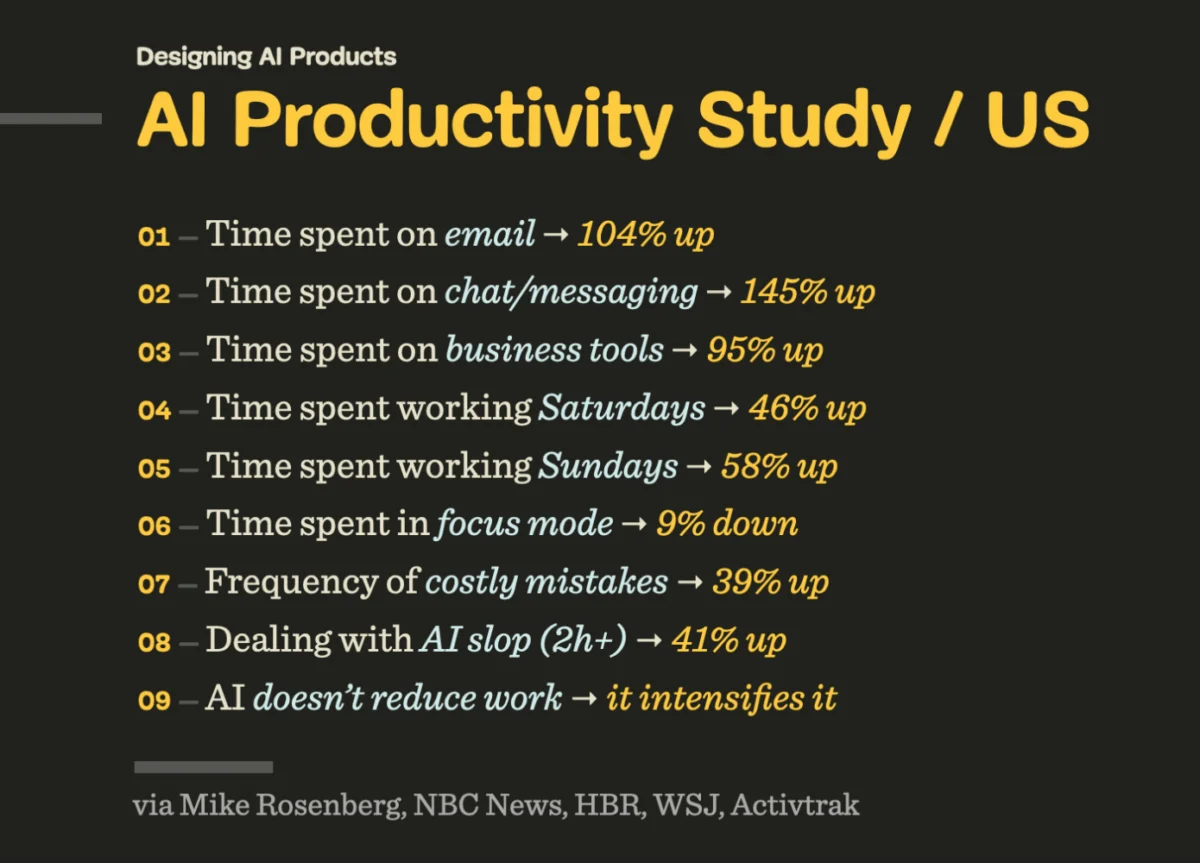
- Communication Overhead: Time spent on email has increased by an average of 104% in some sectors, as AI-generated drafts lead to a higher volume of low-value correspondence.
- Digital Debt: Chat and messaging volume has surged by 145%, as AI tools make it easier to send messages but harder to manage the resulting notifications.
- The Hallucination Tax: A study by the Nielsen Norman Group found that users are often discouraged from error-checking AI-generated content due to "automation bias," yet when errors are made, the cost to correct them is 39% higher than if the task had been performed manually from the start.
- Workday Extension: Despite the promise of shorter work weeks, data suggests that "working Sundays" have increased by 58% for some knowledge workers, as the ease of generating content with AI has increased the total volume of work expected by management.
These statistics suggest that AI is currently "intensifying" work rather than reducing it. For the average employee, AI has not yet delivered the promised "gift of time"; instead, it has increased the "noise" they must filter through daily.
The Value Proposition Fallacy
A critical error in current AI leadership is the assumption that AI itself is a value proposition. In product design, a value proposition is the specific benefit a customer receives from using a product. Historical analysis of technology adoption shows that users do not care about the underlying technology (e.g., SQL databases, cloud computing, or JavaScript frameworks); they care about the outcome.

When AI is presented as the primary feature, it often fails to address the underlying "job to be done." Furthermore, AI has a unique tendency to amplify existing organizational flaws. If a company has poor data quality, an AI tool will simply generate faster, more confident versions of incorrect information. If an organization has a broken culture of decision-making, AI will provide more conflicting data points to argue over. In these cases, AI does not fix the problem; it makes the mess more visible and hands the responsibility of sorting it to the end user.
Stakeholder Reactions: Resistance and Anxiety
The pushback against AI-heavy environments is not merely a matter of technical friction; it is deeply rooted in human psychology and sociology. Reactions from different sectors of society reveal a common theme of "AI fatigue."
The Workforce: Employees in creative and analytical fields express deep anxiety about "vibe-coded" changes to their professions. There is a sense that the rewarding parts of a job—the thinking, the craft, and the human intuition—are being automated, leaving humans to perform the "boring labor" of managing AI agents and proofreading machine-generated text.
The Consumer: In the consumer market, there is a growing resistance to AI-narrated books, AI-generated art, and AI-driven customer service. A quote from industry leader Bo Young Lee encapsulates this sentiment: "I don’t want AI making my medical decisions. I want AI to do all the physical and mental labor that taxes me so I can read books written by humans and go to art galleries to engage with art made by humans."

The UX Community: User experience designers, such as Vitaly Friedman, are increasingly advocating for "AI-second" design. This philosophy suggests that AI should be subtle, humble, and ambient. It should remain in the background, performing dull and repetitive tasks—such as data entry, file organization, or scheduling—without demanding a conversational interface or a change in the user’s mental model.
Broader Impact and Implications for the Future
The long-term success of artificial intelligence will likely depend on its ability to become "invisible." The most successful technologies in history—such as electricity, the internet, and the smartphone—transitioned from being "revolutionary features" to "invisible utilities."
1. The Shift to Functional Automation
Future development is expected to pivot away from "chat-with-your-data" interfaces toward functional automation. This involves AI that works within existing tools to perform specific, high-value tasks, such as automatically reconciling bank statements or identifying anomalies in medical imaging, without requiring a separate "AI prompt."
2. The Preservation of Human-Centric Value
As AI becomes more prevalent, the value of "human-made" content and "human-delivered" services is likely to increase. In fields like education, therapy, and high-end hospitality, the absence of AI may become a luxury feature.

3. Redefining Productivity
Organizations will need to move beyond "speed of delivery" as the primary metric for AI success. True productivity gain will be measured by the reduction of "drudge work" and the increase in time available for deep thinking, strategy, and creative problem-solving—tasks that AI, for all its processing power, cannot yet replicate with human-level nuance and taste.
Conclusion
The current trajectory of AI integration suggests that more is not necessarily better. While the technological capabilities of AI are undeniable, the human appetite for its constant presence is limited. People do not crave more AI in their lives; they crave the freedom that AI could potentially provide. The challenge for the next generation of AI leaders and designers will be to move past the hype of "AI-first" and embrace a more disciplined, "AI-second" approach that respects human workflows, values human creativity, and prioritizes reliable utility over technological novelty. Ultimately, the goal of AI should not be to force humans to change themselves, but to automate the mundane so that humans can spend more time engaging with the world and each other.

