
The modern web development landscape is currently undergoing a significant architectural shift as the gap between "browser-native" capabilities and third-party library requirements continues to narrow. For over a decade, developers have relied on the Node Package Manager (npm) ecosystem to fill critical voids in the web platform, leading to a culture where dependencies are often installed once and rarely re-evaluated. However, the introduction of the "Baseline" initiative—a collaborative effort by the WebDX Community Group—is now providing a structured framework for developers to audit their applications and remove redundant code. Industry data suggests that a typical mid-sized JavaScript application can shed between 60KB and 90KB of minified and gzipped dependencies by simply leveraging features that are now built directly into modern browsers.
The Emergence of the Baseline Standard
The Baseline initiative was launched to solve a long-standing communication problem in web development: knowing when a CSS or JavaScript feature is truly "safe" to use across different browser engines. Managed by the WebDX Community Group, which includes representatives from Google, Apple, Mozilla, and Microsoft, Baseline categorizes web features into three distinct stages.
A feature is considered "Limited Availability" when it is supported by some, but not all, major browser engines. It moves to "Newly Available" once it is supported by the "core" engines—Chromium (Chrome and Edge), Gecko (Firefox), and WebKit (Safari). Finally, a feature becomes "Widely Available" after 30 months have passed since its initial cross-browser support. This 30-month window serves as a proxy for the time it takes for the majority of the global user base to update their devices and browsers, providing a "green light" for developers to remove polyfills or libraries that previously provided that functionality.
The Hidden Cost of Dependency Inertia
The primary reason legacy libraries persist in modern codebases is not developer negligence, but rather a lack of systematic auditing. While security-focused audits like npm audit are common, architectural audits—which ask whether a library is still necessary—are rare. This inertia results in "JavaScript bloat," where users are forced to download, parse, and execute code that replicates functionality already present in their browser’s engine.

From a performance perspective, the cost of these dependencies is multifaceted. Beyond the network download time, JavaScript carries a high execution cost. Every kilobyte of code must be decompressed, parsed by the JavaScript engine, and compiled before it can run. On lower-end mobile devices, this process can significantly delay the "Time to Interactive" (TTI) and "Total Blocking Time" (TBT), negatively impacting user experience and search engine rankings.
Chronology of Native Feature Integration (2020–2026)
To understand the speed of this transition, it is helpful to look at the timeline of when major features achieved Baseline status:
- 2020–2021: The
fetchAPI andAbortControllerreached broad stability, providing a native alternative to XMLHttpRequests and early HTTP clients. - 2022: The
<dialog>element achieved cross-browser support, offering a native way to handle modals and focus management. - 2023:
structuredClonebecame Widely Available, allowing for deep cloning of objects without the need for utility libraries like Lodash. - 2024:
Object.groupByand newSetmethods (union, intersection) reached Newly Available status. - 2025: The Popover API and
Intl.DurationFormatreached Newly Available status across all major engines. - 2026: CSS Anchor Positioning and the Temporal API (Stage 4) began their rollout into stable browser releases.
Cluster Analysis: Identifying Redundant Dependencies
The most effective way to reduce bundle size is to audit dependencies in "clusters"—groups of libraries that serve a similar functional purpose.
Internationalization and Formatting
The Intl namespace is perhaps the most significant area where native APIs have replaced the need for external libraries. Libraries such as timeago.js, numeral, and pluralize were once essential for handling the complexities of localizing dates, numbers, and lists. Today, Intl.RelativeTimeFormat can transform timestamps into strings like "3 hours ago" with built-in support for dozens of languages. Similarly, Intl.NumberFormat handles currency, percentages, and compact notations (e.g., "1.2M"), while Intl.ListFormat manages localized conjunctions and the "Oxford comma" in arrays. Replacing this cluster can save approximately 14KB gzipped.
HTTP Clients and Request Management
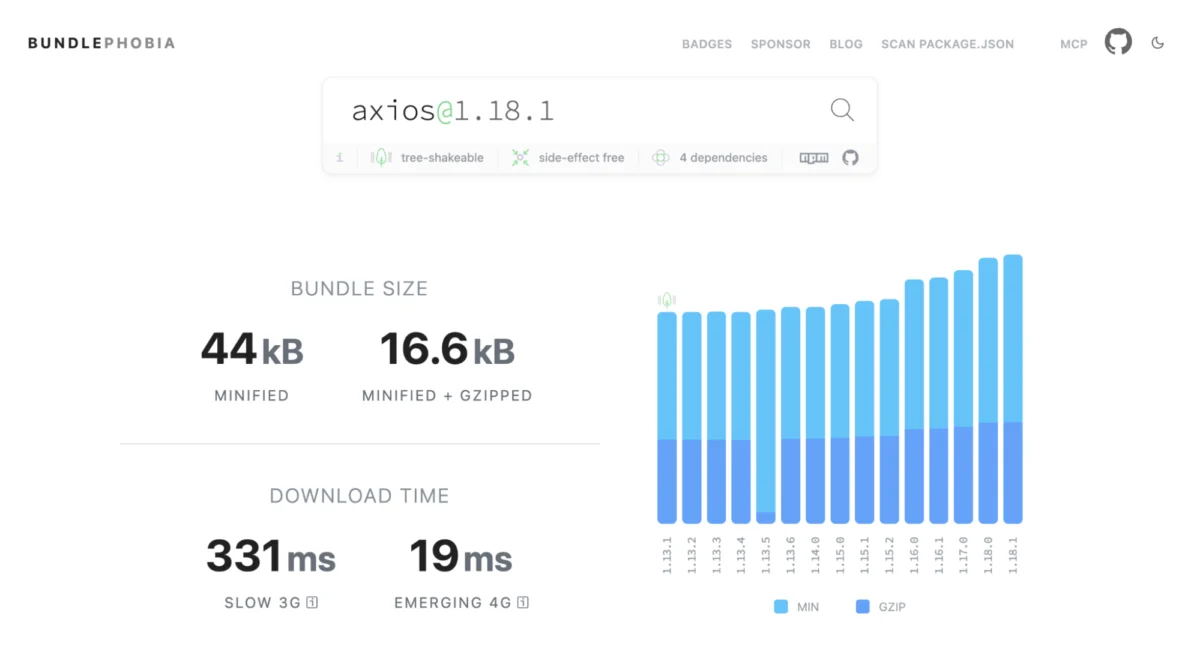
For years, axios and superagent were the industry standards for handling API requests. While these libraries offer "quality of life" features like automatic JSON parsing and request interceptors, the native fetch API combined with AbortSignal.timeout() now covers the vast majority of use cases. While axios remains useful for complex scenarios involving heavy use of interceptors or upload progress monitoring, a transition to a thin wrapper around fetch can remove roughly 17KB from the production bundle.

User Interface Primitives
The transition of UI patterns from JavaScript-heavy implementations to HTML and CSS primitives represents a major win for accessibility. The <dialog> element now handles "Top Layer" rendering, focus trapping, and keyboard interaction (the Escape key) natively. Previously, developers needed libraries like a11y-dialog or focus-trap to ensure these modals were accessible. Furthermore, the Popover API and the emerging CSS Anchor Positioning spec are set to replace positioning engines like Popper.js and tooltip libraries like tippy.js. This cluster represents a potential saving of 24KB gzipped.
Utility Libraries
General-purpose utility libraries like Lodash are frequently used for only a handful of functions. Modern JavaScript has absorbed many of these, including lodash.clonedeep (now structuredClone), lodash.groupby (now Object.groupBy), and various array/set utilities. By using native methods, developers can avoid the overhead of these standalone packages, saving 8KB or more.
Case Study: The Temporal API and the Risk of Early Adoption
While the trend is toward native adoption, the "Baseline" framework also provides a cautionary tale regarding timing. The Temporal API is the proposed replacement for the notoriously difficult Date object in JavaScript. As of early 2026, Temporal has reached Stage 4 of the TC39 process and has seen implementation in Firefox and Chrome. However, because it has not yet reached stable support in Safari, it is not yet "Baseline."
Adopting Temporal today requires a polyfill that can weigh up to 44KB gzipped. For a developer currently using a lightweight library like dayjs (3KB), "upgrading" to the native-but-polyfilled Temporal API would actually increase the bundle size by 41KB. This highlights the importance of the Baseline audit: native is only better when it does not require a heavy compatibility layer for the majority of users.
Strategic Implementation Framework
For organizations looking to implement a dependency audit, a three-question decision framework is recommended before removing any library:

- Is the replacement Baseline-safe for the specific audience? Developers must check their own analytics. A B2B application where users are required to use modern browsers can adopt "Newly Available" features immediately. A public-facing government site with a high percentage of legacy mobile users should wait for "Widely Available" status.
- What is the total cost of the swap? If the native feature requires a polyfill that is larger than the original library, the swap should be deferred or implemented via conditional loading.
- Does the platform feature cover the specific use case? Native features are often "primitives," meaning they do the core job but lack the "syntactic sugar" of libraries. Developers must ensure they aren’t inadvertently signing up to manually rebuild complex logic that a library already handles efficiently.
Broader Implications for the Web Ecosystem
The move toward Baseline standards has implications beyond mere performance. It represents a maturation of the web as a platform. When functionality moves from a library into the browser engine, it benefits from "platform-level" optimizations that no JavaScript library can match. This includes better memory management, C++ level execution speeds, and automatic accessibility features that are baked into the browser’s rendering engine.
Furthermore, reducing dependency counts improves the security posture of an application. Every third-party package in a package.json file is a potential vector for a supply-chain attack. By handing responsibility back to the browser vendors, development teams reduce their surface area for vulnerabilities and simplify their long-term maintenance requirements.
As the WebDX Community Group continues to track and promote Baseline features, the role of the front-end developer is shifting from "library integrator" to "platform expert." The quarterly audit of dependencies is becoming a standard best practice, ensuring that applications remain lean, fast, and accessible by utilizing the full power of the modern web platform.

