
The Technical Foundation of Tree-Counting Functions
For decades, CSS has lacked the internal "self-awareness" required to identify an element’s numerical position among its peers without the use of selectors. While the :nth-child() selector allowed developers to target specific elements, it did not provide a way to use that index as a raw numerical value within a calculation. The introduction of sibling-index() and sibling-count() bridges this gap.
The sibling-index() function returns an <integer> representing the position of the element among its siblings, starting from 1. Conversely, sibling-count() returns an <integer> representing the total number of sibling elements within the same parent. Unlike the counter() function, which returns a string intended for use in the content property of pseudo-elements, these new functions resolve to actual numbers. This allows them to be utilized within calc(), min(), max(), and the recently introduced trigonometric functions like sin() and cos().
The technical specifications, found in Section 9 of the CSS Values and Units Module Level 5, dictate that these functions take no arguments and operate based on the DOM tree structure. By resolving to integers, the browser can perform type coercion to convert these numbers into valid CSS units, such as <time> for animation delays or <percentage> for layout widths.
A Chronology of Implementation and Standardization
The journey toward native tree-counting functions began in early 2020 within the W3C CSS Working Group (CSSWG). The proposal, tracked under CSSWG Issue #4559, was born out of a collective frustration among web engineers regarding the "staggered animation" problem. Historically, creating a sequence where items in a grid fade in one after another required one of two inefficient methods.
The first method involved CSS preprocessors like Sass or Less. Developers would write loops to generate dozens, or sometimes hundreds, of :nth-child() rules, each manually assigning a CSS variable (e.g., --index: 1;). This approach was notoriously brittle; if a list exceeded the number of pre-generated rules, the animation would fail to stagger for the remaining items. Furthermore, it bloated the final CSS file with repetitive selectors.
The second method relied on JavaScript. Upon the DOM content loading, a script would iterate through all elements in a list and inject inline styles (e.g., element.style.setProperty('--index', i)). While dynamic, this method introduced "layout thrashing" and created a dependency where the visual presentation of the site was tied to the successful execution of a script.
The CSSWG approved the proposal for sibling-index() and sibling-count() after substantial debate regarding performance and the scope of the functions. By late 2024, implementation work began in the Chromium and WebKit engines. In June 2025, Google and Microsoft released Chrome/Edge 138, which included full support for these functions. Apple followed shortly after with Safari 26.2. Currently, Mozilla is tracking the implementation for Firefox under Bugzilla issue #1953973, with a "positive" standards position, signaling that universal browser support is on the horizon.
Practical Applications in Modern Web Design
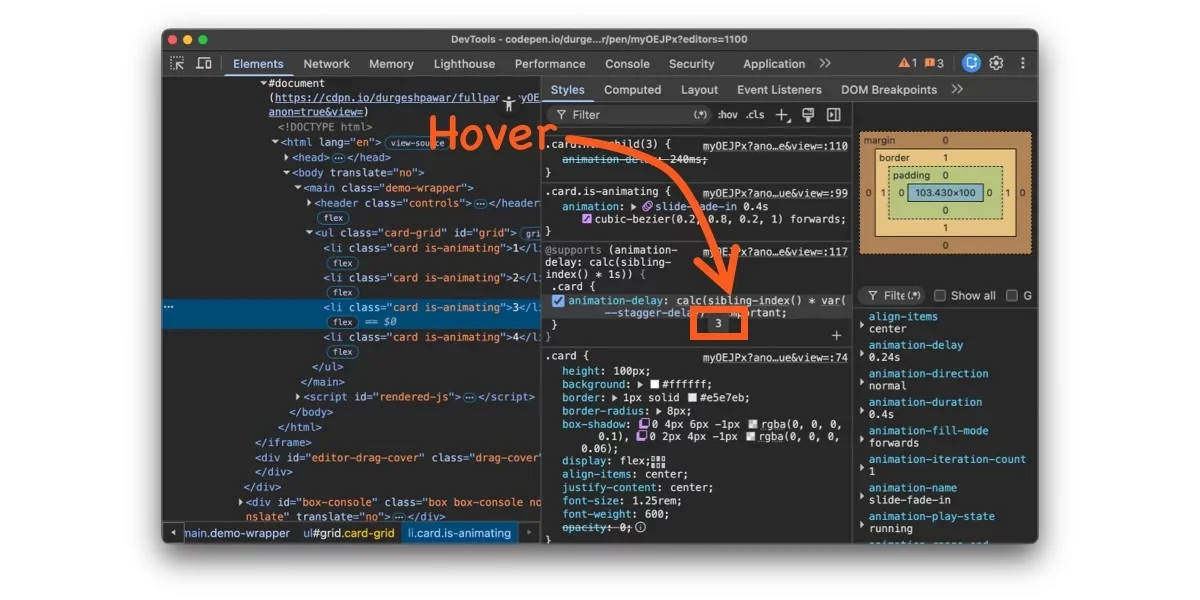
The most immediate impact of these functions is the simplification of staggered animations. Previously, animating a list of 50 items required 50 lines of CSS or a JavaScript loop. Now, the same effect can be achieved in a single declaration:
animation-delay: calc(sibling-index() * 100ms);
This one-line solution is robust enough to handle five items or five thousand, as the browser dynamically calculates the index for every element during the cascade phase. Beyond simple delays, the industry is identifying several key patterns that benefit from this mathematical approach.
Proportional Layouts and Automated Widths
Web components such as tab bars and navigation menus often require items to be distributed evenly across a container. In the past, this required media queries or JavaScript ResizeObservers to recalculate widths when items were added or removed. With sibling-count(), the width can be defined as calc(100% / sibling-count()). This ensures that a four-item menu automatically gives each item 25% width, while a five-item menu adjusts to 20% without manual intervention.
Advanced Color Distribution
Designers often seek to spread colors evenly across a hue wheel for data visualization or decorative swatches. By using sibling-index() and sibling-count() inside an hsl() color function, developers can create adaptive palettes. For instance, hsl(calc((360deg / sibling-count()) * sibling-index()), 70%, 50%) will automatically calculate the correct degree of separation for any number of elements, ensuring a perfect rainbow distribution regardless of the DOM’s size.
Radial and Complex Geometric Layouts
The combination of tree-counting functions and trigonometric CSS functions allows for the creation of radial menus and circular layouts without a single line of JavaScript. By calculating an angle based on the sibling-index() and sibling-count(), and using sin() and cos() to determine top and left positions, developers can build hexagons, octagons, or complex circular galleries that recalculate themselves if the number of items changes.
Technical Constraints and Shadow DOM Considerations
Despite the power of these functions, the CSSWG has implemented specific constraints to maintain performance and security. One of the primary "gotchas" identified by early adopters is the behavior of these functions within the Shadow DOM.
sibling-index() and sibling-count() operate on the flat DOM tree rather than the visual tree. In the context of Web Components, this means that the functions only "see" elements within the same shadow root. If a component uses a <slot>, the functions will count the slot itself, not the elements projected into it from the light DOM. Additionally, for security reasons, if an external stylesheet attempts to access these functions via a ::part() selector, the browser will return a value of zero. This prevents external styles from "probing" the internal structure of a third-party component.
Another critical distinction is the treatment of hidden elements. An element set to display: none is removed from the layout tree but remains in the DOM tree. Consequently, it is still counted by sibling-count() and occupies an index in sibling-index(). This can lead to visual gaps in staggered animations or layouts if elements are filtered out using display: none instead of being removed from the DOM entirely.
Performance Analysis at Scale
The browser handles these calculations during the style recalculation phase. Because this occurs before the layout and paint phases, it is inherently more efficient than JavaScript-based DOM manipulation. However, engineers caution that the cost of these functions is not zero.

In scenarios involving massive DOM trees—such as infinite-scroll feeds with tens of thousands of nodes—inserting an element at the beginning of the list triggers a recalculation for every subsequent sibling. For standard UI components like navigation bars or card grids, the performance impact is negligible. However, for "virtualized" lists where performance is critical, developers may still prefer JavaScript-managed indexes to limit the scope of recalculations.
Official Responses and Industry Impact
The reception from the web development community has been overwhelmingly positive. Prominent CSS architects have noted that these functions represent the "missing link" in CSS’s ability to handle logic-based layouts.
The Mozilla team’s positive stance on the specification suggests that Firefox will likely see implementation by the end of the 2025 calendar year. Until then, developers are encouraged to use @supports blocks to provide progressive enhancement. This ensures that users on modern browsers receive the optimized mathematical layout, while those on older versions see a functional, if less dynamic, fallback.
Accessibility and Semantic Integrity
A vital consideration for the implementation of these functions is the distinction between visual order and semantic order. Because sibling-index() allows developers to manipulate the visual placement of elements (through properties like order or grid coordinates), there is a risk of creating a "disconnect" for assistive technology users.
Screen readers and keyboard navigation follow the DOM source order. If a developer uses sibling-index() math to visually place the last item in the DOM at the top of the page, a keyboard user will still tab to it last. Experts emphasize that while these functions are powerful for visual design, they do not replace the need for proper ARIA attributes. Attributes such as aria-posinset and aria-setsize must still be managed via JavaScript to ensure that the experience for screen reader users matches the visual representation.
Future Outlook: The Next Phase of Tree-Counting
The current iteration of the spec is viewed as only the beginning. The CSSWG is already discussing extensions to these functions. One proposed addition, tracked in Issue #9572, is the inclusion of an of <selector> argument. This would allow developers to write sibling-index(of .active), which would only count siblings matching a specific class. This would solve the "hidden element" problem, allowing for sequential counting even when some siblings are filtered out.
Furthermore, proposals for children-count() and descendant-count() are currently in the early stages of discussion. These functions would provide "vertical" awareness, allowing a parent element to style itself based on how many children or grandchildren it contains. Combined with the "horizontal" awareness of sibling-index(), CSS is rapidly evolving into a language capable of handling complex, data-driven layouts that were once the exclusive domain of heavy JavaScript frameworks.

