
The global design community and the broader technology sector have entered a critical period of "conversational tunnel vision," a phenomenon where the default delivery mechanism for every artificial intelligence capability has become the chat-based interface. Driven by the rapid proliferation of Large Language Models (LLMs) which are natively trained on dialogue data, the industry has collectively, and perhaps prematurely, decided that the chat bubble is the natural home for AI. However, emerging research into user experience (UX) and cognitive ergonomics suggests that while the chat interface is a powerful tool, it is merely one instrument in an expansive toolkit. As AI integration moves from experimental stages to mission-critical infrastructure, product teams are being urged to pivot toward "modality-aware" design—an approach that matches the interface to the user’s physical context, immediate intent, and cognitive capacity.
The Evolution of the Interface: From Command Lines to Chat Bubbles
To understand the current obsession with chatbots, one must look at the chronology of human-computer interaction. The 1970s and 80s were defined by Command Line Interfaces (CLI), requiring users to memorize syntax. The 1990s ushered in the Graphical User Interface (GUI), which used visual affordances like buttons and menus to reduce memory load. By the 2010s, Natural User Interfaces (NUI) like touch and voice became mainstream.
The current era, beginning roughly in 2022 with the mainstreaming of generative AI, has seen a regression toward a sophisticated form of CLI: the natural language prompt. While LLMs allow for more flexibility than 1980s code, they still impose what experts call a "linguistic barrier." Instead of clicking a clearly labeled button, users must now act as writers, translating vague intentions into specific textual commands. Industry analysts note that this "creative burden" is leading to a new form of digital fatigue, where the effort of prompting outweighs the benefit of the AI’s output.
The Hidden Costs of Conversational Interfaces
The allure of the chatbot from a product development standpoint is its "blank slate" nature. It suggests a system that can handle any query. However, this versatility comes with significant psychological and physical taxes. UX researchers identify two primary burdens: the linguistic challenge for input and the cognitive challenge for output.
On the input side, a blank chat box often triggers choice paralysis. Unlike a GUI, which signals available options through visual cues, a chat box requires the user to guess the system’s capabilities. For professionals like data analysts or project managers, describing complex logic or spatial reorganization in text is often more difficult than performing the task through traditional drag-and-drop or filtering methods.
On the output side, text is a "serial medium." The human brain must process words one by one to extract meaning. In high-stakes environments—such as a medical emergency or a volatile trading floor—this sequential processing is dangerously slow. A visual dashboard or a color-coded alert allows for "parallel processing," where the brain can spot patterns or outliers in milliseconds. When AI responds to a simple status query with three paragraphs of text, it effectively transfers the interpretive work back to the user, creating a "reading assignment" rather than a solution.
Market Data and User Friction
Recent industry data supports the move away from pure chat. According to a 2024 report on AI adoption, while 70% of enterprises have deployed some form of chatbot, only 22% report high user satisfaction for complex workflows. The primary complaint cited is "interaction friction." Furthermore, cognitive load studies have shown that users experiencing "prompt fatigue" are 40% more likely to abandon a task compared to those using structured graphical interfaces.

Accessibility advocates also point out that conversational tunnel vision can be exclusionary. While text-heavy interfaces might work for some, they create barriers for users with dyslexia, visual impairments, or those working in environments where typing is physically impossible. The shift toward multi-modality is therefore not just an efficiency play; it is an accessibility mandate.
The Task Audit: A Scientific Approach to Design
To combat conversational tunnel vision, design leaders are advocating for a rigorous "Task Audit" before any interface is built. This framework moves teams away from assumptions and toward evidence-based modality selection. A successful Task Audit evaluates four specific areas:
- Physical Constraints: Is the user’s movement restricted? Are their hands or eyes occupied?
- Social Context: Is the user in a loud public space where voice input is inappropriate, or a sterile environment where they cannot touch a screen?
- Cognitive Load: Is the user already performing a high-stakes task that requires their full mental focus?
- Information Fidelity: Does the task require a simple "yes/no" or a deep, nuanced analysis?
By answering these questions, product teams can utilize an Input/Output Alignment Matrix. For example, a "Quick Status Check" might be best served by a single-tap button (input) and a push notification (output). Conversely, "Creative Generation" might require a multi-modal input of image and text, resulting in an interactive canvas as the output.
Case Study: High-Voltage Safety and Adaptive Modality
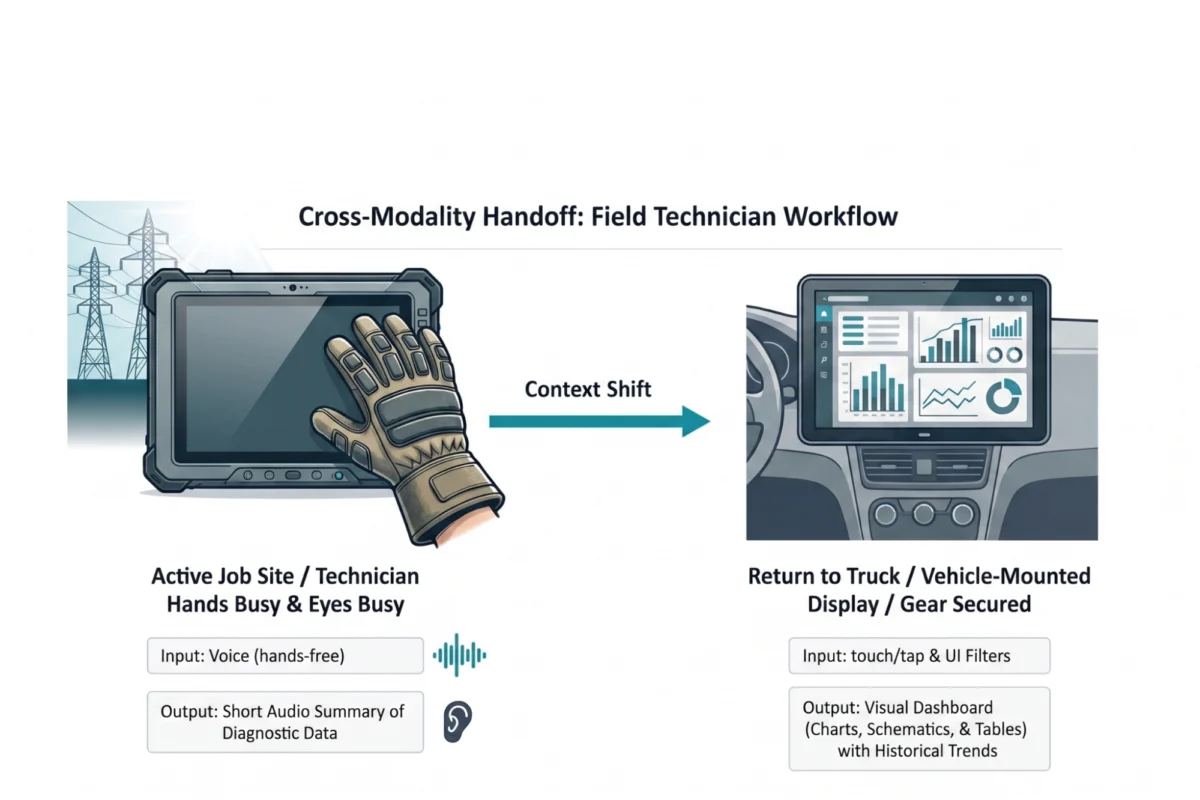
The real-world implications of modality selection are perhaps most visible in high-risk industrial sectors. A recent implementation for field technicians servicing national electrical grids serves as a primary example. Traditionally, these technicians used ruggedized tablets to access diagnostic data. However, the reality of the field—wearing thick protective gloves, working at heights in bucket trucks, and dealing with intense sunlight glare—made touchscreens and text-heavy reports nearly useless.

Researchers conducted a contextual inquiry and found that the "hands-busy, eyes-busy" nature of the job necessitated a voice-first approach. The redesigned system allowed technicians to query the AI via voice. Crucially, the system did not respond with a long diagnostic narrative. Instead, it provided a short audio summary of immediate "safe/unsafe" vital signs.
The most innovative aspect of the solution was the "cross-modality handoff." Once the technician returned to their vehicle, the system automatically transitioned the data to a large, vehicle-mounted visual dashboard. This allowed the technician to perform deep-dive historical trend analysis in a safe, seated environment with high-resolution visual tools. This adaptive approach resulted in a 20% reduction in diagnostic time and a significant increase in safety compliance.
The Broader Impact on Enterprise Productivity
The move toward context-aware AI interfaces is expected to have a profound impact on enterprise productivity. As AI agents become more autonomous, the need for constant human prompting will decrease, shifting the user’s role from "writer" to "supervisor." In this new paradigm, the interface must prioritize "glance verification."
Economic analysis suggests that companies that successfully implement multi-modal AI interfaces could see a 15-25% increase in operational efficiency by 2027. This gain stems from reduced training times (as interfaces become more intuitive) and faster decision-making cycles (as cognitive load is minimized).

Implications for the Future of Design
The future of AI interface design is not a single chat window, but a diverse ecosystem of vocal, haptic, visual, and ambient interactions. The industry is currently in a transitional phase, moving from "model-centered design"—where the interface is dictated by the LLM’s training data—to "user-centered design," where the interface is dictated by the human’s environment.
Designers are being urged to "leave the screen" and observe work where it actually happens: the warehouse floor, the operating room, the construction site, and the commute. These environments are not edge cases; they are the primary contexts for the next generation of AI tools.
Conclusion: Fitting the Tool to the Person
As artificial intelligence becomes an invisible layer in our daily lives, the success of the technology will depend less on the complexity of the underlying model and more on the elegance of its delivery. A brilliant AI model packaged in a lazy, text-only interface is a failure of design.
The industry’s path forward requires a rejection of the "do-it-all chatbot" myth. By grounding modality choices in physical and cognitive evidence, technology providers can create tools that feel like natural extensions of human capability. In the words of leading UX practitioners, the goal is to ensure the interface adapts to the user, rather than forcing the user to adapt to the machine. The shift from conversational tunnel vision to multi-modal clarity is not just an aesthetic choice; it is the next frontier of the digital revolution.

