
The Legislative Foundation and Global Reach
The EU AI Act, which officially entered into force on August 1, 2024, is structured as a risk-based framework. While much of the legislative focus has been on "prohibited" AI practices and "high-risk" systems, Article 50 addresses the "transparency risk" associated with synthetic content. The core objective of these transparency obligations is to ensure that individuals are aware they are interacting with an AI system or consuming content generated by one, thereby fostering digital trust and mitigating the spread of disinformation.
The reach of these rules is governed by the "Brussels Effect," a regulatory phenomenon where EU standards become the de facto global benchmark. Similar to the General Data Protection Regulation (GDPR) and the European Accessibility Act (EAA), the AI Act applies to any company whose AI-generated output is utilized by citizens within the EU’s 27 member states. Consequently, tech conglomerates based in Silicon Valley, Shenzhen, or Bangalore must align their user interfaces and content metadata with European standards if they intend to maintain operations within the world’s largest integrated market.
Chronology of Implementation
The path toward the August 2026 deadline follows a carefully staged timeline designed to allow industry stakeholders to transition from experimental AI deployment to regulated compliance.
- April 2021: The European Commission first proposed the AI Act framework.
- December 2023: The European Parliament and Council reached a landmark political agreement on the final text.
- August 1, 2024: The AI Act officially entered into force.
- February 2026: Provisions regarding "prohibited" AI systems (such as untargeted scraping of facial images) become enforceable.
- August 2, 2026: The full suite of transparency obligations under Article 50, including AI labeling and deepfake disclosure, becomes legally binding for most AI systems.
- August 2027: Obligations for high-risk AI systems integrated into products already subject to EU safety legislation take full effect.
Specific Labeling Requirements Under Article 50
The guidelines specify four primary categories where AI disclosure is non-negotiable. These requirements apply to both "providers" (those who develop AI models) and "deployers" (entities that use AI models to generate public-facing content).
1. Interaction Transparency
Any AI system designed to interact directly with natural persons, such as customer service chatbots or virtual assistants, must be disclosed as such. Users must be informed at the start of the interaction that they are communicating with an automated system, unless this is obvious from the context.

2. Deepfakes and Synthetic Media
The Act defines deepfakes as AI-generated or manipulated images, audio, or video that resemble existing persons, objects, places, or events and would falsely appear to a person to be authentic or truthful. These must be labeled prominently. The disclosure must be "clear and distinguishable," appearing at the moment the content is consumed.
3. Textual Content for Public Interest
AI-generated text intended to inform the public on matters of public interest—including topics related to health, safety, the environment, economy, finances, politics, science, or culture—must be disclosed. This is a direct response to concerns regarding AI’s role in influencing elections and public discourse.
4. Emotion Recognition and Biometric Categorization
Though more niche in general consumer products, any AI system used to detect emotions or categorize individuals based on biometric data must inform the individuals exposed to the system of its operation.

Defining the Threshold: Human Intervention vs. AI Generation
A significant point of technical debate during the drafting of the guidelines was the distinction between "AI-assisted" and "AI-generated" content. The European Commission has clarified that the disclosure obligation does not apply where the AI-generated content has undergone a "substantive editorial review" by a human.
Under these rules, minor assistive edits do not trigger the labeling requirement. These include:
- Standard spell-checking and grammar correction.
- Formatting and layout adjustments.
- Basic image cropping or color balance.
- AI-generated translations where a human translator assumes responsibility for the final text.
Conversely, "AI generation" that requires disclosure includes:

- Automated summaries of long-form documents.
- Composite imagery or substantive rewrites of text.
- The addition or removal of elements within a photograph or video.
- Generating content where the "editorial responsibility" is not clearly held by a named human entity.
The Commission is explicit that a human "skimming" a document before publication does not constitute a substantive review. For a piece of content to be exempt from AI labeling, there must be an intentional manual intervention where a person or entity takes legal and editorial responsibility for the accuracy and context of the output.
The "Sparkle" Icon Problem and New Design Standards
For several years, the software industry has gravitated toward the "sparkle" emoji (✨) as a universal symbol for AI-powered features. However, the EU’s Code of Practice on AI labeling suggests that this symbol is insufficient for legal compliance. Research from organizations like the Nielsen Norman Group has indicated that the sparkle icon is often too ambiguous; users frequently interpret it as a "new feature," "premium tool," or "formatting enhancement" rather than a disclosure of synthetic origin.
To address this, the European Commission has introduced a specific EU AI icon set. This set includes three distinct marks:

- Basic AI Mark: To signal the presence of an AI system.
- Fully Generated Mark: For content produced entirely by AI.
- Partially Modified Mark: For human-authored content that has been substantively altered by AI.
The guidelines mandate that these labels must be "accessible" and "persistent." A label that appears only briefly or is buried in a "Terms of Service" footer will not meet the standard of being "clear and distinguishable." Furthermore, labels must be embedded in the metadata of the file so that the disclosure remains intact when the content is downloaded, screenshotted, or reshared on social media platforms.
Supporting Data and Economic Implications
The necessity for these regulations is supported by emerging data on public sentiment. According to the 2024 Reuters Institute Digital News Report, approximately 56% of respondents expressed concern about the use of AI in news production, with 72% stating that AI-generated content should be clearly labeled.
The financial stakes for non-compliance are substantial. The EU AI Act includes a tiered penalty system:

- Non-compliance with transparency obligations: Fines of up to €15 million or 3% of the company’s total worldwide annual turnover, whichever is higher.
- Supply of incorrect or misleading information: Fines of up to €7.5 million or 1% of turnover.
- Prohibited practices: Fines of up to €35 million or 7% of total global turnover.
These penalties are designed to be "dissuasive," ensuring that even the largest technology firms prioritize compliance over the "move fast and break things" ethos that characterized the early era of social media.
Comparative Global Landscape
The EU is not alone in its pursuit of AI transparency, though its approach is the most comprehensive.
- China: The Cyberspace Administration of China (CAC) implemented rules in 2023 requiring "clear marks" on AI-generated content, specifically focusing on watermarking and metadata.
- United States: While there is no federal AI labeling law, several states (including California and Texas) have passed legislation regarding deepfakes in political advertising. President Biden’s 2023 Executive Order on AI also directed the Department of Commerce to develop standards for watermarking AI-generated content.
- South Korea: Proposed amendments to the Act on Promotion of Information and Communications Network Utilization would require similar disclosures for synthetic media to prevent the spread of deepfake-related crimes.
The alignment of these global powers suggests that AI disclosure is transitioning from a design choice to a fundamental requirement of the digital social contract.

Official Responses and Industry Impact
Industry reactions to the finalized guidelines have been mixed. Digital rights advocacy groups, such as the European Digital Rights (EDRi) network, have largely welcomed the move, stating that transparency is the first line of defense against AI-driven manipulation.
In contrast, some technology trade associations have expressed concerns regarding "labeling fatigue." They argue that over-labeling every minor AI interaction could lead users to ignore the warnings entirely, similar to the "cookie consent" fatigue that followed the implementation of the ePrivacy Directive.
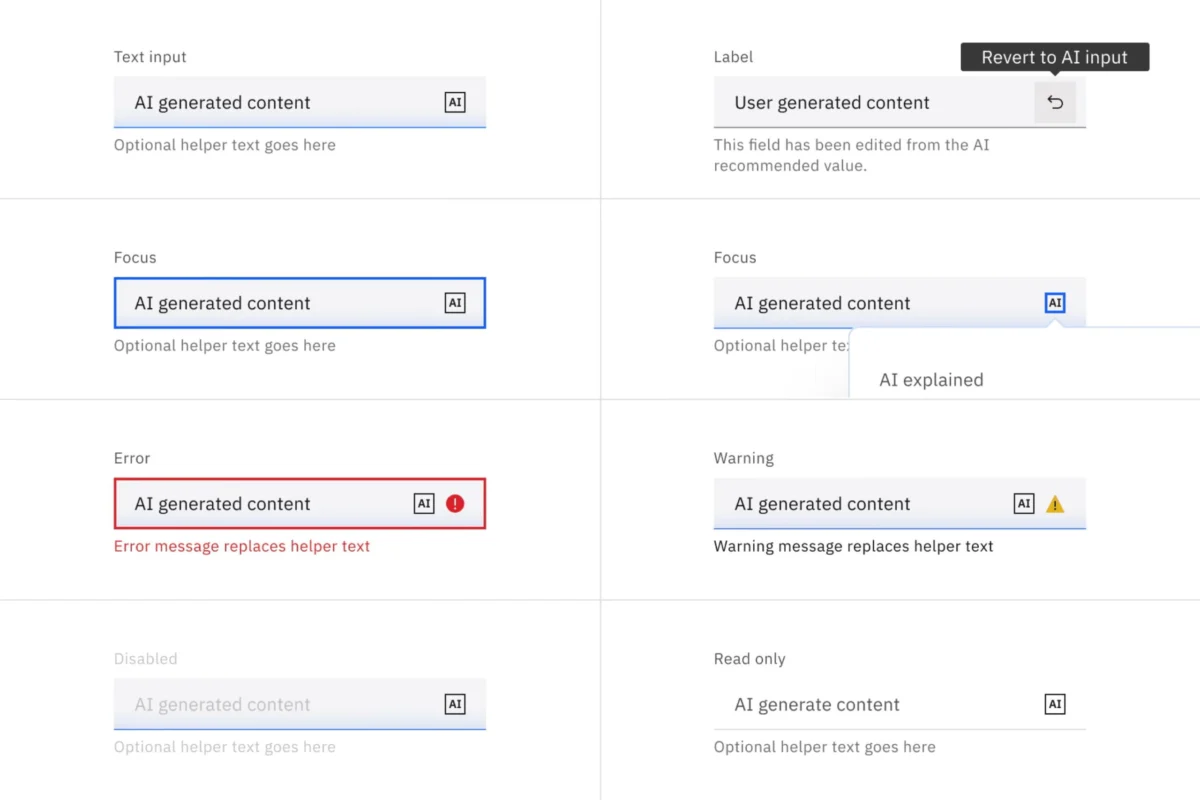
From a product development perspective, the August 2026 deadline forces a redesign of many existing User Experience (UX) patterns. Designers must now find ways to integrate "explainability panels" and "provenance information" into interfaces without compromising usability. The Carbon Design System by IBM has already begun providing templates for these AI labels, offering a glimpse into how professional software will likely adapt to the new EU mandates.

Summary of Broader Implications
The EU AI Act’s transparency rules represent a significant step toward "Algorithmic Accountability." By 2026, the distinction between human and machine output will no longer be left to the user’s intuition. For businesses, this means the immediate implementation of internal auditing processes to track where AI is used in the content supply chain. For consumers, it promises a digital environment where the origin of information is verified and visible.
As the August 2, 2026, deadline approaches, the European AI Office will continue to issue "Codes of Practice" to refine these standards. Companies are advised to begin the transition now, as the technical debt associated with retrofitting labeling systems into complex AI pipelines can be significant. Ultimately, these rules are not merely a bureaucratic hurdle but an attempt to preserve the integrity of human communication in an era of increasingly sophisticated synthetic media.

