
The global technology sector is currently navigating a significant disconnect between corporate strategy and consumer desire regarding the integration of Artificial Intelligence (AI). While executive leadership across various industries has pivoted toward an "AI-first" mentality, a growing body of data and user experience (UX) analysis suggests that the general public is not seeking an increase in AI features. Instead, users are expressing a preference for reliability, predictability, and the automation of mundane tasks rather than the wholesale replacement of human-centric workflows. This divergence in expectations has led to what analysts describe as an "adoption gap," where high-cost AI implementations suffer from low retention rates and mounting user frustration.
The Myth of the AI Value Proposition
A fundamental error in current corporate strategy is the assumption that "AI-powered" serves as a standalone value proposition. According to research from the Nielsen Norman Group, labeling a product as AI-driven does not inherently increase its market value or user appeal. In many instances, AI features are treated as "bolt-ons"—ancillary tools that exist outside a user’s established workflow. Rather than streamlining operations, these tools often force users to exit their primary environment to interact with a separate interface, creating a fragmented experience that decreases overall efficiency.
Furthermore, AI integration often highlights existing organizational shortcomings. Rather than rectifying years of accumulated technical debt, poor data quality, or broken internal cultures, AI tends to amplify these issues. When inconsistent data is fed into an AI system, the resulting output is often contradictory or erroneous. This "hallucination tax" places the burden of fact-checking and error correction back on the user, frequently requiring more time and effort than the manual processes the AI was intended to replace.
Chronology of the AI Integration Cycle
The current state of AI adoption can be traced through a distinct timeline of technological hype and subsequent market adjustment:
- Late 2022 – The Emergence: The release of large-scale generative models, such as ChatGPT, triggered a global rush toward AI. Companies feared being left behind, leading to a period of rapid, often unvetted, feature releases.
- 2023 – The Feature Saturation: Major software suites began integrating "Copilots" and "Assistants." During this phase, the focus was on the speed of delivery and the novelty of the technology rather than specific user needs.
- Early 2024 – The Adoption Friction: Reports began to surface indicating that while initial trial rates for AI tools were high, long-term retention was struggling. Users reported "AI fatigue," citing the mental load of managing AI outputs.
- Late 2024 – The Strategic Pivot: Current market trends suggest a shift toward "AI-second" or "ambient AI" designs, where the technology operates in the background to handle invisible tasks, rather than acting as the primary interface.
Supporting Data: The Productivity Paradox
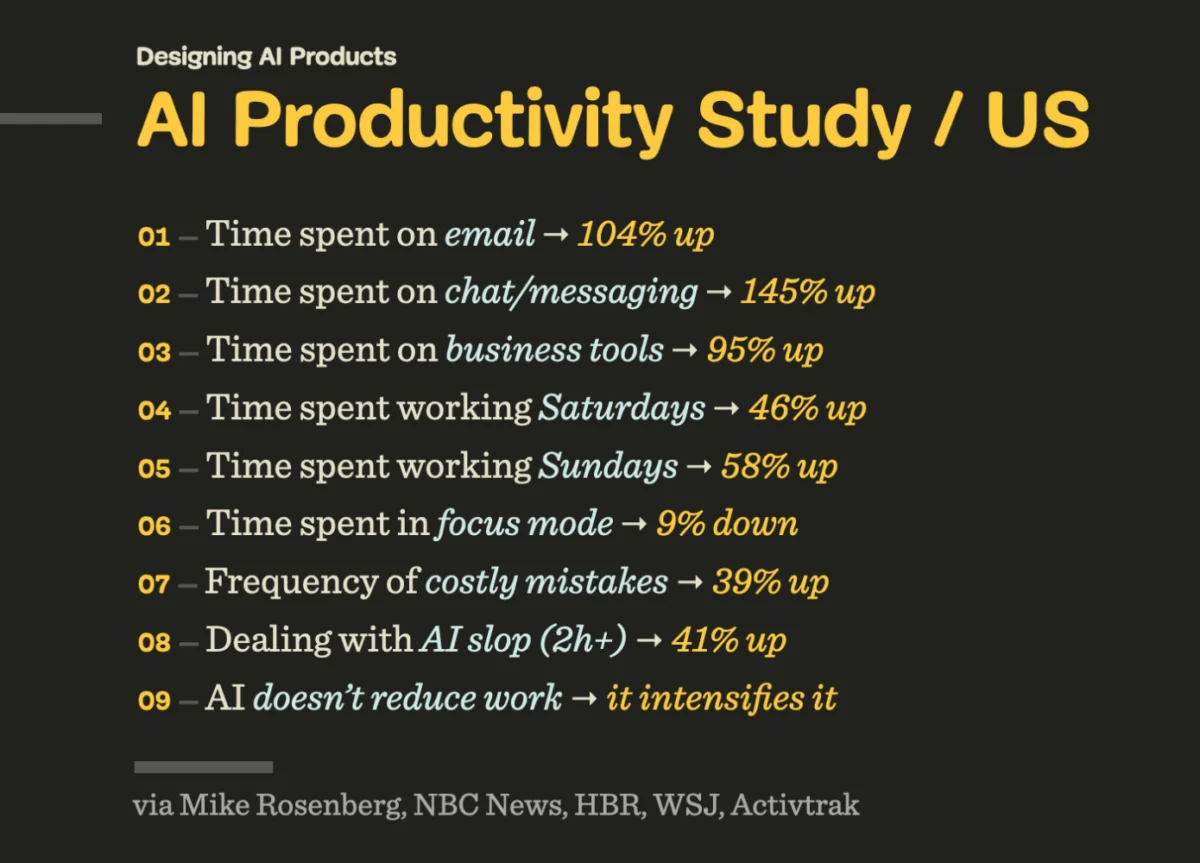
Recent studies conducted by organizations such as ActivTrak and Harvard Business Review have challenged the narrative that AI inherently increases productivity. In a comprehensive study of US-based workers, the data revealed that AI integration often intensifies work rather than reducing it. Key findings include:
- Communication Overhead: Time spent on email increased by 104%, while chat and messaging time rose by 145% as users spent more time coordinating AI-generated content.
- System Fragmentation: Usage of business tools increased by 95%, indicating that users are hopping between more systems than before the AI boom.
- After-Hours Labor: There was a noted 46% increase in working on Saturdays and a 58% increase on Sundays, suggesting that the "efficiency" of AI has not translated into shorter workdays for many professionals.
- Error Management: Costly mistakes rose by 39%, and time spent dealing with "AI slop"—low-quality or irrelevant automated output—increased by 41%.
These figures suggest that while AI can generate content quickly, the quality of that content often necessitates a secondary layer of human labor that offsets any initial time savings.
Human Sentiment and Resistance to Change
Beyond productivity metrics, there is a significant psychological component to the current AI skepticism. For many employees, AI was not a choice but a mandate. When technology arrives "uninvited" and at a pace determined by external leadership, it frequently meets with resistance. This is compounded by persistent messaging regarding AI’s potential to replace human workers, leading to deep-seated anxiety about job security and the value of human intuition.

Vitaly Friedman, a prominent UX design expert and founder of Design Patterns for AI Interfaces, notes that users do not compare AI to humans; they compare features to other features. If a traditional, non-AI feature works consistently and an AI-driven alternative is unpredictable, the user will invariably choose the former. The demand is not for "magical" interfaces, but for tools that are fast, accessible, and, above all, reliable.
This sentiment is echoed by Bo Young Lee, a former Chief Diversity and Inclusion Officer, who argues that the current trajectory of AI development ignores human desires. "I don’t want to read books written by AI or gaze upon paintings by AI," Lee stated. "I want AI to do all the physical and mental labor that taxes me so I can engage with art made by humans." This distinction—automating the "dull, dirty, and dangerous" while preserving the "creative and communal"—is the core of the consumer demand that many tech leaders are currently overlooking.
Broader Impact on the Labor Market
The impact of AI is not distributed evenly across the workforce. According to data from the Brookings Institution and The Washington Post, jobs with high exposure to AI automation include software developers, public relations specialists, and administrative assistants. Conversely, roles requiring physical presence and manual dexterity, such as firefighters and healthcare providers, remain the least vulnerable.
However, "exposure" does not necessarily mean "replacement." In many high-exposure fields, there is a rewarding, unique, and creative component that requires a human point of view. The risk for companies is that by over-automating these roles, they strip away the "joy of work"—the feeling of achievement that comes from solving a complex problem or creating something original. When AI automates the rewarding parts of a job while leaving the user to handle the mundane tasks of fact-checking and system management, it leads to burnout and decreased job satisfaction.

Fact-Based Analysis of Future Implications
The current trajectory suggests that the companies that will succeed in the next phase of the AI evolution are those that adopt an "AI-second" approach. This philosophy prioritizes the user’s existing mental models and workflows.
1. Integration over Isolation: AI should not be a separate "box" to type into. It should be deeply integrated into existing tools, functioning as a silent assistant that handles background tasks like data entry, scheduling, or formatting without requiring direct user intervention.
2. Predictability over Novelty: For a tool to be useful in a professional environment, it must produce predictable results. The stochastic nature of current Large Language Models (LLMs) is a significant barrier to professional adoption in fields where accuracy is paramount, such as law, medicine, or engineering.
3. Augmentation over Automation: The most successful AI implementations are those that augment human capabilities. By taking over the mentally exhausting and tedious tasks, AI can provide users with the "headspace" to focus on decision-making and creative strategy—areas where humans still vastly outperform machines.

4. Reputation Risk: Organizations that rush to implement unvetted AI features face a high risk of reputation damage. High-profile instances of AI hallucinations or biased outputs can erode customer trust, which is far more difficult to rebuild than a technical infrastructure.
Conclusion: A Return to Human-Centric Design
The evidence suggests that the "AI revolution" is reaching a plateau of disillusionment. To move forward, industry leaders must recognize that the desire for AI is not universal. People do not want "more AI" in their lives; they want more time. They want the ability to complete their work efficiently so they can spend time with other people, engage in hobbies, and participate in their communities.
The future of technology lies not in creating a world where AI-generated content replaces human interaction, but in using AI to eliminate the barriers to human connection. By focusing on "humble" and "ambient" AI that automates the boring and the repetitive, developers can create products that truly serve the user. As the market matures, the branding of "AI" will likely fade into the background, becoming just another standard component of high-quality, reliable software—much like the database or the cloud before it. The ultimate goal is not a world full of AI, but a world where humans are empowered by technology to be more human.

