
The technology industry has reached a critical juncture in the evolution of artificial intelligence, characterized by a phenomenon increasingly described by design experts as conversational tunnel vision. Since the public release of Large Language Models (LLMs) like ChatGPT in late 2022, the digital landscape has been flooded with chat-based interfaces. Because these models are fundamentally trained on dialogue data, product teams have reflexively defaulted to the chat bubble as the primary home for every AI capability. However, emerging research and user experience (UX) audits suggest that while the chat interface is a powerful tool, it is often a suboptimal choice for complex workflows. The industry is now seeing a pivot toward intentional modality—matching the way a person interacts with a system to their specific context, intent, and cognitive load.
The core challenge lies in the definition of modality: the sensory method—seeing, hearing, touching, speaking, or typing—a person uses to interact with a system. In the rush to integrate AI, the nuance of user environment has often been overlooked. As AI transitions from a novelty to a critical professional tool, designers are being urged to move beyond the "blank slate" of the chatbot toward a more sophisticated toolkit that includes the Task Audit and the Input/Output Alignment Matrix.
The Chronology of Interface Evolution
To understand the current reliance on chat, one must look at the timeline of human-computer interaction (HCI). The 1960s introduced the first conversational programs like ELIZA, which mimicked therapy through simple text mirroring. The 1980s and 90s saw the rise of the Graphical User Interface (GUI), which revolutionized computing by replacing command lines with visual metaphors like folders and buttons. By 2011, Apple’s Siri introduced mainstream voice modality, though it remained limited by the narrow capabilities of pre-transformer AI.
The 2022 explosion of generative AI marked a return to the "command line" in the form of natural language prompts. While this felt revolutionary, it effectively transferred the burden of operation from the machine back to the user. By 2024, the "Conversational Tunnel Vision" era reached its peak, leading to what many professionals describe as "prompt fatigue." The current phase, beginning in late 2024 and heading into 2025, is focused on "Agentic UI" and multimodal systems where the interface adapts to the user’s physical and cognitive state rather than forcing the user to adapt to a text box.
The Linguistic Barrier of Input
The industry’s reliance on text-heavy input creates what linguists call a high adaptation load. A blank chat box is essentially a "choice paralysis" engine. In a traditional GUI, menus and buttons provide clear visual affordances that signal what a tool can do. Conversely, a chat box requires a user to guess the AI’s capabilities and remember specific phrasing to achieve a desired result.
For professionals, this creates a significant barrier. A data analyst seeking a specific trend in a massive dataset must translate complex logic into a written sentence—a task that is often more cognitively demanding than simply clicking a "Filter" or "Sort" button. Similarly, a designer may have a precise visual concept for a texture but lack the specialized vocabulary to describe it in a text prompt. In these instances, sliders, color pickers, or drag-and-drop interfaces are far more efficient than natural language. Composing a prompt is a creative act that requires cognitive energy; if the task is a routine professional operation, forcing that creative act adds unnecessary friction.
The Cognitive Tax of Sequential Output
The failure of the chat-centric model is perhaps most evident in output modality. Text is a serial medium. The human brain must process words one after another to extract meaning, a process that takes significant time and focus. While sequential reading is necessary for nuanced tasks like legal analysis or medical history review, it is highly inefficient for data-heavy updates.

Visual formats, by contrast, allow for parallel processing. A human can glance at a color-coded chart and identify a trend or an outlier in less than a second. When an AI responds to a status query with three dense paragraphs of text, it transfers the "interpretive work" to the user. The user must now read, summarize, and extract the relevant data points, turning a quick check into a reading assignment. In high-stakes environments—such as a stock trading floor or a hospital emergency room—this cognitive tax is not just an inconvenience; it is a liability that increases the risk of error.
Strategic Framework: The Task Audit
To move past the chatbot default, design teams are adopting the Task Audit framework. This evidence-based approach gathers data on the physical, social, and cognitive context of a task before any interface design begins. The audit focuses on four primary constraints:
- Physical Constraints: Are the user’s hands or eyes busy? (e.g., a driver or a surgeon).
- Social Constraints: Is the environment loud, or does it require privacy? (e.g., a shared office or a public terminal).
- Cognitive Load: How much mental effort is the user already expending?
- Fidelity Needs: Does the user need a quick "glanceable" update or a deep-dive report?
Industry leaders suggest using contextual inquiry—observing users in their natural environment—to identify "hidden work." Users often adapt so thoroughly to poor interfaces that they forget to mention the workarounds they use, such as writing down a reference number on their hand because the app doesn’t display it prominently.
The Input/Output Alignment Matrix
Once a Task Audit is complete, designers utilize an Alignment Matrix to pair user intent with the most effective modality.

- Quick Status Checks: Optimal with voice or single-tap input and audio or push notification output. This fits "hands-busy, eyes-busy" environments.
- Complex Analysis: Best served by GUI filters and visual dashboards, suited for desk-based, high-resolution environments.
- Creative Generation: Requires multi-modal input (image + text) and interactive canvas output for iterative drafting.
- Monitoring/Alerting: Utilizes passive background systems and audio or haptic alerts for ambient awareness.
Case Study: Adaptive Modality in the Energy Sector
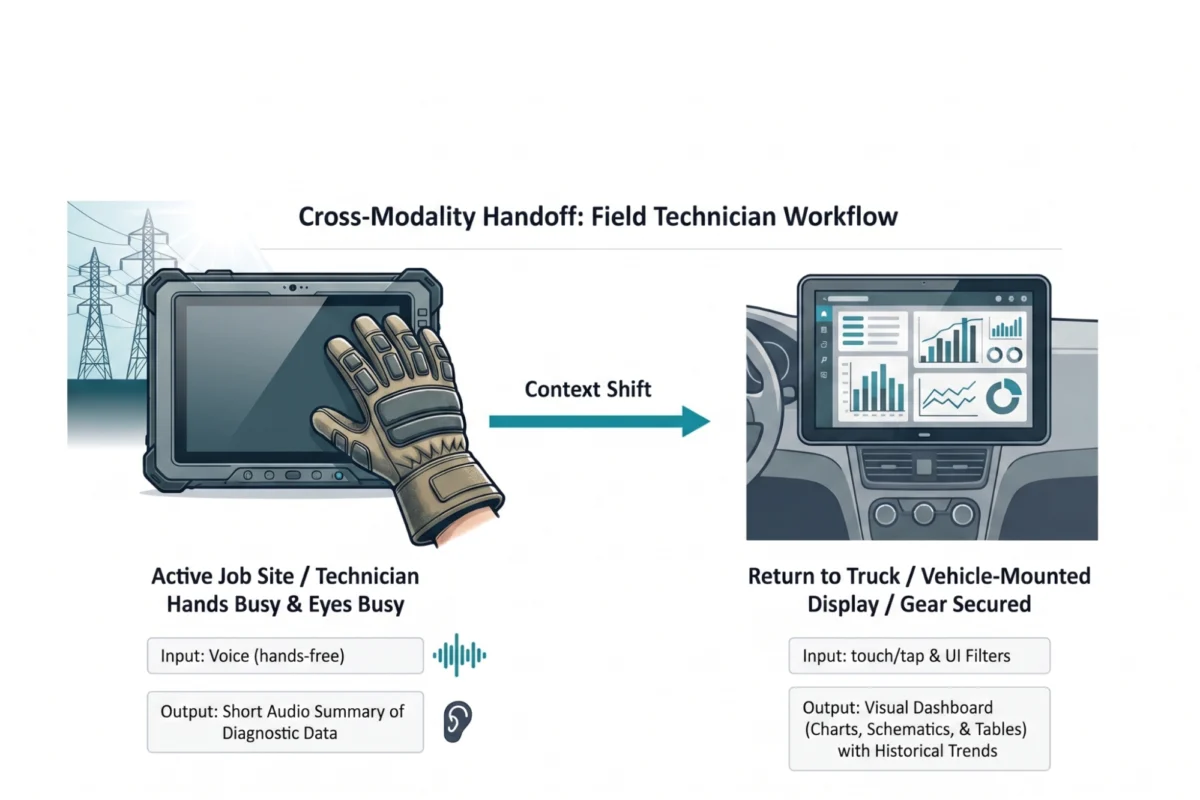
The practical application of these principles is best illustrated by a recent overhaul of tools for field technicians servicing high-voltage electrical grids. Traditionally, these technicians used ruggedized tablets to access manuals and log data. However, a Task Audit revealed that the physical reality of the job made these tablets nearly unusable. Technicians wore thick, protective gloves, making touchscreens unresponsive. Furthermore, the glare of direct sunlight at high altitudes made reading dense text reports impossible.
The redesigned system implemented an adaptive modality handoff. While on-site and in the bucket truck, technicians used voice-first input to query the AI. The system responded with short audio summaries, allowing the technician to maintain visual focus on the dangerous high-voltage equipment. Once the technician returned to their vehicle, the system automatically handed the workflow off to a large, vehicle-mounted dashboard. This allowed for the parallel processing of complex schematics and historical trends that the audio format could not convey. This shift reportedly reduced diagnostic time by 20% and significantly increased tool adoption among veteran crews who had previously rejected the tablet-only interface.
Broader Impact and Industry Implications
The shift toward multimodal AI interfaces has profound implications for accessibility and enterprise productivity. For users with visual or motor impairments, the move away from rigid text boxes toward voice, gesture, and audio-first interfaces is a major step forward in inclusive design. By providing multiple pathways to information, companies can ensure their AI tools are usable by a broader demographic.
From an economic perspective, the "psychological tax" of poor UX is a hidden drain on corporate efficiency. As AI is integrated into every facet of the workforce, the cumulative time lost to "interpreting" AI text responses or "fighting" with prompts represents a significant loss in potential ROI. Industry analysts predict that the next generation of successful AI startups will not be those with the "smartest" models, but those with the most "context-aware" interfaces.

Conclusion: The Future of Ambient AI
The future of AI interface design lies in a diverse ecosystem that is vocal, visual, haptic, and ambient. The chat window will remain a vital tool for exploratory research and follow-up questions, but it will no longer be the default. By grounding design decisions in field evidence and physical reality, the industry can create tools that feel like a natural extension of human capability rather than a cognitive burden.
As the industry moves forward, the "design brief" for AI must start outside the screen. It must start in the warehouse, the operating room, and the airport terminal. Only by fitting the modality to the person and the place can the true potential of artificial intelligence be realized. The era of conversational tunnel vision is ending; the era of adaptive, intent-driven design has begun.

